

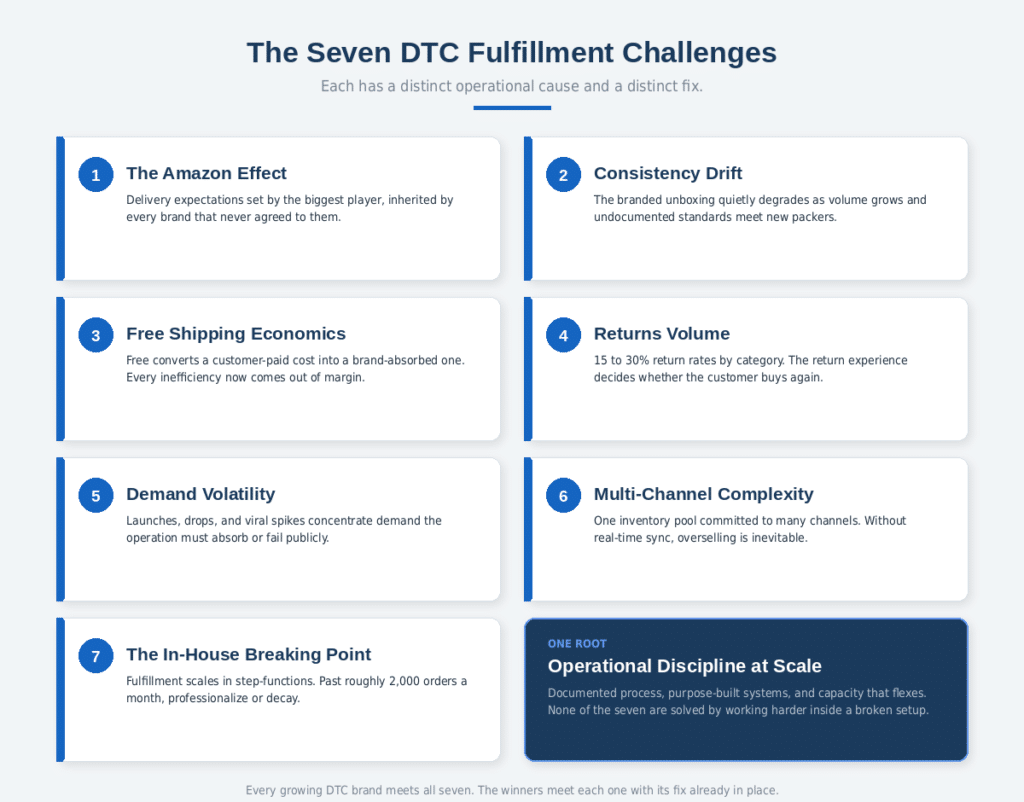
The seven challenges that break DTC operations, what causes each one, and the operational fix for each.
The direct-to-consumer model runs on a trade every founder accepts, knowingly or not. The brand owns the entire customer relationship: the data, the margin, the experience. It also owns every failure inside that experience. When a marketplace order arrives late, the customer blames the marketplace. When a DTC order arrives late, damaged, or wrong, there is exactly one name on the box. That ownership paradox is why 73% of DTC brands report dealing with fulfillment problems, according to 2026 industry research.
The biggest DTC fulfillment challenges are customer expectations set by Amazon’s 2-day default, scaling branded packaging without consistency drift, free shipping economics, returns volume, demand volatility from launches and viral spikes, multi-channel complexity, and outgrowing in-house operations. Each has a distinct operational cause and a distinct fix, and this article covers all seven in that structure: what the challenge looks like from inside the business, what actually causes it, and what fixing it requires.
This is the problem-side companion to our our DTC fulfillment service page which covers how ShipBuddies runs the model.. Both sit within our broader coverage of industry-specific fulfillment, because DTC is one of several business models where generic order fulfillment approaches quietly fail. Here is where they fail for DTC brands specifically.
1. The Amazon Effect: Expectations You Didn’t Set
The challenge: customers judge every DTC brand against Amazon’s delivery standard, regardless of the brand’s size. In 2026 industry surveys, 80% of consumers say they expect same-day delivery options, 98% say the delivery experience affects their brand loyalty, and 90% consider real-time tracking essential. A five-person brand shipping from one facility inherits the expectations set by a trillion-dollar logistics network.
The cause is structural. Delivery expectations are set by the most capable player in the market, not negotiated with each seller individually. The customer who ordered your product yesterday ordered from Amazon this morning, and their brain does not maintain separate standards. Roughly 52% of brands now target 2-to-3-day delivery windows just to stay in the acceptable range.
The fix is to compete on the parts of the experience the brand actually controls, and to stop competing on the part it cannot. Same-day processing with a published cutoff time. Proactive tracking notifications at every scan. And above all, honest delivery promises kept consistently: a 3-day promise kept 99% of the time builds more loyalty than a 2-day promise broken every promotion. Customers forgive speed they were told about. They do not forgive surprises.
There is a quieter expectation underneath the speed conversation: accuracy. One wrong item damages a DTC brand more than a marketplace seller, because the DTC customer has nobody else to assign the blame to. An order accuracy standard of 99.8% or better is the floor for a brand whose entire model depends on repeat purchase.
2. Scaling the Branded Experience Without Losing It
The challenge: the unboxing experience that built the brand at 50 orders per month quietly degrades at 2,000. The tissue paper folds vary. The thank-you card sits at a different angle in every box. Inserts get skipped when the packing line falls behind. No single box is wrong, but the boxes are no longer the same, and subscribers to the brand’s social channels notice before the founder does.
This failure mode has a name: consistency drift. It is the aggregate variance that accumulates when a personally maintained standard gets distributed across people who were never given the standard in documented form. The founder’s eye does not scale. Undocumented standards cannot be trained, so every new packer produces their own interpretation of the brand.
The fix is documentation. Build a photographic packing spec for every SKU and bundle: what the opened box looks like, where each insert sits, how the product is wrapped, where the tape goes. Train packers against the spec. Audit finished boxes against the spec on a sampling schedule. The spec sheet is the scaling artifact that lets the thousandth box match the tenth, whether the packing happens in-house or at a fulfillment partner.
Brands that run recurring programs feel this challenge on a fixed deadline every month, where an entire cycle of boxes ships in a single window and any drift is multiplied across the full subscriber base at once. Our guide to subscription box fulfillment covers how kit assembly discipline handles that version of the problem.
3. The Free Shipping Economics Problem
The challenge: customers treat free shipping as a default, and punish its absence at checkout. DHL’s 2025 E-Commerce Trends Report found 76% of shoppers abandon carts when their preferred delivery option is unavailable, and separate 2026 research puts abandonment at 58% when a fast option is missing. Meanwhile the cost side keeps rising: last-mile delivery now consumes 53% of total shipping spend, up from 41% in 2018.
The cause: free shipping does not make shipping free. It converts a variable cost the customer used to pay into a fixed cost the brand absorbs on every order. Once that conversion happens, every dollar of fulfillment inefficiency (oversized boxes, unoptimized carrier selection, wrong service levels) comes directly out of margin instead of being passed through.
The fix is to treat free shipping as a pricing decision and engineer the cost side deliberately. Set the free-shipping threshold above average order value, so the offer lifts order size instead of just absorbing cost: a brand with a $48 AOV setting free shipping at $60 converts the promise into larger carts. Engineer packaging to cut dimensional weight, since carriers bill on box size as much as actual weight. Rate-shop every order across carriers rather than defaulting to one. And run the honest math on your customer geography: a promise that works for customers within three shipping zones can be a margin leak for the coasts.
The cost concentration in the final delivery leg is its own discipline. Our guide to last-mile delivery optimization covers where that 53% goes and which levers actually move it.
4. Returns Volume That Decides Repeat Purchase
The challenge: DTC return rates run 15 to 30% depending on category, with apparel and footwear at the high end. Each return costs roughly $10 to $65 to process once return shipping, inspection, restocking, and support time are counted. Part of the volume is structural customer behavior: bracketing, where a shopper orders multiple sizes or colors intending to return the extras, is now a normal purchasing pattern rather than an edge case.
The cause: returns are a feature of the DTC model, not a defect in it. Customers buying without touching the product will sometimes guess wrong. The brand cannot eliminate returns without eliminating sales. What the brand controls is whether the return experience retains the customer or finishes losing them.
The fix runs in two directions. Operationally: fast refund processing (the refund delay is the single most complained-about part of returns), clear policies stated before purchase, and prepaid labels where the unit economics support them. Strategically: feed returns data back into the product pages. If one SKU generates outsized size-related returns, the fix is a better size guide, not a stricter policy. Every prevented return saves the full processing cost and keeps the margin.
Handled well, a return is the second chance at retention: the customer who returns easily buys again, and the customer who fights for a refund does not. Our returns management best practices guide covers the full operational playbook.
5. Demand Volatility: Launches, Drops, and Viral Spikes
The challenge: DTC demand is marketing-shaped, not smooth. A product launch, an influencer post, or one TikTok video can multiply daily order volume overnight. The operation either absorbs the spike or fails publicly at the exact moment of maximum audience attention, converting the brand’s best marketing day into a wave of shipping-delay complaints.
The cause: paid and viral acquisition concentrate demand into spikes that flat staffing and static inventory cannot absorb. The particularly expensive version is the stockout during a spike, where the brand pays for acquisition, wins the customer’s intent, and then cannot sell to them. The ad spend that created the demand is wasted, and the customer’s first impression of the brand is an out-of-stock page.
The fix is to connect marketing and fulfillment before the spike, not after. Fulfillment should know about every launch, drop, and campaign in advance, with expected volume ranges. Safety stock gets sized to the marketing calendar, not just to historical averages. Surge labor arrangements exist before they are needed. And a documented spike protocol defines what happens when volume crosses each threshold: extra packing shifts, extended cutoffs, customer communication templates. Brands that plan the spike ship through it. Brands that hope survive the first one and get punished by the second.
The math favors preparation heavily. A brand spending $20,000 on a launch campaign that drives 3,000 orders has paid roughly $6.67 per order in acquisition before a single box ships. If a shipping backlog turns 15% of those first-time buyers into one-and-done customers, the brand loses not just those relationships but the entire repeat-purchase value the campaign was priced against. Surge labor for a spike week costs a fraction of that. The spike protocol is not an operational nicety; it is protection on the marketing investment itself.
6. Multi-Channel Expansion Multiplies Everything
The challenge: successful DTC brands rarely stay single-channel. Amazon arrives with its seller performance metrics. TikTok Shop arrives with 24-to-48-hour ship windows. Wholesale arrives with retailer routing guides. The fulfillment operation built carefully around one channel now serves four, and each new channel brought its own SLAs, packaging rules, and integration requirements.
The cause is a single inventory pool committed to multiple channels at once. Without real-time synchronization across every channel, the brand oversells on one channel while stock sits committed to another. The result is canceled orders, refunds, and damaged seller metrics on whichever platform drew the short straw, and platform algorithms remember.
There is also a sequencing trap worth naming. Most brands add channels one at a time, and each addition looks manageable in isolation. Amazon integration takes a few weeks. TikTok onboarding takes a few more. The complexity is not any single channel; it is the interaction between them, and that interaction only becomes visible during the first promotion that hits all channels at once. The time to build unified inventory is before the second channel launches, not after the first cross-channel oversell.
The fix: unified inventory with real-time sync as the non-negotiable foundation, channel-appropriate workflows layered on top (the branded unboxing for DTC orders, compliant labeling for Amazon, fast-window processing for TikTok), and returns routed back to the channel each order came from. This challenge is large enough to be its own discipline; our multi-channel fulfillment coverage develops it in full.
7. The In-House Breaking Point
The challenge: the fulfillment setup that got the brand here cannot get it there. The symptoms are recognizable from inside: the founder packing orders at midnight, ship times slipping every time a promotion works, error rates creeping up as tired people pack faster, and growth decisions quietly constrained by packing capacity rather than demand.
The arc has rough but real numbers. Founder-packed fulfillment typically works to somewhere between 300 and 500 orders per month. A garage or spare room with part-time help stretches to 1,000 to 2,000. Past that, the operation needs real warehouse space, trained staff, a warehouse management system, and quality processes, or the customer experience decays in exactly the ways challenges one through four describe.
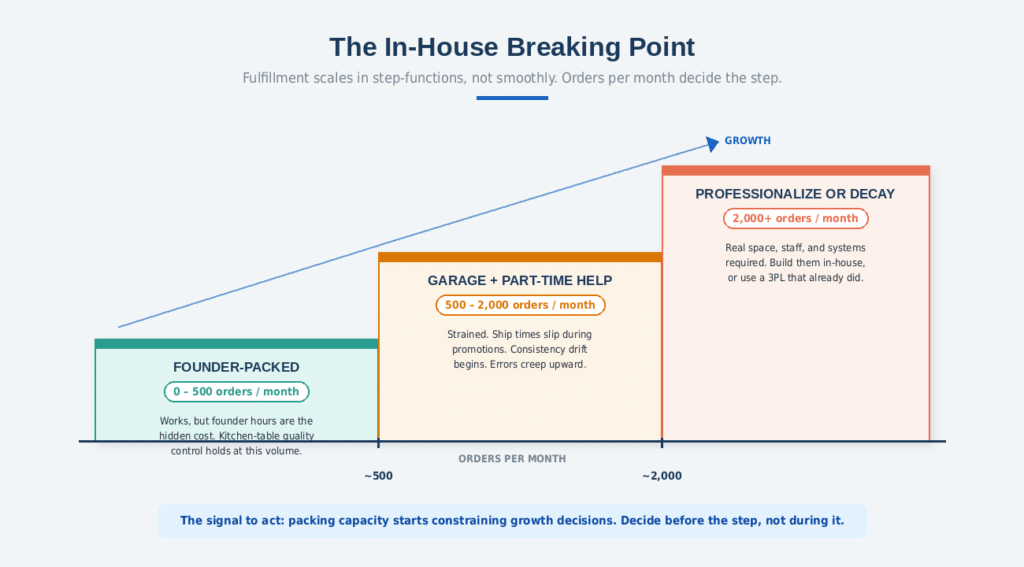
The cause: fulfillment does not scale smoothly. It scales in step-functions. Each step (more space, more people, real systems) demands capital and management attention, and both come out of the same budget that product development and marketing draw from. The founder packing boxes is not saving money; they are spending their most expensive hours on their least differentiated work.
The fix is an honest decision, made before the breaking point rather than during it: invest in professionalizing the in-house operation, or outsource to a partner that already made those investments. The math should include the opportunity cost of founder hours, not just the per-order fee comparison. For brands leaning toward outsourcing, our guide to choosing the right 3PL partner walks through the evaluation criteria, the discovery questions, and the red flags to check before signing anything.
What Solving These Actually Looks Like
Look back across the seven challenges and a pattern emerges. None of them are solved by working harder inside a broken setup. All of them are solved by the same three things: documented process, purpose-built systems, and capacity that flexes. Published cutoffs and accuracy standards answer the Amazon effect. Photographic packing specs answer consistency drift. DIM-engineered packaging and rate shopping answer free-shipping economics. Fast, clear processing answers returns. Surge protocols answer demand spikes. Real-time sync answers multi-channel complexity. And a professionalized operation answers the breaking point.
That list is also a fair description of what a DTC-focused fulfillment partner exists to provide. ShipBuddies runs each of these as standard practice: same-day processing with published cutoffs, packing specs and branded materials managed per client, carrier rate shopping on every order, returns processed on defined timelines, documented surge protocols for launches and viral moments, and native integrations with Shopify, Amazon, TikTok Shop, WooCommerce, and BigCommerce for brands selling across channels.
Every order ships from a single disciplined facility, with one team trained on one set of documented procedures. For the challenges that punish variance hardest (expectations, branded consistency, the breaking point), that is precisely the structure the fix requires: the thousandth box matches the tenth because the same operation packed both.
Brands evaluating ecommerce fulfillment services against these seven challenges should ask any provider to show, not describe, how they handle each one: the packing spec process, the surge protocol, the accuracy numbers, the integration list. The challenges are predictable. A serious partner has a documented answer to every one of them.
Frequently Asked Questions
What are the biggest fulfillment challenges for DTC brands?
The biggest DTC fulfillment challenges are customer expectations set by Amazon’s 2-day default, scaling branded packaging without consistency drift, free shipping economics, returns volume, demand volatility from launches and viral spikes, multi-channel complexity, and outgrowing in-house operations. Each has a distinct operational cause and a distinct fix.
Why do customers expect 2-day shipping from small DTC brands?
Amazon set the delivery standard for all of ecommerce, and customers carry that expectation to every brand they buy from, regardless of size. 80% of consumers say they expect same-day delivery options and 98% say delivery experience affects brand loyalty. Small brands compete by keeping honest promises: published cutoffs, proactive tracking, and a 3-day promise kept beats a 2-day promise broken.
How much do returns cost DTC brands?
DTC return rates run 15 to 30% depending on category, with apparel at the high end. Each return costs roughly $10 to $65 to process when shipping, inspection, restocking, and support time are counted. The larger cost is retention: a bad return experience loses the customer, while a fast, clear one frequently produces a repeat purchase.
How can DTC brands offer free shipping without losing money?
Treat free shipping as a pricing decision. Set the free-shipping threshold above average order value to lift order size, engineer packaging to reduce dimensional weight charges, rate-shop across carriers, and confirm the promise matches your customer geography. Free shipping paired with inefficient fulfillment comes straight out of margin on every order.
How do DTC brands handle viral demand spikes?
The brands that absorb spikes plan for them: fulfillment is told about launches and campaigns in advance, safety stock is sized to the marketing calendar, and surge labor arrangements exist before they are needed. A stockout or shipping backlog during a viral moment wastes the acquisition that created the demand and hands the audience a bad first impression.
When does in-house fulfillment stop working for a DTC brand?
Founder-packed fulfillment typically works to roughly 300 to 500 orders per month. With dedicated space and part-time help it stretches to 1,000 to 2,000. Past that, the operation needs real warehouse space, staff, and systems, or ship times and accuracy decay. The signal is when packing capacity starts constraining growth decisions.
How does multi-channel expansion complicate DTC fulfillment?
Each new channel arrives with its own SLAs, packaging rules, and integration requirements: Amazon enforces seller metrics, TikTok Shop expects 24-to-48-hour ship windows, wholesale demands retailer compliance. The core problem is one inventory pool committed to multiple channels. Without real-time sync, brands oversell on one channel while stock sits committed to another.
When should a DTC brand outsource fulfillment to a 3PL?
The common thresholds: sustained volume past what founder-and-friends packing handles (roughly 500+ orders monthly), fulfillment consuming founder time that product and marketing need, error rates or ship times damaging reviews, or an approaching peak season the current setup cannot absorb. The decision is a cost comparison that includes the opportunity cost of founder hours.
Seven Challenges, One Root
Strip the seven challenges to their causes and they turn out to be one challenge wearing seven costumes: operational discipline at scale. Expectations demand consistency. Branding demands consistency. Free shipping demands efficiency, which is consistency applied to cost. Returns, spikes, and channels demand systems. And the breaking point is simply the moment a brand discovers that discipline does not emerge from effort; it emerges from documentation, systems, and structure.
The ownership paradox that opened this article resolves in the brand’s favor when fulfillment gets treated as part of the product. The brands that win DTC are not the ones that avoid these challenges; every growing brand meets all seven. They are the ones that meet each challenge with its fix already in place.
If some of these challenges read like a description of your current operation, that is worth a conversation. Contact ShipBuddies and bring your hardest one.