

DTC, B2B, subscription, crowdfunding, TikTok, Shopify, Amazon: each business model needs a fulfillment workflow built for it.
Industry-specific fulfillment is the practice of running outsourced order processing on workflows built for a specific business model rather than a one-size-fits-all template. A DTC brand needs branded packaging and unboxing care. A subscription box needs kitting and predictable cycle batching. A B2B seller needs EDI integration and routing guide compliance. A crowdfunding campaign needs one-time mass shipping to thousands of backers. A TikTok Shop seller needs surge capacity for viral spikes.
Each workflow is fundamentally different. A 3PL that treats them all the same fails most of them.
The shift to outsourced fulfillment continues to accelerate. Roughly 57% of ecommerce companies now outsource some or all of their fulfillment, according to Productiv 2026 research. The choice is no longer just in-house versus 3PL. It is generic 3PL versus specialized 3PL, and the gap between the two is wider than most growing brands realize.
If you run a DTC brand, a subscription box, a B2B operation, a crowdfunding campaign, or a multi-channel store selling across Shopify, TikTok Shop, and Amazon, the rest of this article is built for you. Each section breaks down what makes the workflow distinct, the KPI that decides whether it works, and what to look for in a 3PL that runs your model well rather than treating it like every other client. The closing section covers how ShipBuddies handles industry-specific fulfillment as part of its order fulfillment service.
Why Fulfillment Requirements Differ by Industry
Most 3PLs market themselves as serving “all industries.” Most actually run one workflow and apply it to every client. This is the generic-3PL fallacy: assuming a single pick-pack-ship template handles a subscription box the same way it handles a B2B pallet order. It does not.
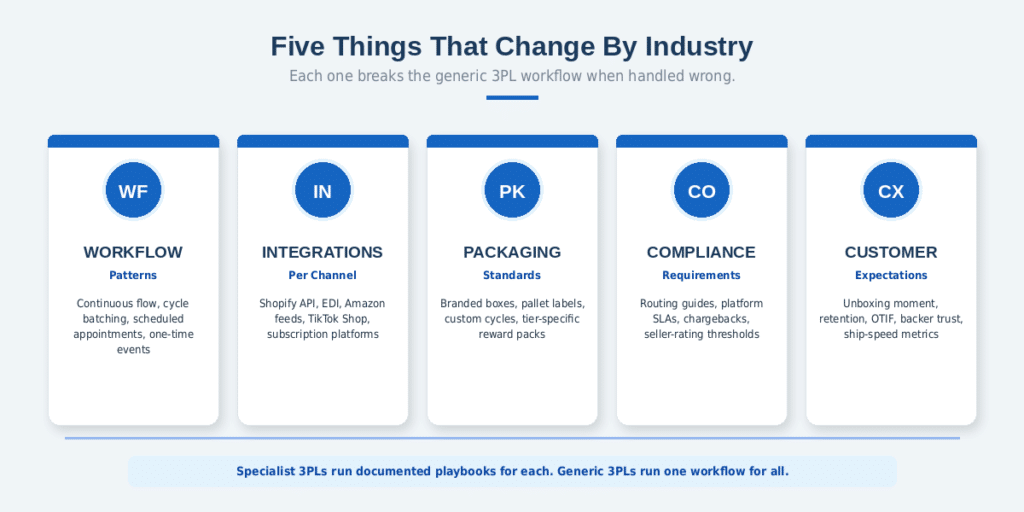
Five things change meaningfully by industry, and each one breaks the generic workflow when handled wrong.
Workflow Patterns
Subscription boxes get pre-assembled in batches on cycle dates. Crowdfunding orders ship as a single mass event after a campaign closes. DTC orders flow continuously as customers buy. B2B orders ship in scheduled appointment windows to retailer distribution centers. The pick-pack process for each is structurally different.
Integrations
Shopify needs native API integration. Amazon FBM needs feed file uploads and tracking submissions. TikTok Shop needs platform-specific order pulls. EDI for B2B needs ASN generation and 856 documents. A 3PL that supports one integration well and the others poorly will fail any client whose primary channel is not the supported one.
Packaging Standards
DTC brands need branded packaging, inserts, and consistent unboxing presentation. B2B orders need pallet labeling per retailer routing guides. Subscription boxes need the same custom box every cycle. Crowdfunding backers need rewards packaged with tier-appropriate materials. Generic packing kits break each of these.
Compliance Requirements
B2B retailers issue routing guides that dictate carton specs, pallet building, ASN format, and delivery windows. Missed compliance generates chargebacks. Amazon enforces FBM seller metrics on ship time and tracking accuracy. TikTok Shop monitors seller ratings tied to ship speed. Each platform has rules a generic 3PL often does not track.
Customer Expectations
A DTC customer expects an unboxing moment. A subscription subscriber expects consistency every cycle. A B2B buyer expects on-time-in-full delivery to the retailer. A crowdfunding backer expects communication about delays. These expectations shape what success looks like, and each industry defines success differently.
A specialized 3PL fulfillment operation runs documented per-industry playbooks for each of these dimensions. The difference between specialist and generalist is not marketing language. It is whether the operation actually executes different workflows for different business models.
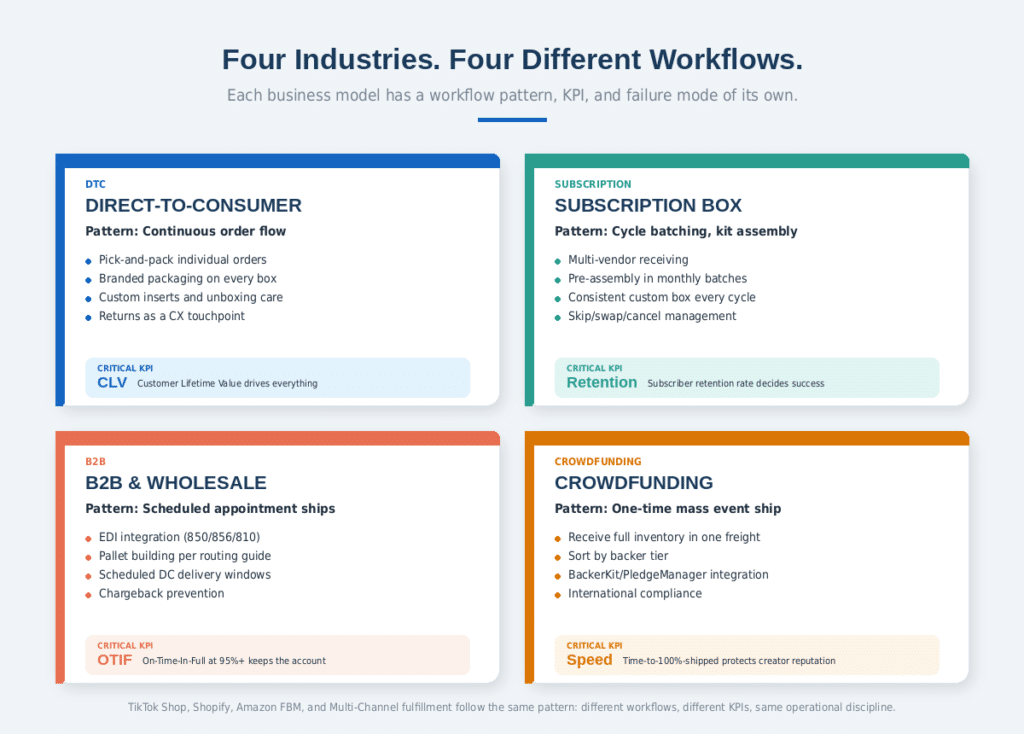
Industry-by-Industry Workflow Comparison
| Industry | Primary Workflow | Key Integration | Packaging | Critical KPI |
|---|---|---|---|---|
| DTC | Continuous flow, single-item picks | Shopify, WooCommerce | Branded boxes, inserts | Customer lifetime value |
| Subscription | Cycle batching, kit assembly | Subscription platform API | Recurring custom box | Subscriber retention rate |
| B2B | Scheduled appointment ships | EDI (850/856/810) | Pallet labels per retailer | On-time-in-full (OTIF) |
| Crowdfunding | One-time mass event ship | Backer survey integration | Tier-specific reward packs | Time to 100% shipped |
| TikTok Shop | Surge-capacity rapid ship | TikTok Shop API | Standard parcel | Ship-time-from-order |
| Shopify | Real-time continuous flow | Native Shopify API | Standard or branded | Order-to-ship time |
| Amazon FBM | SLA-driven fast ship | Amazon Seller Central | Amazon-compliant labels | On-time delivery rate |
DTC (Direct-to-Consumer) Fulfillment
DTC fulfillment ships individual orders directly from the brand to the consumer without a retailer intermediary. The model defines the modern ecommerce playbook: own the customer relationship, own the data, own the experience. Fulfillment is the moment the brand promise gets delivered, literally.
What makes DTC fulfillment different is brand control. Every package is a brand touchpoint. The box, the tape, the inserts, the thank-you card, the tissue paper, the return slip all signal something about the brand. A generic 3PL packs each order in plain corrugate with no inserts. A DTC-aware 3PL maintains branded packaging stock for each client and applies it consistently every order.
The customer experience extends to returns, communication, and post-purchase follow-up. DTC brands often invest heavily in the unboxing moment and the first-purchase experience because customer lifetime value (CLV) is the metric that decides whether the business works. A 3PL that breaks the unboxing experience or mishandles a return damages the metric that matters most.
Workflow Specifics
- Branded packaging inventory managed per client (boxes, inserts, void fill matching brand voice)
- Custom inserts (thank-you cards, discount codes, product samples) applied per order
- Returns processed as a customer experience touchpoint, not just a logistics task
- Personalization at scale (handwritten notes, gift wrapping) when the brand requires it
The KPI that matters most is customer lifetime value. Every fulfillment decision affects whether the customer comes back. Slow ships, damaged products, missing inserts, and sloppy returns all chip away at CLV. A DTC-aware 3PL builds the workflow around protecting that metric.
The most common challenge for growing DTC brands is scaling the branded experience as volume grows. The first thousand orders get hand-finished by the founder. The hundred-thousandth order needs to look the same despite the brand never touching it. This is where specialized 3PL infrastructure matters more than enthusiasm. For deeper coverage of DTC-specific workflows, see the dedicated DTC fulfillment article.
Subscription Box Fulfillment
Subscription box fulfillment is the recurring shipment of a curated set of products to subscribers on a predictable cycle. The model creates predictable revenue, predictable demand, and a fulfillment workflow that looks fundamentally different from individual order shipping.
What makes subscription fulfillment different is kitting. The unit of work is the box, not the SKU. A monthly beauty box contains 5 to 10 individual products that must be assembled into a single shipment. The assembly happens in batches, typically a few days before the cycle ship date. A generic 3PL that picks one item at a time per order will spend 5 to 10 times the labor cost on a subscription order than necessary.
Workflow Specifics
- Multi-vendor receiving (individual products arrive from different suppliers, often weeks apart)
- Pre-assembly of boxes in batches on or near the cycle date
- Consistent branded packaging applied to every box in the cycle
- Subscriber list management (skips, swaps, cancellations, new sign-ups)
- Tier handling (different boxes for different subscription levels)
The KPI that matters most is subscriber retention. Subscription businesses live or die on whether last month’s subscriber stays for next month. A late shipment, a wrong product, or a damaged box can cancel a subscription that would have generated 12 to 24 months of recurring revenue. The cost of a fulfillment mistake compounds over the subscriber lifetime.
Common challenges include skip/swap/cancel handling (subscribers who want to pause or change), seasonal SKU rotation (the box changes contents each month), and surge handling when a viral campaign brings ten times the usual new sign-ups in a single week. For deeper coverage, see the subscription box fulfillment article.
B2B and Wholesale Fulfillment
B2B fulfillment ships orders to other businesses rather than individual consumers. The most common B2B model in ecommerce is wholesale: a brand sells direct online and also ships bulk inventory to retailers (independent stores, regional chains, or major national accounts like Target or Walmart).
What makes B2B fulfillment different is compliance. Retailer buyers issue routing guides that dictate everything from carton dimensions to pallet build patterns to Advanced Shipping Notice (ASN) timing to delivery appointment windows. Missing a routing guide rule triggers chargebacks (sometimes 1 to 3% of invoice value per violation). A growing B2B account can issue thousands of dollars in chargebacks against a single non-compliant shipment.
Workflow Specifics
- EDI integration (850 purchase orders, 856 ASNs, 810 invoices, 820 remittance advice)
- Pallet building per retailer specification (carton orientation, label placement, slip sheets versus interlock)
- Scheduled appointment delivery (retailer DCs assign 30-minute windows; missing them generates fees)
- Routing guide tracking (each retailer has its own; some change quarterly)
- Compliance audit (carton labeling, pallet labels, ASN accuracy verified before ship)
The KPI that matters most is on-time-in-full (OTIF). Major retailers measure OTIF down to the percentage point and penalize suppliers who fall below threshold (usually 95%). A 3PL that handles B2B fulfillment carelessly costs the brand its retail relationships, not just its margin.
The DTC + B2B Dual Model Challenge
A growing number of brands sell both direct AND wholesale and need fulfillment that handles both models without compromise. This is harder than it sounds. DTC requires branded packaging, single-item picks, and individual order workflows. B2B requires palletized shipments, retailer-spec labeling, and scheduled delivery. Most generalist 3PLs handle one well and the other poorly.
The right approach is a 3PL that runs documented separate workflows for each model. Same warehouse, same inventory pool, different playbooks. Without that, brands either compromise their DTC experience to fit a B2B-oriented 3PL or compromise their B2B compliance to fit a DTC-oriented one. For deeper coverage, see the B2B order fulfillment article, which also talks about retail and wholesale fulfillment.
Crowdfunding Fulfillment
Crowdfunding fulfillment is the one-time mass shipment of campaign rewards to thousands of backers after a Kickstarter or Indiegogo campaign closes. The model is structurally different from ongoing ecommerce. Most campaigns produce a single shipping event rather than a continuous flow of orders.
What makes crowdfunding fulfillment different is the spike. A successful campaign that raised $500K from 3,000 backers will need to ship roughly 3,000 packages within a compressed window. The orders arrive all at once when product manufacturing completes, and the deadline for backer-acceptable delivery is usually measured in weeks rather than months. A generic 3PL that handles continuous order flow cannot easily absorb a one-time spike of this size without scheduling chaos.
Workflow Specifics
- Receiving full campaign inventory in one or two large freight shipments
- Sorting orders by backer tier (different reward levels get different packages)
- Backer survey integration (BackerKit, PledgeManager) for shipping addresses and add-ons
- International compliance (a significant portion of backers are outside the campaign country)
- Batch shipping thousands of orders in a tightly scheduled window
The KPI that matters most is time-to-100%-shipped from inventory arrival. Backers tolerate delay during manufacturing. They are far less tolerant once they see “Shipping Now” updates from other backers. A 3PL that gets to 100% shipped in two weeks protects the campaign creator’s reputation. A 3PL that takes two months damages it.
The crowdfunding-to-DTC transition is a common gap. Most successful campaigns transition to ongoing DTC sales through Shopify, Amazon, or a direct website. A 3PL that handles the campaign event well but cannot transition to ongoing ecommerce forces the creator to re-platform mid-stream, losing operational continuity and the institutional knowledge built during the campaign ship.
For deeper coverage, see the crowdfunding fulfillment article.
TikTok Shop Fulfillment
TikTok Shop fulfillment ships orders generated through TikTok’s native commerce platform. The model is recent (TikTok Shop launched broadly in the US in 2023) and the operational requirements are unlike any other ecommerce channel.
What makes TikTok Shop fulfillment different is the spike potential and the seller-rating system. A product can sit at 10 orders per day for months, then a single creator video drives 5,000 orders in 48 hours. The 3PL must absorb that spike without breaking ship times, because TikTok’s seller-rating algorithm tracks ship performance and penalizes slow shippers by suppressing future product visibility on the platform.
Workflow Specifics
- Tight ship windows (TikTok expects orders shipped within 24 to 48 hours of receipt)
- Surge capacity (the ability to scale packing labor for viral spike events without scheduled notice)
- Direct integration with TikTok Shop seller tools (order pull, tracking upload)
- Returns processing within TikTok’s return-handling window
- Pre-shipment quality checks (TikTok customers are often first-time buyers from the seller, increasing return risk)
The KPI that matters most is ship-time-from-order. TikTok measures it directly on the seller dashboard. Sellers consistently below threshold see reduced placement on creator videos and lower default visibility, which compounds into lower future sales. The penalty is invisible until it has already cost the seller weeks of growth.
Common challenges include the unpredictability of viral spikes (no warning), returns volume that tracks impulse-purchase patterns (higher than average), and seller-rating impact from any operational failure. For deeper coverage, see the TikTok Shop fulfillment article.
Shopify Fulfillment
Shopify fulfillment is order processing integrated natively with the Shopify platform. The model is the default starting point for most growing DTC and multi-channel ecommerce brands because Shopify is the dominant ecommerce platform for SMB and mid-market sellers.
What makes Shopify fulfillment different is native integration. The 3PL connects to Shopify through the Shopify API, which pushes orders to the warehouse in real time as customers buy and pushes status updates (ship notifications, tracking numbers, delivery confirmations) back to Shopify for customer communication. The integration eliminates manual data entry and reduces order-to-ship time materially.
Workflow Specifics
- Real-time order ingestion via Shopify API
- Inventory sync that prevents overselling across Shopify and any connected sales channels
- Status push-back to Shopify so customer notifications fire automatically
- Returns initiated through Shopify’s portal route to the 3PL
- Shopify Flow automation hooks for advanced order routing rules
The KPI that matters most is order-to-ship time. Shopify merchants compete on shipping speed, and the integration is the operational backbone that makes fast ship times possible. A 3PL that does not push status updates back to Shopify in real time forces the merchant into customer service work that should be automated.
Common challenges include multi-location Shopify setups (the merchant has multiple stores or fulfillment locations), Shopify Plus brands with custom workflows, and sub-fulfillment routing (different SKUs ship from different facilities). For deeper coverage, see the Shopify fulfillment article.
Amazon FBM Fulfillment
Amazon FBM (Fulfilled By Merchant) is the model where the seller handles fulfillment for Amazon orders rather than using Amazon’s FBA program. The 3PL acts as the merchant’s fulfillment arm, meeting Amazon’s shipping commitments without using Amazon’s warehouses.
What makes Amazon FBM fulfillment different is the SLA pressure. Amazon enforces tight performance metrics on FBM sellers: on-time delivery rate, valid tracking rate, pre-fulfillment cancel rate, late shipment rate. Falling below threshold on any of these can suppress the seller’s products in Amazon search results or, in severe cases, suspend the account.
Workflow Specifics
- Amazon-compliant labeling (FNSKU labels for stickered products, proper carrier labels)
- Tight ship windows to meet Amazon’s promised delivery dates
- Accurate tracking upload to Amazon Seller Central within hours of ship
- Returns routed back through Amazon’s returns system
- Pre-FBA prep capability when the seller transitions some products to FBA
The KPI that matters most is on-time delivery rate, which Amazon monitors directly. The threshold sits at 97% for most categories. A 3PL that consistently lands below 97% costs the seller account health, which affects every product the seller lists.
The strategic question for many brands is FBM versus FBA. Brands choose FBM over FBA when they want control over the customer experience (Amazon strips branding from FBA packages), better per-unit economics at certain volume tiers (FBA fees scale aggressively), or branded packaging that FBA does not support. FBM through a 3PL captures these benefits without losing Amazon Prime eligibility (via Seller-Fulfilled Prime, which requires meeting tight performance standards). For deeper coverage, see the Amazon FBM fulfillment article.
Multi-Channel Fulfillment: The Modern Reality
Most growing ecommerce brands eventually sell on three or more channels simultaneously: their own Shopify store, Amazon, TikTok Shop, and often wholesale to retailers as well. Multi-channel fulfillment is the operational system that handles all of those channels from a single inventory pool.
What makes multi-channel fulfillment different is the synchronization problem. The brand has one inventory pool. The pool has commitments to multiple channels at once. Without real-time sync across channels, the brand oversells on one channel while inventory sits committed to another. The result is canceled orders, refunded payments, and damaged seller ratings on every affected platform.
Workflow Specifics
- Real-time inventory sync across all connected sales channels
- Unified order routing (orders from all channels enter one fulfillment workflow)
- Channel-specific packaging rules where required (branded boxes for DTC, Amazon-spec labels for FBM, plain parcels for TikTok)
- Channel-specific ship-time SLAs honored per channel (Amazon’s 97%, TikTok’s 24-to-48 hour, DTC’s standard)
- Returns routed back to the channel of origin
The KPI that matters most is inventory accuracy across channels. A 95% accuracy rate sounds high until you realize that the 5% gap creates exactly the overselling problem described above. The threshold for healthy multi-channel operation is 99%+.
How ShipBuddies Approaches Industry-Specific Fulfillment
ShipBuddies runs documented separate workflow playbooks for each business model served. The 3PL operates from a single facility with dedicated staff, integrated systems, and per-industry procedures built into the standard operating model. The advantage is operational consistency: every order for a given client follows the workflow built for that client’s business model, not a generic process applied uniformly.
The model works because the workflows are documented at the procedural level rather than embedded in tribal knowledge. A subscription client’s cycle batching runs the same way every month because the procedure is written down and trained. A B2B client’s routing guide compliance runs against a documented checklist for each retailer. A TikTok client’s surge-capacity protocol activates when order velocity crosses a defined threshold. The work product is consistent because the work process is consistent.
Channel-Specific Integrations Supported
- Shopify (native API)
- WooCommerce
- BigCommerce
- Amazon Seller Central (FBM, Seller-Fulfilled Prime)
- TikTok Shop
- EDI for major retailers (Walmart, Target, others)
- Subscription platforms (Recharge, Bold, Stay AI)
- Crowdfunding platforms (BackerKit, PledgeManager)
The branded packaging program is configured per client. DTC brands get the inserts and custom boxes their experience requires. B2B clients get the retailer-spec pallet labels and ASNs. Subscription clients get the same custom box every cycle. Crowdfunding clients get tier-specific reward packaging built into the campaign workflow.
The single-facility model is a feature, not a limitation. Every order ships from the same disciplined operation. There is no variance between East Coast and West Coast facilities, no drift between regional teams, no different SOP at the secondary warehouse. The consistency that industry-specific fulfillment requires is built into the operational base.
Brands choosing a fulfillment partner for industry-specific requirements should ask three questions of any 3PL they evaluate. Does the 3PL maintain documented per-industry playbooks? Does the 3PL operate the integrations my channel requires natively? And does the 3PL have the operational discipline to execute the playbook consistently at volume? Outsourced ecommerce fulfillment services that pass all three questions deliver the industry-specific value that generic alternatives miss.
Frequently Asked Questions
What is industry-specific fulfillment?
Industry-specific fulfillment is outsourced order processing configured to match the workflow, integration, and customer-experience requirements of a particular business model. DTC brands need branded packaging. Subscription boxes need kitting. B2B sellers need EDI compliance. Crowdfunding campaigns need one-time mass shipping. A generic 3PL approach handles each poorly because the workflow requirements diverge by industry.
Why do different industries need different fulfillment approaches?
Different industries have different workflow patterns, integration requirements, packaging standards, compliance obligations, and customer expectations. A subscription box requires kitting and predictable cycle batching. A B2B order requires EDI and routing guide compliance. A TikTok Shop order requires fast ship-window response. A 3PL that runs identical workflows for all clients misses these requirements.
How does DTC fulfillment differ from B2B fulfillment?
DTC fulfillment ships individual orders to consumers with branded packaging, custom inserts, and customer-experience focus. B2B fulfillment ships bulk orders to retailers using EDI integration, routing guide compliance, palletized shipments, and on-time-in-full (OTIF) metrics. The pick-pack workflow, integration, and KPIs all differ. Brands that sell both direct and wholesale need a 3PL that handles each model distinctly.
What does subscription box fulfillment require?
Subscription box fulfillment requires kitting and assembly (combining multiple SKUs into a single box), predictable cycle batching (shipping all boxes on the same date each month), recurring shipment scheduling, and consistent branded packaging. The workflow is fundamentally different from individual order fulfillment because the unit of work is the kit, not the SKU.
Can one 3PL handle both DTC and B2B orders?
Yes, but only if the 3PL runs separate workflow playbooks for each. Most generalist 3PLs handle one model well and the other poorly. The right 3PL maintains documented per-model procedures, separate packing protocols, distinct integration paths, and KPI tracking that fits each business model. Brands selling both direct and wholesale should explicitly ask whether their 3PL operates dual workflows.
What is special about crowdfunding fulfillment?
Crowdfunding fulfillment is a one-time mass shipping event rather than an ongoing flow of orders. A successful campaign delivers thousands of backer orders that must ship in a compressed window, often with international destinations, multiple backer tiers, and post-campaign survey data informing the shipment list. The workflow is event-shaped rather than continuous, which generalist 3PLs are not built for.
How is TikTok Shop fulfillment different from regular ecommerce?
TikTok Shop fulfillment requires fast ship-windows (typically 24 to 48 hours), surge capacity for viral product spikes, and tight integration with TikTok’s seller-rating system. Slow ships hurt seller metrics on the platform, which suppresses future product visibility. A 3PL handling TikTok Shop needs both the operational speed and the platform integration that most generic 3PLs do not maintain.
What does Amazon FBM fulfillment involve?
Amazon FBM (Fulfilled By Merchant) handles Amazon orders outside of FBA. The 3PL operates as the merchant’s fulfillment arm, meeting Amazon’s shipping SLAs, providing accurate tracking uploads, and (for Seller-Fulfilled Prime) hitting two-day shipping commitments. Brands choose FBM over FBA when they want control over the customer experience, branded packaging, or better per-unit economics at specific volume tiers.
How does Shopify fulfillment integration work?
Shopify fulfillment integration uses native API connections to push orders from Shopify to the 3PL in real time and push status updates (ship notifications, tracking numbers) back to Shopify for customer communication. Returns are typically initiated through Shopify’s portal and routed to the 3PL. Real-time inventory sync prevents overselling across multi-location Shopify setups.
Can a 3PL handle multiple sales channels at once?
Yes. A 3PL with multi-channel fulfillment capability syncs inventory across all sales channels in real time, routes orders from each channel through the appropriate workflow, and applies channel-specific packaging or shipping rules where required. The key requirement is real-time inventory synchronization. Without it, brands oversell on one channel while inventory sits committed to another.
Industry-Specific Fulfillment Is the Operational Difference
Industry-specific fulfillment is not a marketing category. It is the operational difference between a 3PL that wins clients and a 3PL that loses them as soon as the work gets harder than picking single items and sticking on labels.
DTC brands win on customer experience, and the experience runs through the box. Subscription businesses win on retention, and retention runs through cycle consistency. B2B operations win on compliance, and compliance runs through retailer-specific procedures. Crowdfunding campaigns win on backer trust, and trust runs through the one-time ship event. TikTok Shop sellers win on ship speed, and speed runs through surge-capacity protocols. Shopify merchants win on integration, and integration runs through real-time order sync. Amazon FBM sellers win on Amazon’s seller metrics. Multi-channel brands win on inventory accuracy across every channel they sell.
Every one of these is a different fulfillment workflow. Generic 3PLs run one workflow and apply it to all of them. Specialist 3PLs run different workflows for different business models. The difference shows up on the customer-facing side as branded experience, on the platform side as seller metrics, on the retailer side as routing-guide compliance, and on the financial side as customer lifetime value.
ShipBuddies operates documented per-industry playbooks for the business models above, from a single disciplined facility. If your fulfillment partner is treating your industry like every other industry, the cost is showing up somewhere in your metrics. Contact ShipBuddies to discuss how an industry-aligned fulfillment workflow could change that.