

Kitting, cycle batching, and subscriber-list discipline for the recurring-shipment business model.
Looking for a fulfillment partner for your subscription business? See our subscription box fulfillment service.
Subscription box fulfillment runs on different operational rules than regular ecommerce. The unit of work is the kit, not the SKU. A monthly beauty box containing 7 individual products ships as one assembled unit, not as 7 separate picks. Operations run on predictable cycle dates rather than continuous order flow. A generic 3PL that handles single-item picks well will mishandle subscription boxes in ways that show up directly on the retention metric.
The market is large and getting larger. Subscription box revenue reached $41.47 billion in 2025 and is projected at $49.7 billion in 2026, with growth forecast past $100 billion by 2030 (The Business Research Company, ResearchAndMarkets 2026). Subscription customers generate 3 to 5 times more revenue over their lifetime than one-time purchasers (Swell 2026). That lifetime value only materializes if subscribers stay, and fulfillment quality is the operational lever that controls retention more than any marketing effort.
This article covers how subscription box fulfillment actually works: the kitting economics that determine unit costs, the cycle batching workflow that runs the operation, the subscriber-list discipline competitors gloss over, the unboxing ritual that drives retention, and the KPI math that ties it all together. The closing section covers how ShipBuddies handles subscription box fulfillment as part of its order fulfillment service, and how that fits into the broader industry-specific fulfillment operation.
What Makes Subscription Box Fulfillment Different
The thesis is straightforward: in subscription fulfillment, the unit of work is the box, not the individual SKU. A subscription box containing 7 products ships as one shipment of 7 items pre-assembled into a single container. A generic 3PL that prices per-pick treats this as 7 separate picks. A subscription-specialist 3PL treats it as one kit assembly. The difference matters because the labor economics are fundamentally different.
At industry-standard pick fees of $0.40 to $0.60 per item, a 7-item subscription box generates $2.80 to $4.20 in pick fees alone at a generic 3PL. A subscription-specialist 3PL charges per-kit at typical rates of $1.50 to $2.50 per kit. The kit pricing reflects the actual labor: a well-designed assembly process runs at 1 to 2 minutes per kit, while a generic 3PL picking each SKU separately can spend 5 to 7 minutes per box. The math compounds across thousands of monthly subscribers.
The pricing difference is structural, not negotiation. A 3PL that runs a single-item-pick workflow physically cannot match the unit economics of a kit assembly operation no matter how the pricing gets restructured. The work itself is different.
Operational Comparison
| Dimension | Generic 3PL | Subscription-Specialist 3PL |
|---|---|---|
| Pick model | Each SKU picked separately | One kit assembled per box |
| Pricing | Per-pick fees stack on multi-SKU boxes | Per-kit flat fee regardless of SKU count |
| Multi-vendor receiving | Treats SKUs as standalone inventory | Allocates against future cycle date |
| Cycle date handling | Continuous-flow assumption | Concentrated batch operation |
| Subscriber list | Pulls each order individually | Locks list 3-5 days before ship |
| Packaging consistency | Standard packing kit | Branded packaging managed per client |
Multi-Vendor Receiving Is the Upstream Discipline
Subscription boxes are curated. The products inside come from multiple suppliers, often arriving at the 3PL weeks apart. Beauty boxes might receive items from 20 different brand partners across 4 weeks. Snack boxes might receive ingredients from 10 producers. Pet boxes might receive treats from one supplier, toys from another, and food samples from a third.
The 3PL has to receive accurately, store with allocation in mind, and stage everything correctly for the cycle day. A generic 3PL that treats each received SKU as standalone inventory will allocate against active orders as they come in, which works fine for regular ecommerce but creates allocation chaos for subscription boxes that need every component reserved against the future cycle.
The receiving and staging discipline is invisible to the subscriber but determines whether the cycle day runs smoothly or breaks. This is one of the most common operational failure modes highlighted in common fulfillment audits of subscription operations.
How Cycle Batching Actually Works
Cycle batching is the operational rhythm of subscription fulfillment. Instead of shipping orders continuously as they arrive (the regular ecommerce model), the 3PL concentrates a month’s fulfillment work into a few high-volume days timed to a fixed cycle ship date. A monthly beauty box with 3,000 subscribers ships all 3,000 boxes in a 1-to-2-day window, not spread across 30 days.
The model works because subscription demand is predictable. The 3PL knows roughly how many boxes will ship each cycle, which means staffing and assembly line setup can be planned in advance. Bulk component receiving allows volume discounts on shipping. Concentrated cycle volume earns better carrier rates than fragmented daily shipping. The cycle date model converts fulfillment from a continuous variable cost into a planned operational event.
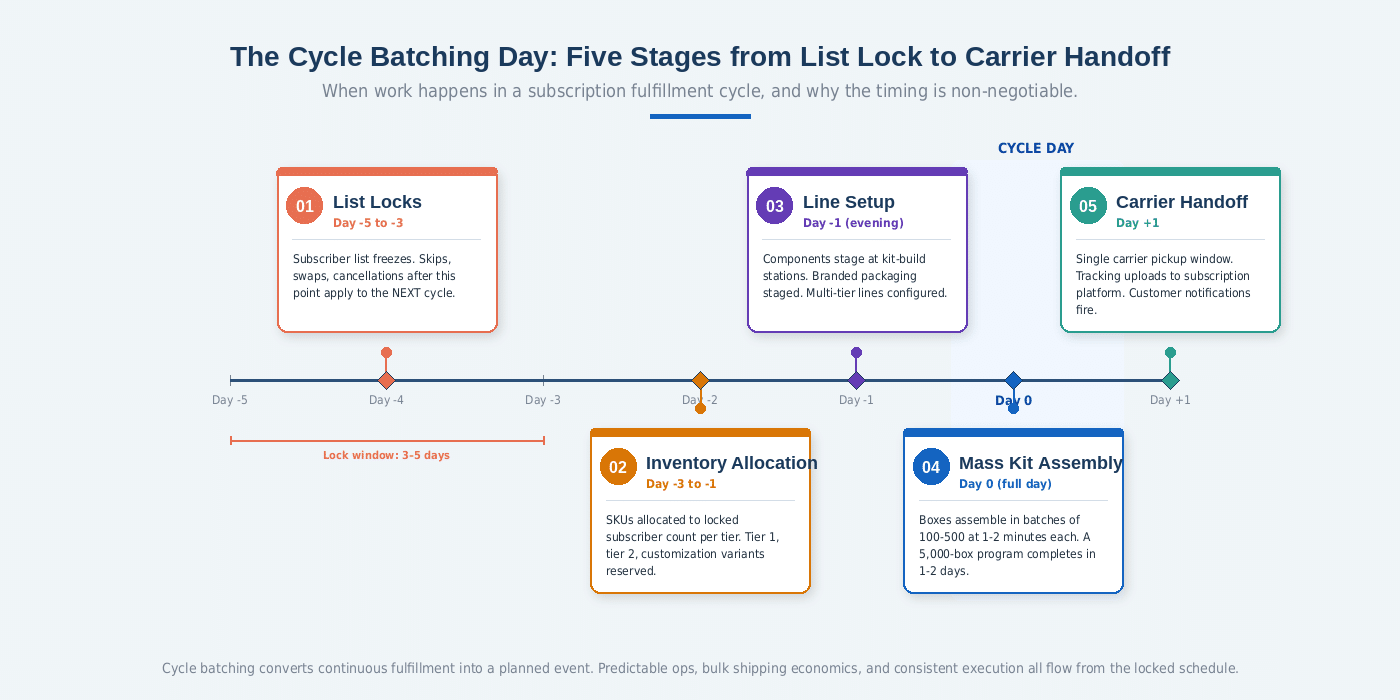
The Five-Stage Cycle Day
The operational rhythm follows a predictable sequence.
- Subscriber list locks. The active subscriber list freezes 3 to 5 days before the ship date. Skips, swaps, and cancellations received before the lock apply to this cycle. Requests received after the lock apply to the next cycle. The lock window is non-negotiable for operational reasons. The 3PL needs the final count to allocate inventory and stage components.
- Inventory allocation. The 3PL allocates each SKU to the locked subscriber count, accounting for tier variants and per-subscriber customization. A 3,000-subscriber program with three tiers might allocate 1,500 units to tier 1 boxes, 1,000 to tier 2, and 500 to tier 3, with separate component counts per tier.
- Assembly line setup. Components stage at the kit-build stations the night before cycle day. Multi-tier boxes require separate assembly lines or clear cycling between configurations. The branded packaging stock (boxes, inserts, void fill, tape) gets staged alongside the components.
- Mass kit assembly. Boxes assemble in batches of 100 to 500 at the rate of 1 to 2 minutes per kit. A 5,000-subscriber program completes assembly in 1 to 2 days with appropriate staffing. The assembly line uses pre-printed pick lists for each tier and visual checklists to verify kit completeness before sealing.
- Carrier handoff. All cycle boxes ship in a single carrier pickup window. The concentrated volume often earns better DIM divisors and surcharge waivers than the same volume spread across the month. Tracking numbers upload back to the subscription platform so customer notifications fire automatically.
Faster handoff to the carrier compresses the delivery window and aligns with last-mile delivery optimization best practices that subscription brands depend on for the first-cycle experience.
Common Cycle-Day Failure Modes
The most common cycle-day failure is late component arrival from suppliers. The 3PL has the assembly line scheduled and staffed; one missing SKU shipment can delay the entire cycle by days. Subscription operations need a receiving discipline that flags late components 1 to 2 weeks before the cycle date so the brand has time to escalate with the supplier or find an alternative.
The second common failure is subscriber-list changes after the lock. Late skip requests, addresses updated after lock, and swap requests received via customer service each create an exception that has to be tracked manually. A 3PL without strict lock enforcement gets buried in exceptions.
Managing the Subscriber List Between Cycles
The subscriber list changes constantly between cycle dates. Skips, swaps, cancellations, new sign-ups, tier upgrades and downgrades, address updates, payment failures: each modifies who gets a box on the next cycle date and what goes in it. A 3PL that handles this poorly creates a steady stream of wrong-product complaints, late shipments, and cancellations that should have been retained.
The List Lock Concept
The subscriber list freezes 3 to 5 days before the cycle ship date. The lock window exists for operational reasons: the 3PL needs the final count to allocate inventory, stage components, and schedule labor. Requests received after the lock apply to the next cycle, not the current one. Subscription operators sometimes push back on the lock window, but compressing it below 3 days usually breaks the operation. The right answer is communicating the cutoff clearly to subscribers via the subscription platform.
Skip Handling
Subscribers skip cycles for vacations, financial constraints, or temporary lack of need. The system tracks the skip without losing the customer. The next cycle resumes normally. Skip handling is itself a retention strategy: a subscriber who skips one cycle is much more likely to return than one who cancels entirely. Subscription platforms (Recharge, Bold Subscriptions, Stay AI, Skio, Loop Subscriptions) handle skip requests natively when integrated with the 3PL.
Swap and Tier Changes
Some programs allow subscribers to substitute one product for another within the same box. Allergies, preferences, and previous-product duplicates are the common triggers. Swap handling requires SKU-level subscriber data flowing from the subscription platform to the 3PL. Without that integration, swaps require manual handling, which breaks at scale.
Tier changes (basic to premium to deluxe upgrades and downgrades) apply to the next available cycle, not the current one. Tier handling requires the 3PL to maintain distinct kit configurations and route each subscriber to the correct configuration on cycle day.
Cancel Handling
Subscribers cancel between cycles. The cancel window timing affects whether one more box ships. A cancel received before the lock means no box ships next cycle. A cancel received after the lock usually means the next box still ships and the cancellation takes effect after. Some programs intentionally lengthen the post-lock window to give the subscriber time to reconsider. The decision is policy-driven, but the 3PL has to execute it consistently.
Surge Sign-Ups
Viral campaigns can bring 10x the usual new sign-up volume in a single week. A creator video, a marketing campaign, or an unexpected social media moment creates a spike the operation has to absorb without breaking the next cycle. A 3PL with documented surge protocols can scale labor and packaging stock on short notice. Without those protocols, the new subscribers receive a poor first experience that triggers cancellations before they even complete their first month. For broader coverage of how customer-experience issues affect retention, see our returns management best practices guide.
Box Design, Branded Packaging, and the Unboxing Ritual
The unboxing moment is structural to the subscription model. Subscribers expect ritual, surprise, and consistency. The first cycle box sets the brand standard; every subsequent box gets compared to it. Visible variation between cycles signals operational chaos and degrades the unboxing experience.
Box Design
Subscription boxes typically use a branded exterior box with interior printing or texture. The box dimensions stay consistent across cycles so the unboxing footprint feels familiar. Structural integrity matters because the box ships filled and has to arrive without damage. Many subscription brands invest in custom corrugate with full-color printing on the lid interior, which transforms the moment of opening into part of the brand experience.
Inserts
Beyond the products themselves, subscription boxes typically include several inserts: a thank-you card or welcome note, content cards explaining each product, a discount code for the brand’s online store, referral incentives, and partner promotions. Inserts give the brand a recurring opportunity to communicate with the subscriber and shape the experience around the products inside.
Custom Packaging Stock
The 3PL maintains branded packaging inventory per client. Boxes, inserts, void fill, branded tape, packing paper, and any other custom materials get stocked at the 3PL and applied consistently every cycle. The discipline of managing branded packaging at scale is what separates subscription-capable 3PLs from generic ones. A generic 3PL using standard packing kits cannot reproduce the brand experience that subscription retention requires.
Welcome Box vs Ongoing Box
Many programs ship a distinct first-cycle box (the welcome box) to new subscribers. The welcome box typically includes additional inserts (a brand story card, a quick-start guide, a starter accessory) and sometimes a bonus product. The system has to flag first-cycle subscribers so the welcome box ships to them and the ongoing box ships to everyone else. Without that flagging, new subscribers get the standard box and miss the onboarding experience designed to retain them through the critical first 3 months.
The branded experience that drives subscription retention parallels what drives DTC fulfillment success more broadly. Both depend on the box arriving exactly as intended, every time, with the brand-defining details intact.
The KPI That Decides Whether You Have a Business
Subscription businesses live or die on subscriber retention. The mathematics are straightforward: a subscriber who stays 12 months is worth 4 to 6 times a subscriber who stays 2 months. A subscriber who stays 18 months is worth more than the cost of acquiring 3 to 4 new subscribers. The compounding effect of retention is what makes the subscription model work at all.
The Retention Math
Take a subscription priced at $35 per month. A subscriber who stays 18 months delivers $630 in lifetime revenue. The same subscriber cancelled at month 4 delivers $140. The difference of $490 per subscriber is the cost of one fulfillment-driven cancellation. Multiply that across thousands of subscribers and the fulfillment-quality-to-margin connection becomes obvious.
| Average Box Price | 3 Months | 6 Months | 12 Months | 18 Months |
|---|---|---|---|---|
| $25 | $75 | $150 | $300 | $450 |
| $35 | $105 | $210 | $420 | $630 |
| $50 | $150 | $300 | $600 | $900 |
The table shows why retention compounds. The difference between a 3-month subscriber and an 18-month subscriber at $35/month is $525 in revenue per subscriber. The math is the same for every subscription brand: longer retention equals higher CLV equals better unit economics.
How Fulfillment Affects Retention
Late shipments delay the cycle anticipation. Wrong products break the curation promise. Damaged boxes signal operational sloppiness. Inconsistent packaging breaks the ritual subscribers expect. Each issue is individually small. Two consecutive issues almost always trigger a cancellation at the next renewal.
The cancellation pattern follows a predictable timeline. The first bad cycle creates frustration but rarely cancels the subscription. The second bad cycle in 3 months almost always does. Customer service can sometimes save the first cancellation, but operational quality is the actual lever. A 3PL that ships consistently across 100 cycles maintains the retention denominator that marketing efforts depend on.
Operational Consistency Is the Retention Strategy
Marketing acquires subscribers. Fulfillment retains them. The split is structural: marketing spend gets the customer to month 1. Fulfillment determines whether they reach month 12. Brands that under-invest in fulfillment quality treat retention as a marketing problem, then watch CLV decline regardless of acquisition spend. Subscription brands that scale across multiple channels (DTC, Amazon, retail wholesale) face additional retention complexity because each channel’s customer expectations differ.
How a 3PL Operationalizes Subscription Fulfillment at Scale
The framework is clear on paper. Executing it every cycle, every month, without drift, is the hard part. Most subscription brands can assemble boxes in-house through roughly 100 to 200 subscribers. Beyond that volume, the operation either professionalizes or breaks.
In-House Barriers
The home-kitchen-table model works at low volume because the founder controls every box personally. At 500 subscribers the founder cannot pack every box in a few days. At 1,000 subscribers the operation needs an actual warehouse, dedicated staff, an assembly line, and surge labor for cycle days. Each step up requires capital investment and operational discipline that pulls focus away from product curation and brand growth.
The hidden cost of in-house at scale is consistency drift. Different staff pack different boxes slightly differently. Insert placement varies. Tape orientation shifts. Subscribers notice. The drift is invisible to the brand because no individual box is wrong, but the aggregate variance damages the ritual that drives retention.
3PL Advantages
A subscription-capable 3PL amortizes the infrastructure across many clients. The assembly line gets set up once and runs cycle after cycle. Surge labor is on tap for cycle days, then released. Branded packaging stock is managed at scale with replenishment triggers built into the operational system. Native integrations with subscription platforms eliminate the manual data sync that breaks at scale.
ShipBuddies operates the cycle batching playbook as part of its core 3PL fulfillment service. The workflow runs out of a dedicated facility with trained packers, documented per-client procedures, and a subscription platform integration layer that handles Recharge, Bold Subscriptions, Stay AI, Skio, and Loop Subscriptions natively. Customers see consistent cycle execution across volume spikes, staffing changes, and product launches.
The single-facility model is the operational consistency that subscription retention requires. Every cycle ships from the same disciplined operation, with the same staff trained on the same documented procedures. There is no variance between facilities, no drift between regional teams, no different SOP at the secondary warehouse. The consistency is built into the operational base.
Subscription brands choosing a fulfillment partner should ask three operational questions of any 3PL they evaluate. Does the 3PL operate documented cycle batching procedures? Does it integrate natively with the subscription platform the brand already uses? Does it maintain branded packaging stock consistently across cycles? Outsourced ecommerce fulfillment services that pass all three questions deliver the retention-supporting value that subscription brands need at scale.
Frequently Asked Questions
What is subscription box fulfillment?
Subscription box fulfillment is outsourced order processing built for the recurring-shipment business model. The unit of work is the kit (multiple SKUs assembled into a single box), not the individual SKU. Operations run on predictable cycle dates rather than continuous order flow. Success depends on kit consistency, retention-driving execution, and the operational ability to handle subscriber list churn.
How is subscription box fulfillment different from regular ecommerce?
Regular ecommerce ships individual items as customers order them, one SKU at a time, continuously. Subscription box fulfillment ships pre-assembled kits of multiple SKUs to all active subscribers on a fixed cycle date. The pick-pack workflow, labor model, packaging requirements, and subscriber-list management all differ. A 3PL built for one workflow is rarely built for the other.
What is kitting in subscription box fulfillment?
Kitting is the process of combining multiple individual SKUs into a single shipment (a kit). For subscription boxes, kitting happens in batches on or near the cycle date. A well-designed kit assembly process runs at 1 to 2 minutes per kit. A generic 3PL picking each SKU separately spends 5 to 7 minutes per box and charges per-pick fees that add up quickly.
How much does subscription box fulfillment cost?
Pricing typically includes receiving fees, monthly storage (per pallet or bin), kit assembly fees per box, and outbound shipping. Specialized subscription 3PLs price the kit assembly as a single line item ($1.50 to $2.50 per kit at typical volume), which is materially cheaper than a generic 3PL charging per-pick on multi-SKU boxes. Request quotes that itemize per-kit pricing.
How do 3PLs handle skip, swap, and cancel requests?
Subscription 3PLs operate on a subscriber list that locks 3 to 5 days before the cycle ship date. Skip, swap, and cancel requests received before the lock apply to the current cycle. Requests received after the lock apply to the next cycle. Native integration with subscription platforms (Recharge, Bold, Stay AI, Skio) automates the data sync so the 3PL ships against the correct active subscriber list.
What is cycle batching for subscription boxes?
Cycle batching concentrates a month’s fulfillment work into a few high-volume days timed to a fixed ship date. The 3PL allocates inventory, stages components, assembles boxes in batches, and ships everything in one carrier handoff window. Cycle batching produces predictable operations, better labor utilization, and concentrated shipping volume that earns better carrier rates.
Can a 3PL scale with viral subscription growth?
Yes, but only if the 3PL has surge labor on tap and assembly line infrastructure that scales. Viral subscription growth can bring 10x the usual new sign-ups in a single week. A 3PL with documented surge protocols absorbs the spike. A 3PL without them ships late or breaks consistency on the next cycle, both of which damage retention on the newly acquired subscribers.
What KPI matters most for subscription box fulfillment?
Subscriber retention rate. Subscription businesses live or die on whether last month’s subscriber stays for next month. Subscription customers generate 3 to 5 times more revenue over their lifetime than one-time purchasers, but only if they actually stay. Late shipments, wrong products, damaged boxes, and inconsistent packaging all trigger cancellations at the next renewal cycle. Fulfillment is the operational lever for retention.
Subscription Box Fulfillment Is a Workflow, Not a Marketing Category
The kit is the unit of work, not the SKU. The cycle date is the operational rhythm, not the continuous flow of incoming orders. The subscriber list is a live variable that locks just before each cycle, not a static dataset. Every operational choice flows back to one metric: subscriber retention.
Generic 3PLs treat subscription boxes like any other ecommerce order and charge per-pick on multi-SKU shipments. The labor math makes that model uneconomic at scale, and the operational mismatches damage retention in ways that show up months later as silent cancellations. Subscription-specialist 3PLs run kit assembly as a single line item, lock the subscriber list on a documented timeline, integrate natively with the subscription platforms operators already use, and maintain branded packaging stock consistently across cycles.
ShipBuddies operates the cycle batching playbook from a single disciplined facility, with documented procedures, native subscription platform integrations, and branded packaging stock managed at scale. If your current fulfillment partner is treating your subscription program like regular ecommerce, the cost is showing up in your retention curve. Contact ShipBuddies to discuss how a subscription-built fulfillment operation could change that.