
Returns are where customer trust is decided. Here is how the returns experience builds loyalty, lifts repeat purchases, and protects brand reputation.
Returns directly shape customer trust by signaling whether a brand stands behind its products. A fast, transparent, and frictionless returns experience builds confidence and drives repeat purchases. A slow or confusing one erodes trust, with 67% of shoppers avoiding future purchases after a negative return experience. This is why returns sit at the center of post-purchase loyalty.
Most ecommerce brands treat returns as a back-office cost. The data tells a different story. Roughly 82% of shoppers check the return policy before completing their first purchase with a brand. After the sale, the returns experience decides whether the customer comes back, leaves a review, or recommends the brand to anyone else.
This article covers how returns affect customer trust across three dimensions: the underlying trust framework that returns either satisfy or violate, the pre-purchase trust signal that a returns policy sends, and the post-purchase experience that decides whether a customer becomes loyal. We also look at the financial cost of returns that erode trust, the operational benchmarks that build it, and how outsourced order fulfillment infrastructure delivers a trust-building returns experience at scale.
Why Returns Function as Trust Signals
Returns function as trust signals because they are the most common test of a brand’s reliability after the sale. Customers buy on promises. They see those promises confirmed or broken when something goes wrong. The returns process is where most of those wrong moments get resolved, which makes it the single highest-stakes interaction in the post-purchase journey.
Trust itself can be measured. The Qualtrics XM Institute identifies three components: Competence (can the brand actually do what it promises), Integrity (does it honor its stated policies without exception), and Benevolence (does it prioritize the customer over short-term cost savings). Returns test all three components in a single transaction.
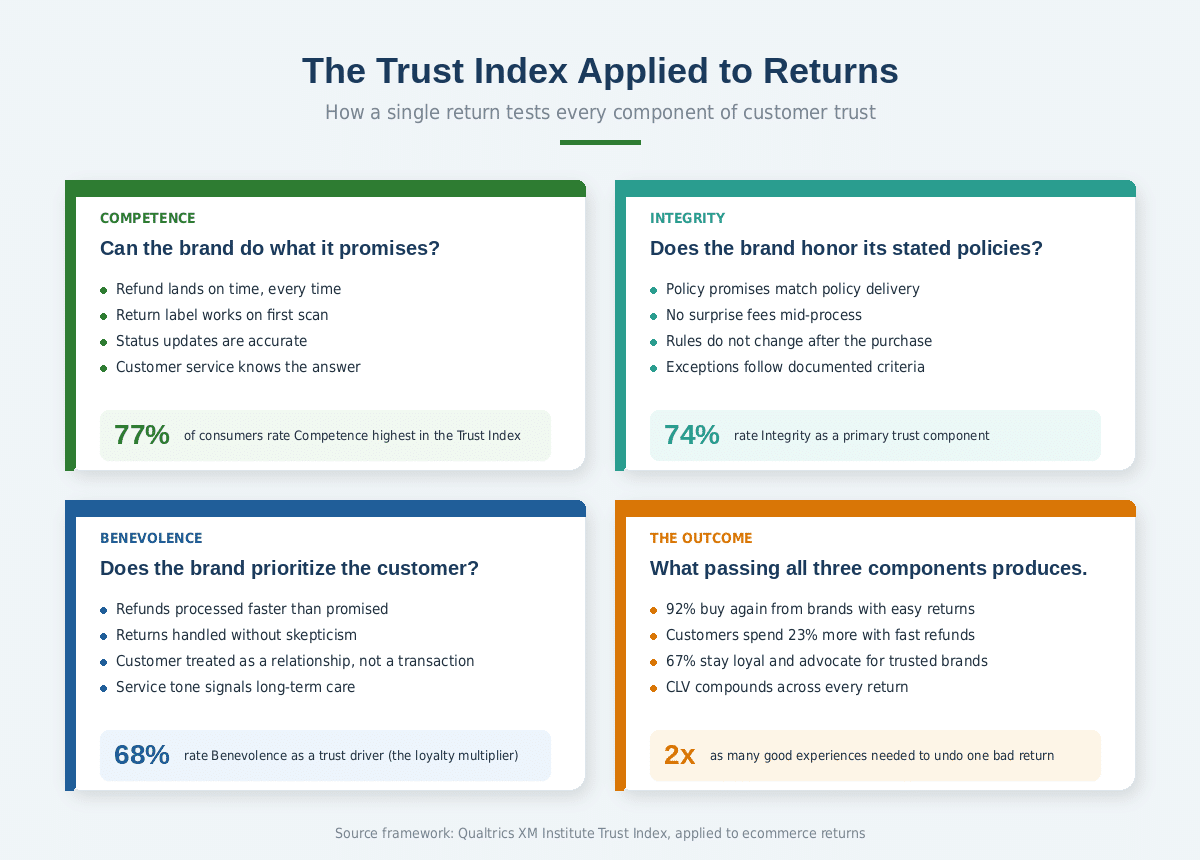
Competence shows up in execution. Does the refund land on time? Does the return label work? Does the customer service rep know what they are doing? When any of these fail, the customer concludes that the brand is sloppy. That conclusion sticks across future purchase decisions.
Integrity shows up in policy enforcement. A return policy that promises 30 days but argues about day 28 destroys trust faster than a stricter policy would have. Customers can accept rules. They cannot accept rules changing mid-process.
Benevolence shows up in tone and judgment. A return processed without skepticism, with a refund issued faster than promised, signals that the brand sees the customer as a long-term relationship rather than a transaction. This component drives the strongest loyalty effects. Industry research shows that 67% of consumers will stay loyal to and actively advocate for brands they trust at this level.
Every return is a trust audit. Brands that pass the audit grow lifetime value. Brands that fail the audit collect short-term cost savings and pay the bill in churn.
How Returns Build Trust Before the Purchase
A returns policy starts working before the customer ever owns the product. NRF data shows that 82% of shoppers check the return policy before making their first purchase with a brand. The policy page often gets visited before the cart does, which makes returns a pre-purchase trust signal rather than just a post-purchase mechanism.
The mechanism is straightforward. Online shoppers cannot touch the product before they buy it, which creates uncertainty. A clear, generous returns policy removes that uncertainty. When the perceived risk of a bad outcome drops, the willingness to buy rises.
The numbers back this up. A 2024 Signifyd survey of European consumers found that 77% base their initial ecommerce shopping decisions on the merchant’s return policy. A separate Shopify analysis found that 76% of shoppers consider free returns essential when choosing where to shop. During the holiday season, 54% of consumers say the return policy is one of their top three considerations, according to a FedEx survey.
These pre-purchase signals translate to revenue. Generous return policies can lift conversion rates by 30 to 40% according to industry analysis. The math works because reduced cart abandonment compounds across every visitor session. A clearer policy converts more browsers without changing the product, the price, or the ad spend.
There is also a quiet inverse effect. Unclear, hidden, or restrictive returns policies actively suppress trust before the purchase. Shoppers who cannot find the policy in a few seconds either bounce or buy with hesitation. Both outcomes hurt long-term metrics.
Three Moves That Turn a Returns Policy Into a Trust Signal
Three specific moves convert a returns policy from a back-office document into a pre-purchase trust signal.
First, surface the policy on product pages, not just the footer. Shoppers should never have to hunt for the return terms while they are evaluating the purchase.
Second, write the policy in plain language that any shopper can understand on a single read. Legal-sounding terms create friction even when the substance is generous.
Third, lead with what is allowed before getting to what is not. Policies that start with restrictions feel adversarial. Policies that start with the customer-friendly terms feel like a partnership.
Brands that do these three things turn the returns page from a friction point into a conversion asset.
How the Returns Experience Shapes Trust After Purchase
After the sale, the returns experience decides whether the customer becomes loyal or quietly leaves. Industry research shows that 92% of shoppers will buy again from a brand with an easy returns process. The same body of research shows that 67% will avoid future purchases after a negative return experience. The gap between these two outcomes is where customer lifetime value is won or lost.
The Narvar 2023 Consumer Report sharpens the point. Roughly 70% of first-time customers decide whether they will buy again based on the return experience. The first return effectively functions as the second-sale audition. Pass it, and the relationship continues. Fail it, and the customer rarely says anything before leaving for a competitor.
Refund Speed Is the Most Visible Trust Signal
Refund speed is the single most visible signal in the post-purchase process. Research shows that 52% of customers would spend more if they knew they would receive a refund quickly, and customers spend an average of 23% more when offered faster refunds. Speed converts to trust because it removes the period of doubt during which the customer wonders whether the brand will honor its policy.
Slow refunds work in the opposite direction. Every day a customer waits past the expected refund window adds doubt. By the time the refund finally lands, the relationship is already damaged, even if the financial outcome is identical.
Communication During the Return Reinforces Trust
Communication during the return matters almost as much as the refund itself. Customers want to know where their item is, when it was received at the warehouse, and when the refund will land. A status update every 24 to 48 hours during the return cycle reduces support contacts and reinforces trust. Brands that handle order tracking and customer communication well during returns see noticeably lower churn and higher reorder rates.
The Trust Asymmetry: Why Bad Returns Hit Harder
There is an asymmetry that brands need to track. Research from the Qualtrics XM Institute suggests it takes roughly twice as many positive experiences to build trust as it takes negative ones to break it. A single bad return can undo months of marketing, packaging investment, and brand storytelling. The math is unforgiving.
This is why the post-purchase customer experience deserves the same operational investment as the conversion funnel. Customers do not separate the moments. They evaluate the brand as one continuous experience, and returns are the part where the brand either earns the next purchase or loses it.
The Financial Cost of Returns That Erode Trust
A returns process that erodes trust generates a measurable financial cost. The NRF 2025 Retail Returns Landscape report estimates that returns cost merchants nearly $850 billion in 2025. The average ecommerce return rate sat at 16.9% in 2024 per NRF data, and CapitalOne Shopping projects this climbs to 24.5% in 2025. These numbers represent the operational cost. The trust cost is separate, and it is larger.
Silent Churn: The Cost You Cannot See
The trust cost shows up as silent churn. Customers who have a bad return rarely complain. They simply do not return. The pattern has earned its own name in industry research: the customer who never came back. If 10% of returns generate silent churn at a brand doing $1 million annually, the lost lifetime value of those customers can exceed $100,000 per year. That figure does not include the cost of replacing them through paid acquisition.
Lifetime Value Compounds in Both Directions
Customer lifetime value compounds in the opposite direction when returns are handled well. Repeat customers spend significantly more per purchase than new customers, with some industry sources placing the gap at 67% higher. Each return processed with care reinforces the relationship, while each return processed poorly removes a future revenue stream. The math is asymmetric in favor of the careful handler.
Customer acquisition cost is the other side of the equation. Every customer lost to a bad return must be replaced through paid channels, organic content, or referral programs. With acquisition costs rising across most ecommerce categories, the cost required to backfill churned customers often exceeds the cost of fixing the returns process in the first place.
Brand Reputation Pays the Price Too
Brand reputation also pays the price. Customer reviews increasingly mention returns experience. Net Promoter Score tracks the post-purchase journey, not just the sale. Bad returns surface in review tags, complaint volumes, and social mentions. All of these damage organic acquisition. A returns process that breaks trust generates compounding losses across acquisition, retention, and reputation simultaneously.
What a Trust-Building Returns Operation Actually Requires
A trust-building returns operation requires measurable performance across five dimensions, not just a generous policy. Most discussions of returns stop at the policy language. The policy is the promise. Trust is built or broken on the delivery.
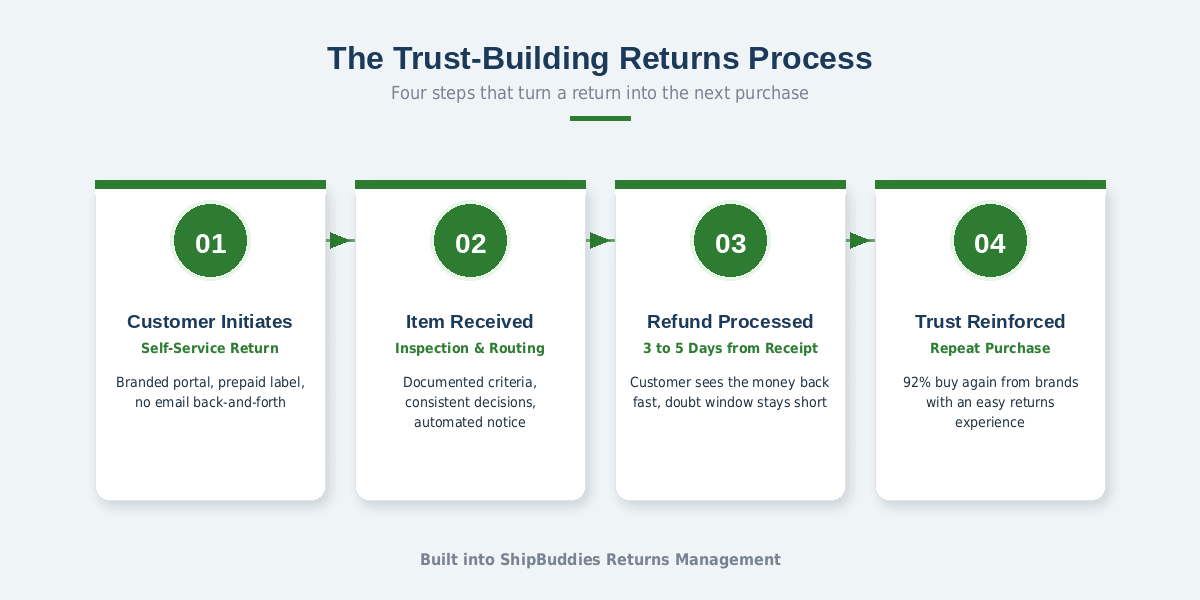
The five dimensions are refund speed, communication cadence, policy clarity, self-service capability, and exception handling. The table below shows what high-trust and low-trust operations look like on each one.
| Dimension | High-Trust Operation | Low-Trust Operation |
|---|---|---|
| Refund speed | 3 to 5 days from item receipt | 10 to 14 days, often longer |
| Communication | Automated updates at three defined touchpoints | No proactive updates, customer must check status |
| Policy clarity | Plain language, surfaced on product detail pages | Buried in footer, written in legalese |
| Self-service | Customer-initiated portal with prepaid label | Email-only initiation, no tracking visibility |
| Exception handling | Documented process, consistent decisions | Case-by-case improvisation, inconsistent outcomes |
Refund Speed Produces the Largest Trust Effect
Refund speed deserves the closest attention because it produces the largest measurable trust effect. Industry benchmarks set the floor at 7 to 10 days. Competitive operations land refunds in 3 to 5 days. The fastest operations process refunds on the day the item is received. Each step down the speed ladder produces measurable lifts in repeat purchase rates.
Communication Cadence Is the Other Half of Speed
Communication cadence matters because uncertainty is the trust killer. Three automated touchpoints handle most of the work: return initiated, item received at the warehouse, and refund processed. Each touchpoint takes seconds to automate but eliminates hundreds of customer service contacts per month at any meaningful volume.
Returns Automation Closes the Policy-Execution Gap
Returns automation closes the gap between policy and execution. Modern returns portals can reduce processing time by up to 50%, according to industry research published in early 2026. The portal handles label generation, status tracking, and inspection routing without manual touch. Without automation, refund speed and communication consistency both suffer at scale.
The operational backbone behind a high-trust returns operation is reverse logistics: the inspection, restocking, and disposition workflow that moves items from the customer’s hands back into sellable inventory. Brands that treat reverse logistics as a strategic process rather than a back-office afterthought consistently outperform on repeat purchase and Net Promoter Score.
Exception Handling Is Where Most Operations Quietly Break
Exception handling is where most operations quietly break. A return that falls outside the standard policy (damaged outside the window, wrong product shipped, partial use) tests the operation’s consistency. Documented exception processes produce consistent customer outcomes. Improvisation produces inconsistent outcomes, which erode trust faster than a stricter policy would have.
These operational standards align with the broader returns management best practices framework used by high-performing ecommerce operations. They also point to the operational reality that many growing brands eventually face: building this infrastructure in-house is expensive, while running it consistently requires dedicated staffing that scales linearly with order volume.
Outsourced ecommerce fulfillment services give growing brands access to the same operational standards as larger competitors without the in-house cost structure. The trust delivery becomes systematic rather than artisanal.
How a 3PL Partner Strengthens Trust Through Returns
A 3PL partner strengthens trust through returns by delivering operational consistency that most in-house teams cannot match at scale. The previous section described what a trust-building returns operation requires. The question for most growing brands is whether they can deliver those standards every day, on every return, while also handling the rest of fulfillment.
The honest answer is that consistency is the hardest part. A small team can hit the standards on a good day. The same team struggles to hit them during a holiday spike, a staffing gap, or a return volume surge after a product launch. Inconsistency is what erodes trust, not occasional slowness.
A specialized 3PL fulfillment operation runs the returns workflow as a defined process with dedicated infrastructure. Items arrive at the warehouse, get inspected against documented criteria, get routed for restocking or disposition, and trigger the refund. The customer sees the same experience every time, which is what trust requires.
ShipBuddies operates returns as part of its core fulfillment service. The workflow runs out of a dedicated facility with trained staff, integrated systems, and documented exception handling. Customers interact with the brand throughout the process while the operational work happens invisibly in the background. This is the model that protects the brand and the trust signal simultaneously.
The financial case for outsourcing returns lines up with the trust case. The benefits of outsourcing fulfillment include predictable per-unit costs, no fixed labor overhead, and access to specialized infrastructure. For most brands between $1M and $50M in annual revenue, these economics favor outsourcing well before they favor in-house operations.
The strongest argument is the consistency one. A returns process that produces the same experience on the busiest day of the year as it does on a quiet Tuesday is what builds the kind of trust that drives repeat purchase. ShipBuddies builds that consistency into the core service, which means the trust signal stays intact regardless of order volume.
For brands evaluating their current returns operation, the question is simple. Does the current setup deliver high-trust standards on the worst day of the year, or only on the average day? If only the average day, the trust signal has a ceiling that no policy rewrite can lift.
ShipBuddies provides outsourced returns management as part of its fulfillment service, with the consistency standards described in the previous section built into the workflow.
Frequently Asked Questions
How do returns affect customer trust?
Returns directly shape customer trust by signaling whether a brand stands behind its products. A fast, transparent, and frictionless returns experience builds confidence and drives repeat purchases. A slow or confusing one erodes trust, with 67% of shoppers avoiding future purchases after a negative return experience.
Does a return policy influence purchase decisions?
Yes. Around 82% of shoppers check the return policy before making their first purchase with a brand, and 77% of consumers say the return policy directly influences their initial buying decision. A clear, generous return policy can lift conversion rates by 30 to 40%.
What percentage of customers check the return policy before buying?
Roughly 67 to 82% of customers review the return policy before completing a purchase, depending on the source. The number climbs higher during the holiday season, when 59% of consumers say they are more likely to consider return policies before buying gifts.
How does refund speed affect customer loyalty?
Refund speed is a primary trust signal. 52% of customers say they would spend more if they knew they would receive a refund quickly, and customers spend an average of 23% more when offered faster refunds. Slow refunds are one of the top drivers of customer churn after a return.
Can a bad return experience cause customer churn?
Yes. Roughly 67% of shoppers say they would avoid future purchases from a business after a negative return experience. This pattern is often called silent churn because customers do not complain. They simply stop buying, which makes the damage hard to detect until repeat purchase rates fall.
Do free returns increase customer trust?
Free returns reduce perceived risk and build trust before the purchase. 76% of shoppers consider free returns essential when choosing where to shop. Free returns also increase return volume, so brands typically balance them with clear conditions or category-specific policies.
How can a 3PL provider improve the returns experience?
A 3PL provider operationalizes the requirements of a trust-building returns process. This includes consistent refund speed, automated status communication, integrated returns portals, and inspection-to-resale workflows. For most growing ecommerce brands, a 3PL delivers more reliable returns service than an in-house operation can sustain.
What does a trust-building returns process look like?
A trust-building returns process is fast (refund within 3 to 5 days), transparent (clear policy and proactive status updates), self-service (customer-initiated through a portal), and consistent (the same experience for every return). The operational backbone matters more than the policy language.
Returns Are Where Customer Trust Is Decided
Returns are where customer trust is decided. Every return is a test of the brand’s competence, integrity, and benevolence. Customers who pass the test become repeat buyers, vocal advocates, and the foundation of long-term revenue. Customers who fail the test quietly leave, taking their lifetime value with them.
The pre-purchase signal matters because shoppers read the returns policy before they buy. The post-purchase experience matters because the first return decides whether the next purchase happens. The operational backbone matters because consistency is what makes trust survive volume spikes, staffing gaps, and product launches.
Most growing ecommerce brands hit a ceiling on the operational side. The standards are clear. Delivering them every day, on every return, is the hard part. ShipBuddies handles outsourced fulfillment and returns management as a defined service, with the consistency standards described above built into the workflow. The trust signal stays intact whether orders are in the hundreds or the tens of thousands.If your current returns process is producing inconsistent outcomes, slow refunds, or measurable churn, the solution is operational, not editorial. Contact ShipBuddies to discuss how outsourced returns management can protect your customer trust at scale.