
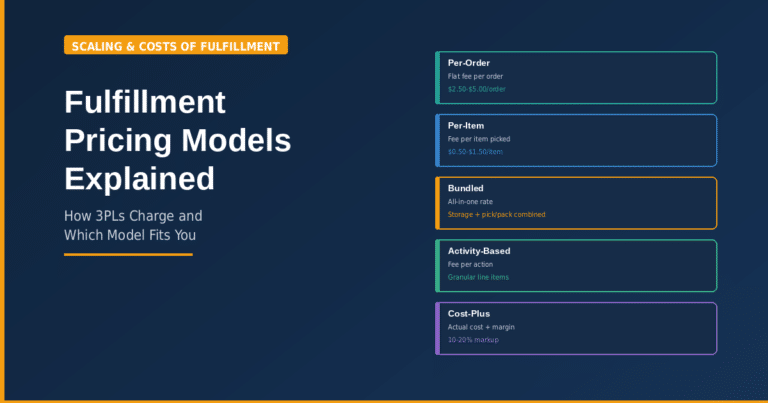
A fulfillment pricing model is the fee structure a 3PL or fulfillment center uses to charge ecommerce sellers for storing inventory, processing orders, and shipping packages. The most common models are per-order pricing, per-item pricing, bundled (all-inclusive) pricing, activity-based pricing, and cost-plus pricing. Each one distributes costs differently across storage, pick and pack, shipping, and value-added services, and two quotes with similar headline rates can produce very different monthly totals once real orders start flowing.
Understanding how each model works is the difference between choosing a fulfillment partner that aligns with your business and choosing one that quietly erodes margin on every order. A complete fulfillment cost breakdown shows what the individual cost components are. This article explains how those components get packaged into pricing models, which model fits which type of seller, and how to compare quotes from different providers on equal terms.
The sections below cover the five pricing models in detail, a decision framework for matching your business profile to the right model, a worked comparison showing the same order data through three different models, red flags to watch for in 3PL quotes, and how pricing changes as your volume grows.
The Five Fulfillment Pricing Models
Every 3PL pricing structure is built from the same underlying cost categories: receiving, storage, pick and pack, packaging materials, shipping, technology, and returns processing. The pricing model determines how those categories are grouped, billed, and scaled.
Per-Order Pricing
Per-order pricing charges a flat base fee for each order processed, regardless of how many items the order contains. A typical per-order rate ranges from $2.50 to $5.00 and covers picking, packing, and basic packaging materials. Storage, shipping, and receiving are billed separately.
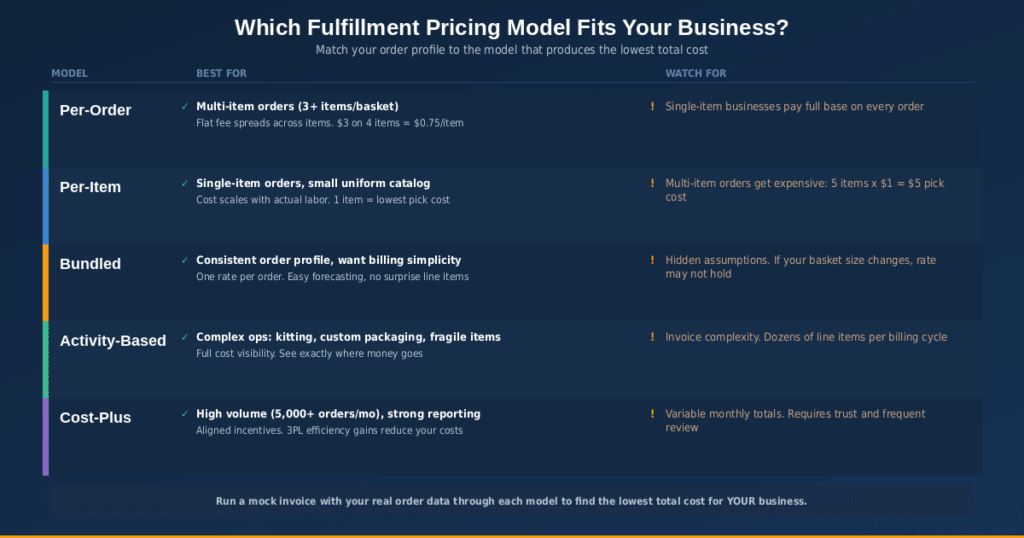
Best for: Sellers with multi-item orders. When a customer orders three or four products, the flat per-order fee spreads across all items, making the cost per item low. A $3.00 per-order fee on a 4-item order is $0.75 per item. The same fee on a single-item order is $3.00 per item.
Watch for: Single-item order businesses paying a full base fee on every order. If 80% of your orders contain one item, per-item pricing may be cheaper.
Per-Item Pricing
Per-item pricing charges a fee for each individual item picked and packed. Rates typically range from $0.50 to $1.50 per item, sometimes with a lower first-item rate and reduced rates for additional items in the same order. Storage, shipping, and receiving are billed separately.
Best for: Sellers with mostly single-item orders or a small catalog of uniform products. The cost scales linearly with order complexity, which means you pay proportionally for the labor involved.
Watch for: Multi-item orders getting expensive. A 5-item order at $1.00 per item costs $5.00 in pick and pack alone, compared to $3.00 under a per-order model. If your average basket size is 3 or more items, per-item pricing works against you.
Bundled (All-Inclusive) Pricing
Bundled pricing combines storage, pick and pack, and sometimes packaging materials and software fees into a single per-order rate. The seller sees one charge per order instead of separate line items for each service. Shipping is usually billed separately, though some providers bundle that too.
Best for: Sellers who want billing simplicity and predictable per-order costs. Bundled pricing removes the need to track multiple fee categories and makes monthly cost forecasting straightforward.
Watch for: Hidden assumptions baked into the bundle. If the provider assumes 1.5 items per order and your actual average is 3, the rate may not cover the real cost, and the provider will either raise your rate mid-contract or add exception fees. Bundled pricing also hides which cost component is driving your expense, making it harder to identify optimization opportunities.
Activity-Based Pricing
Activity-based pricing charges for each specific action the fulfillment center performs: receiving per pallet, storage per bin, picking per item, packing per order, labeling per unit, kitting per assembly, and returns processing per item. Every touchpoint has its own rate.
Best for: Sellers who want full cost visibility and control. Activity-based pricing shows exactly where money goes, which makes it easier to identify waste and negotiate specific rates. Operations with complex, variable order profiles (kitting, custom inserts, fragile handling) benefit from pricing that reflects the actual labor involved.
Watch for: Billing complexity. Monthly invoices can run several pages long with dozens of line items. If you do not have the reporting tools or time to analyze invoices, the granularity becomes noise rather than insight.
Cost-Plus Pricing
Cost-plus pricing charges the actual cost of fulfillment services plus a defined margin (typically 10-20%). The seller sees the true cost of labor, materials, and shipping, plus the provider’s markup. This model is most common in high-volume enterprise partnerships where both parties benefit from transparency.
Best for: High-volume sellers with strong reporting capabilities and an established relationship with their 3PL. Cost-plus pricing aligns incentives: when the 3PL operates more efficiently, the seller’s costs drop.
Watch for: Unpredictable monthly totals. Since costs fluctuate with volume, staffing, and carrier rates, the monthly bill varies more than under fixed-rate models. This model requires trust in the provider’s cost reporting and frequent invoice review.
Which Pricing Model Fits Your Business
The right pricing model depends on four variables: your average items per order, your order volume, the complexity of your fulfillment requirements, and how much cost visibility you need.
If your average order has 1-2 items and your catalog is straightforward, per-item pricing or per-order pricing both work. Compare the math: if your average order is 1.3 items and the per-item rate is $1.00, your average pick and pack cost is $1.30 per order. If the per-order rate is $3.00, per-item pricing saves $1.70 per order.
If your average order has 3 or more items, per-order pricing almost always wins. The flat fee absorbs the multi-item labor at a lower cost than per-item rates applied to every product in the basket.
If you want billing simplicity and your order profile is consistent, bundled pricing gives you one number to plan around. Verify that the bundle assumptions match your actual order data before signing.
If you have complex operations (kitting, custom packaging, fragile items, multiple channels), activity-based pricing gives you the visibility to manage costs at the line-item level. The complexity in billing reflects the complexity in your operation.
If you ship 5,000+ orders per month and want maximum transparency, cost-plus pricing aligns incentives between you and your provider and gives you the data to optimize continuously.
Comparing Pricing Models: Same Data, Different Results
The only accurate way to compare fulfillment pricing models is to apply each one to the same set of real order data. Headline rates are meaningless without context. Here is how the same month of orders looks under three different models.
Scenario: 1,000 orders per month. Average 2 items per order. 20 pallets of storage. 10 pallets received. Average shipping cost $7.50 per order.
Per-Order Model: Pick and pack: $3.00/order x 1,000 = $3,000. Storage: $20/pallet x 20 = $400. Receiving: $15/pallet x 10 = $150. Technology: $200/month. Shipping: $7.50 x 1,000 = $7,500. Total: $11,250. Cost per order: $11.25.
Per-Item Model: Pick and pack: $1.00/item x 2,000 items = $2,000. Storage: $20/pallet x 20 = $400. Receiving: $15/pallet x 10 = $150. Technology: $200/month. Shipping: $7.50 x 1,000 = $7,500. Total: $10,250. Cost per order: $10.25.
Bundled Model: All-in rate: $4.50/order x 1,000 = $4,500 (includes storage and pick/pack). Receiving: $15/pallet x 10 = $150. Shipping: $7.50 x 1,000 = $7,500. Total: $12,150. Cost per order: $12.15.
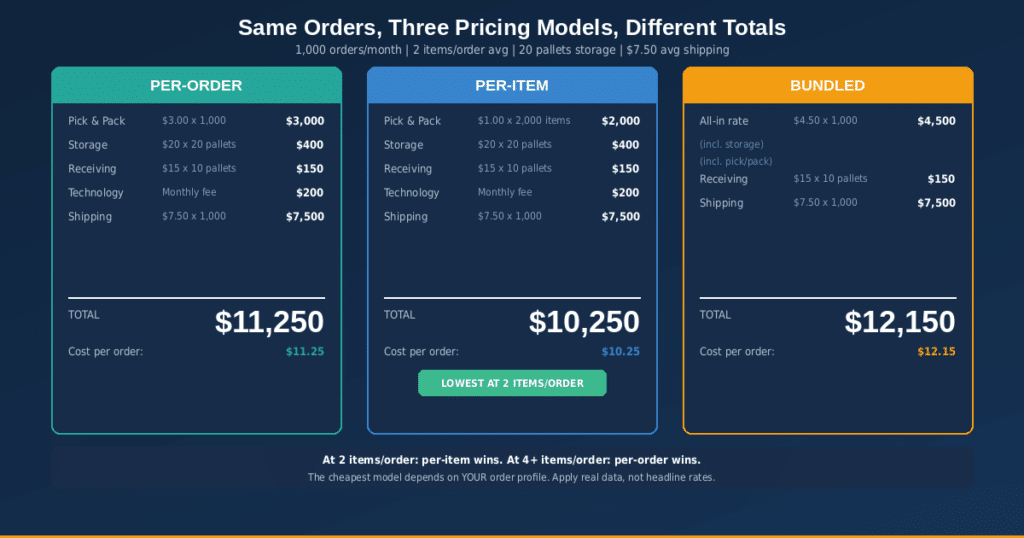
In this scenario, per-item pricing produces the lowest cost because the average basket size (2 items) keeps per-item fees below the per-order flat rate. Change the average to 4 items per order and per-order pricing wins. Change it to 1 item and per-item pricing wins by an even larger margin. The model that costs least depends entirely on your order profile.
Fees That Exist Outside the Pricing Model
Every pricing model sits on top of additional fees that are billed separately or embedded in the rates. These fees affect total cost regardless of which model you choose.
Minimum volume requirements. Most 3PLs set a monthly minimum spend ($500 to $2,000+). If your orders do not reach the threshold, you pay the minimum anyway. For lower-volume sellers, this inflates the effective cost per order well above the quoted rate.
Setup and onboarding fees. One-time charges for system integration, SKU configuration, and workflow setup. These range from $0 (often waived for sellers committing to minimum volume contracts) to $1,000+ for complex integrations with custom ERP or WMS systems.
Shipping pass-through vs. markup. Some 3PLs pass carrier shipping costs through to you at the negotiated rate with no markup. Others add 5-15% on top. Both approaches are legitimate, but you need to know which one applies. A multi-carrier shipping strategy that rate shops across carriers reduces shipping costs under either approach.
Annual rate increases. 77% of fulfillment providers increase prices annually, with typical increases of 3-7%. Ask whether rate increases are capped, how much advance notice is provided, and whether increases apply to all fee categories or specific ones.
Peak season surcharges. Many providers add surcharges to storage, pick and pack, and receiving during Q4. Factor these into your annual cost projection, especially if holiday volume represents a significant share of your sales. Understanding how surcharges interact with your base rates is part of preparing to scale fulfillment for peak seasons.
Red Flags in 3PL Fulfillment Quotes
Not all fulfillment quotes are created with the seller’s clarity in mind. Some are structured to look competitive on paper while concealing costs that surface after the contract is signed. Watch for these specific warning signs.
A single all-in rate with no breakdown. If the provider will not itemize what the per-order rate includes (storage, pick/pack, packaging, technology), you cannot identify which components drive cost or where there is room for optimization. Ask for a line-by-line breakdown of every fee category.
No mention of minimums. If the quote does not reference a minimum monthly spend, ask directly. Discovering a $1,500 monthly minimum after signing a contract changes the economics for a seller doing 200 orders per month.
Shipping rates quoted without zone distribution. A provider quoting “$5.50 average shipping” without specifying zone assumptions may be modeling a best-case scenario. Ask for the zone distribution used in the estimate and compare it to your actual customer location data.
Receiving fees missing entirely. Receiving inventory into a fulfillment center costs labor and dock time. If the quote does not list receiving fees, they may be embedded in other line items at a higher total cost, or they may appear as a surprise on your first invoice.
No reference to rate increases or peak surcharges. A quote that locks in current rates without addressing how and when they change is incomplete. Ask about annual GRI (general rate increase) schedules, peak surcharges, and the notice period for any rate adjustments.
How Pricing Changes as You Scale
Fulfillment pricing is not static. As order volume grows, three things change in your favor.
Per-unit costs decrease. Most 3PLs offer tiered pricing that reduces per-order or per-item rates at higher volume thresholds. A seller shipping 500 orders per month may pay $3.50 per order. At 2,000 orders per month, that rate may drop to $2.75. At 5,000, it may drop further. Ask your provider for their volume tier schedule so you know when to renegotiate.
Carrier discounts improve. Higher shipping volume gives you (or your 3PL) more leverage in carrier negotiations. A 3PL provider aggregates volume across all clients, so even a small seller benefits from the 3PL’s total shipping volume. As your own volume grows within the 3PL, your contribution to their total becomes more significant, which can support account-specific rate improvements.
The pricing model itself may change. A seller that starts on per-item pricing at 200 orders per month may find that per-order pricing is cheaper at 1,000 orders per month because the average basket size has grown. Revisit your pricing model annually. The benefits of outsourcing to a 3PL include the flexibility to adjust your pricing structure as your business profile evolves.
How to Compare 3PL Quotes Accurately
The most accurate comparison method is the mock invoice. Take one real month of your order data: total orders, average items per order, total items shipped, average package weight and dimensions, storage volume in pallets or cubic feet, receiving volume, and return count. Send this data set to each provider and ask them to generate a sample invoice applying their rates to your actual numbers.
Compare the total monthly cost, not the per-order headline rate. Two providers quoting $3.00 and $3.50 per order may produce totals that are reversed once storage, technology, receiving, and shipping markups are factored in. The provider with the higher per-order rate and lower storage and shipping costs may be cheaper overall.
Ask each provider to break their mock invoice into: storage, receiving, pick and pack, packaging materials, shipping (with zone breakdown), technology, minimums, and any value-added services. This line-by-line comparison reveals where each provider is competitive and where they are expensive relative to others.
Frequently Asked Questions
What is the most common fulfillment pricing model?
Per-order pricing and per-item pricing are the two most common models. Per-order pricing charges a flat fee per order regardless of items included. Per-item pricing charges for each individual product picked. Most 3PLs use one of these two models as their base, with storage, shipping, and receiving billed separately.
Which fulfillment pricing model is cheapest?
The cheapest model depends on your order profile. Per-item pricing is typically cheapest for sellers with mostly single-item orders. Per-order pricing is cheapest for sellers with multi-item orders (3+ items per basket). The only way to determine which model costs less for your business is to apply both models to the same month of real order data and compare the totals.
What is a monthly minimum in fulfillment pricing?
A monthly minimum is a floor amount you pay regardless of order volume. Most 3PLs set minimums between $500 and $2,000 per month. If your fulfillment activity does not reach the minimum, you pay the minimum anyway. Minimums are standard in the industry but should align with your actual operating volume. A $1,500 minimum on 100 orders means you are paying $15 per order effective rate.
How do I compare quotes from different 3PLs?
Use the mock invoice method. Send each provider the same month of real order data (order count, items per order, package dimensions, storage volume, receiving volume, return rate) and ask for a sample invoice. Compare total monthly cost, not headline per-order rates. Line-item breakdowns reveal where each provider is competitive and where hidden costs exist.
Do fulfillment pricing models change as my business grows?
Yes. Most 3PLs offer tiered pricing that reduces per-order or per-item rates at higher volume thresholds. The pricing model that fits best also changes: a seller starting on per-item pricing at low volume may switch to per-order pricing as average basket size grows. Revisit your pricing model and rates annually to ensure alignment with your current order profile.
Choosing the Right Pricing Model for Your Growth Stage
Fulfillment pricing models are not inherently good or bad. They are structures that distribute costs in different ways, and the best model for your business depends on how your customers order, how much you ship, and how much cost visibility you need. The sellers who overpay are the ones who sign contracts without applying their real order data to the provider’s rate structure.
Request line-by-line breakdowns. Run mock invoices. Compare total monthly cost, not headline rates. Revisit your model as your volume and order profile change.
ShipBuddies provides transparent fulfillment pricing with every fee itemized. Storage, pick and pack, shipping, and returns are broken out clearly so sellers can see exactly what they pay and model exactly what they will pay as they grow. Request a quote to get a custom breakdown based on your products, order volume, and shipping profile.