

Amazon FBM and a 3PL are not competing Amazon fulfillment programs. Fulfilled by Merchant (FBM) means you arrange fulfillment instead of using Fulfillment by Amazon (FBA) for that order. A third-party logistics provider (3PL) can do the warehouse work for your FBM orders.
The practical choice is between fulfilling those orders in-house and hiring a fulfillment partner. Compare your capacity, service requirements and total costs. There is no universal monthly order count at which outsourcing becomes the better option.
What Is Amazon FBM?
With Amazon FBM, you arrange inventory storage, picking, packing and shipping. You also manage the seller-side responsibilities for cancellations, returns and customer support, subject to Amazon’s policies and any applicable service programs. You can carry out the physical work yourself or use a fulfillment partner.
Outsourcing warehouse tasks does not remove your responsibility for your Amazon account. Set handling times and delivery promises that your operation can meet, confirm shipments, provide valid tracking and monitor Account Health. Amazon’s FBM guidance identifies order defects, late shipments, pre-fulfillment cancellations and valid tracking as metrics to watch.
Customer-service and returns responsibilities need a clear agreement. A warehouse receiving a returned item is not the same as answering the buyer, authorizing a refund or resolving an account issue.
What Does a 3PL Do for Amazon FBM Sellers?
A 3PL provider can receive inventory, store products, pick and pack orders, and hand shipments to carriers. Returns processing, custom packaging, inventory reporting and FBA preparation depend on the provider and your agreement.
Before committing, confirm how Amazon orders reach the warehouse, how tracking returns to Seller Central, how stock updates are synchronized and who handles exceptions. Do not assume that every integration supports every workflow or that automation eliminates the need for monitoring.
This differs from FBA, where Amazon stores inventory and handles picking, packing, shipping, customer service and returns for FBA orders. Amazon allows sellers to combine FBA and FBM. A 3PL may also offer FBA preparation or replenishment as a separate service; verify that scope and its fees.
Self-Fulfillment vs. a 3PL: The Practical Differences
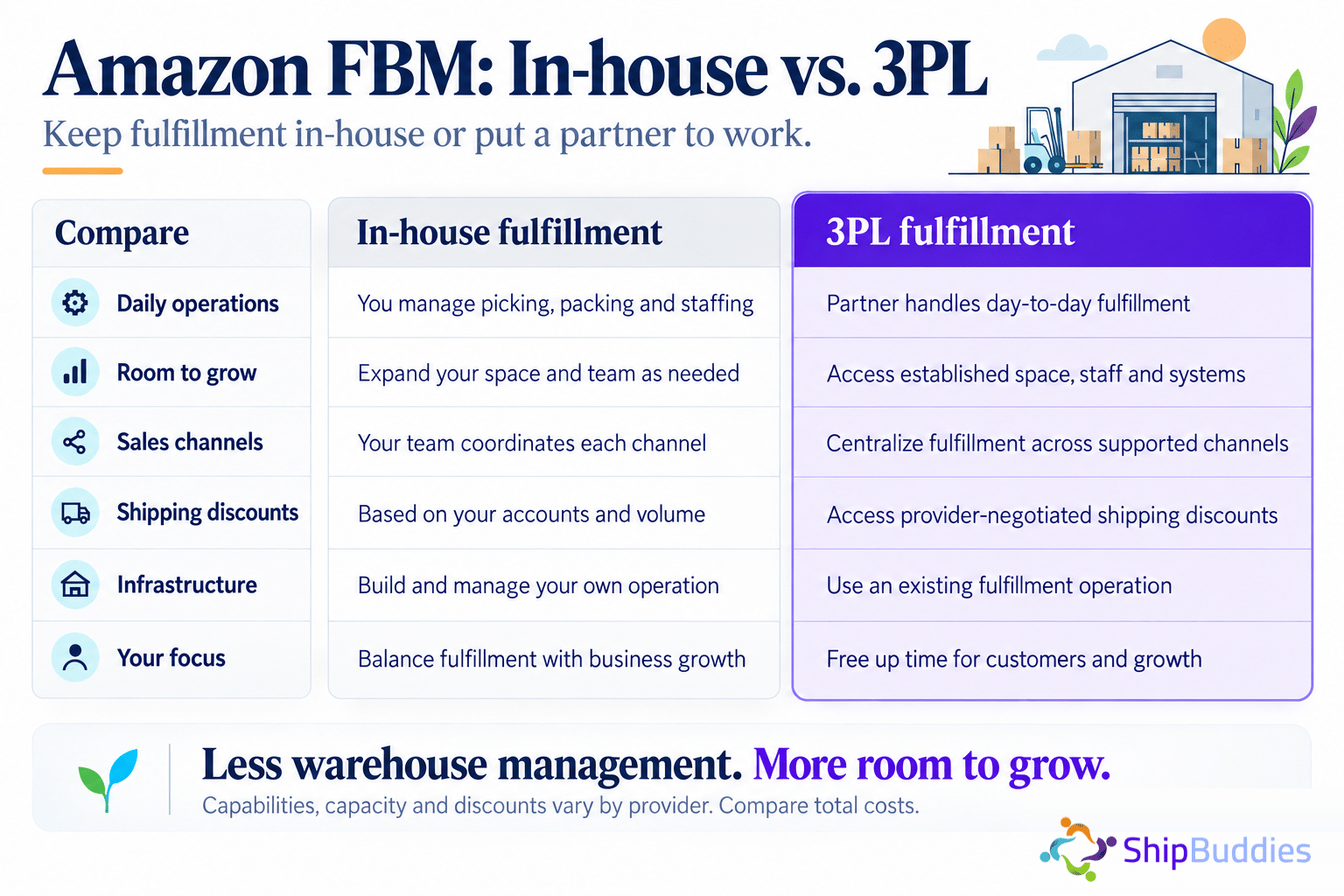
Daily operations and control
In-house fulfillment gives you direct oversight of warehouse work, staffing and packing procedures. With a 3PL, you manage those tasks through agreed procedures, reporting and service commitments. Neither arrangement guarantees accuracy or unlimited capacity.
Multiple sales channels
Both in-house teams and 3PLs can fulfill orders from multiple channels. Amazon’s FBM guidance describes multichannel inventory and shipping tools available to sellers. The question is whether your systems keep orders, inventory and tracking accurate across the channels you use.
A shared inventory pool can simplify operations, but channel reservations, product restrictions and stock allocation rules may still be necessary. Ask a prospective provider to explain the setup instead of assuming every product can be pooled across every channel.
Capacity and packaging
Compare reliable daily capacity during normal weeks and peaks. Check receiving times, order cutoffs, carrier pickups, exception handling and backup arrangements. For branded packaging or special preparation, agree on materials, instructions, availability and charges before shipping inventory.
When Does Self-Fulfillment Make Sense?
Keeping fulfillment in-house may fit when you have enough staff, space and time to meet your delivery promises consistently. It can also suit products that need hands-on customization or inspection that a potential partner cannot provide.
Existing space and staff are useful, but they are not free simply because you already have them. Include ongoing costs and the time those resources could spend elsewhere. Track actual labor, errors, late shipments and storage needs before deciding whether the arrangement still works.
When Should You Consider a 3PL?
Consider outsourcing when warehouse work is taking time from other priorities, your operation is missing delivery promises, or you need capabilities that would be expensive to build internally. A provider still needs to demonstrate that it can meet your requirements.
Use your recent order history and a realistic peak forecast. Review package dimensions, units per order, destinations, return volumes and handling needs with the provider. Ask how it will handle exceptions and how performance will be reported. A higher order count alone does not prove that a 3PL will save money or fix operational problems.
Can a 3PL Help You Get the Prime Badge?
Seller Fulfilled Prime (SFP) is a separate program for eligible seller-fulfilled offers. Hiring a 3PL does not automatically qualify your account or products for Prime. Amazon evaluates actual performance, and eligible offers receive the badge only after successful trial completion and enrollment.
For Amazon’s US program, the detailed trial and enrollment policy checked on October 1, 2026 specifies prequalification followed by a four-week (28-day) trial. It requires at least 100 packages from Prime trial orders for each participating size tier, consistent weekly shipping and compliance with the trial performance requirements. Check the policy for current eligibility rules, attempt limits and restricted graduation periods before planning a launch.
The SFP performance policy separates delivery-speed requirements by size tier. It measures delivery promises shown to customers, not simply whether a warehouse advertises one-day or two-day shipping. Requirements and seasonal provisions can change.
If Prime is part of your plan, ask the provider for evidence relevant to your products and destinations: carrier first scans, delivery performance, weekend operations, cutoff handling and capacity. Model the shipping costs needed to meet the applicable requirements. Neither a coverage estimate nor a provider’s “SFP-ready” description guarantees qualification.
Amazon says it handles post-order customer service for SFP and automatically authorizes returns within the return window. Confirm the remaining warehouse and seller responsibilities for receiving returns, inspecting products and processing exceptions.
Compare the Full Cost of Each Option
Compare the same products, order mix, destinations and delivery promises. Use your actual shipping rates rather than assuming self-fulfillment means paying retail rates. Amazon Buy Shipping and other shipping arrangements may offer negotiated rates to sellers.
In-house costs
- Space, utilities, equipment and inventory systems.
- Receiving, picking, packing, customer-support coordination and returns labor.
- Packaging materials, shipping labels and carrier charges.
- Peak staffing, errors, replacement shipments and time spent resolving exceptions.
Costs to confirm in a 3PL quote
- Receiving and storage, including how space is measured and when rates change.
- Pick and pack charges, additional-item fees and packaging materials.
- Shipping charges, discounts, fuel or delivery-area surcharges and peak fees.
- Monthly minimums, account or software fees, and any setup charges.
- Returns, kitting, special handling, FBA preparation and inventory removal.
Ask what is included, what is charged separately and which assumptions could change the quote. Compare a normal month and a peak month. Keep your remaining management time in the outsourced scenario; a 3PL does not eliminate every operational task.
For an FBA comparison, Amazon’s FBA overview links to its Revenue Calculator. Estimates can help compare methods, but they are not a substitute for your actual invoices and a complete provider quote.
Discuss Your Requirements With ShipBuddies
Bring your product details, recent order history, sales channels and delivery requirements to a fulfillment discussion. Ask us to confirm the Amazon order and tracking workflow, inventory allocation, packaging needs, returns process and costs for your operation.
If Seller Fulfilled Prime is a requirement, make that clear before committing. Do not assume a general fulfillment proposal includes SFP support or guarantees eligibility.
Request a quote to review your fulfillment needs with ShipBuddies.
Frequently Asked Questions
Is using a 3PL still FBM?
For seller-fulfilled Amazon orders, yes. The 3PL performs agreed warehouse tasks while you remain responsible for the seller account. This is different from sending inventory to Amazon for FBA.
How many orders do I need before a 3PL makes sense?
There is no universal threshold. Compare your reliable capacity, product complexity, costs and the provider’s minimums using your actual order data.
Is a 3PL always cheaper?
No. Storage, labor, packaging, shipping, minimums and additional services all affect the result. A provider may reduce some costs and add others.
Can I use FBA and FBM together?
Yes. Amazon allows a combination. Choose the approach for each eligible product based on its requirements and costs, and plan inventory allocation and replenishment accordingly.
Does a 3PL guarantee Seller Fulfilled Prime eligibility?
No. Amazon’s detailed enrollment policy explicitly says that qualification depends on actual trial performance. The seller and fulfillment partner must assess whether their operation can meet the requirements.
Choose Based on Your Operation
Use self-fulfillment when your team can reliably meet requirements at an acceptable total cost. Consider a 3PL when a specific provider can meet those requirements and the full proposal makes sense for your business. Keep Prime qualification, fulfillment costs and day-to-day responsibilities as separate parts of the decision.