
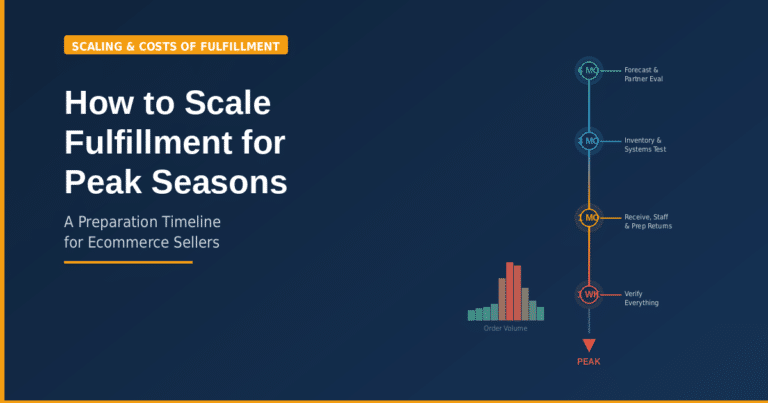
Peak season fulfillment scaling is the process of expanding inventory levels, warehouse throughput, staffing capacity, carrier coordination, and technology systems to absorb order volumes that increase 100% to 200% above daily baseline during high-demand periods. For most ecommerce sellers, peak season spans October through January, driven by Black Friday, Cyber Monday, and holiday shopping. Unscheduled peaks from viral TikTok products, influencer mentions, and flash sales create the same operational pressure with less warning.
Sellers who scale peak season fulfillment successfully follow a staged preparation timeline that begins six months before the expected surge. Sellers who wait until orders pile up face stockouts, shipping delays, negative reviews, and carrier surcharges that erase whatever revenue the season generates.
This article covers the financial cost of failing to prepare, a month-by-month preparation timeline from six months out to one week before peak, the five operational areas that require scaling (inventory, warehouse operations, staffing, shipping, and technology), how to handle unpredictable demand spikes outside of scheduled holidays, what to do after peak season ends, and how a 3PL provider turns peak scaling from a capital investment into a variable cost.
What Peak Season Costs When You Are Not Ready
Unprepared sellers lose revenue, rankings, and customers during peak season, and the damage compounds across four areas that feed into each other.
Stockouts reverse revenue and rankings. A product that goes out of stock during peak season loses the sale immediately. On Amazon and other marketplaces, stockouts also trigger ranking penalties. The listing drops in search results, and recovering that visibility takes weeks or months of consistent sales velocity after restocking. Inventory distortion cost retailers $1.77 trillion globally in 2023, with stock outs driving the largest share of that loss.
Shipping delays produce permanent negative reviews. Customers who order holiday gifts expect delivery by a specific date. When fulfillment backlogs push shipments past that date, the result is negative reviews that stay on your listing permanently. 84% of customers say they will not return to a retailer after a poor delivery experience. Those reviews reduce conversion rates on every future order, not just the ones that shipped late.
Carrier surcharges erode margins. UPS and FedEx both implement peak season surcharges, typically $1 to $5 per package, from October through January. Without advance rate negotiation or a multi-carrier shipping strategy that routes volume to lower-cost carriers, those surcharges apply to every package and cut directly into profit margins.
Post-peak returns overwhelm operations. Up to 30% of online purchases are returned, and the return wave hits hardest two to four weeks after peak sales. A returns management process that handles 50 returns a day can collapse at 200. Delayed refunds generate support tickets, chargebacks, and more negative reviews. The cost of not scaling extends well beyond the selling season.
The Peak Season Preparation Timeline
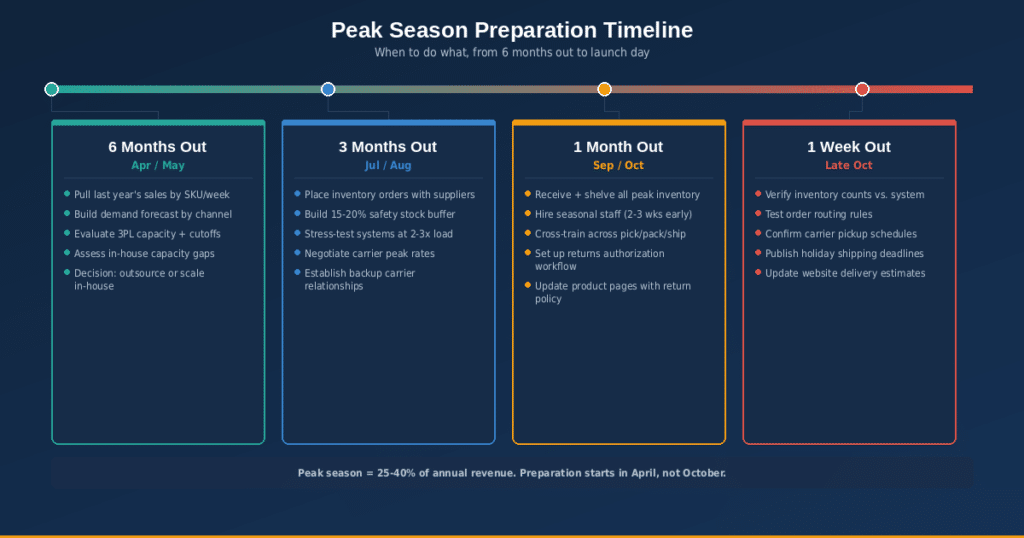
Peak season preparation follows a staged timeline where each phase builds on the one before it. Starting late compresses every step and increases the probability of failure.
6 Months Before Peak: April and May
Demand forecasting is the foundation of peak season scaling. Pull the previous year’s sales data by SKU, by week, and by channel. Layer in planned promotions, new product launches, marketing campaigns, and any platform-specific events (Prime Day, TikTok Shop sales) that will drive traffic during peak. Compare projected volume against current fulfillment capacity to identify the gap between what you expect to sell and what your operation can handle.
This is also the decision point for fulfillment partnerships. If you use a 3PL, confirm their peak capacity, inbound receiving cutoff dates, and any volume commitments they require. If you fulfill in-house, assess whether your warehouse space, staff count, and technology systems can handle double your current daily volume. If the answer is no, this is the time to explore outsourcing, not in September when every 3PL’s capacity is already allocated.
3 Months Before Peak: July and August
Inventory orders go to suppliers during this window. Factor in manufacturing lead times, international shipping transit, customs clearance, and your 3PL’s receiving schedule. Products that miss the inbound receiving cutoff will not be available for peak season sales. Build a safety stock buffer of 15-20% above your demand forecast to absorb demand that exceeds projections.
Systems testing happens here. Run your ecommerce platform, order management system, and inventory sync at simulated peak volume. Identify bottlenecks in order processing, label generation, and warehouse management system performance. A system that lags under 2x normal load will fail under 3x.
Carrier negotiations also happen during this phase. Contact carriers about peak season surcharge schedules, volume commitments, and pickup windows. Lock in rates where possible. Establish backup carrier relationships so you have routing flexibility when your primary carrier hits capacity limits or extends transit times.
1 Month Before Peak: September and October
All peak season inventory should arrive at your fulfillment center before the rush begins. Late-arriving inventory creates receiving bottlenecks that compete with outbound order processing for warehouse labor and dock space. Every hour spent receiving inbound pallets in November is an hour not spent shipping customer orders.
Seasonal staffing ramps up now. Hire temporary warehouse workers 2-3 weeks before they are needed at full capacity. New warehouse employees operate at 40-60% of experienced staff productivity during their first week. Hiring in November means your busiest days are staffed with your least productive workers. Cross-train seasonal staff across receiving, picking, packing, and shipping so they can shift between functions as volume dictates.
Returns preparation also happens now. Set up return authorization workflows, inspection and restocking protocols, and refund processing timelines. Communicate return policies clearly on product pages and in order confirmation emails. The post-peak returns wave arrives whether you prepare for it or not.
1 Week Before Peak
Verify everything. Confirm inventory counts match your system. Test order routing rules. Verify carrier pickup schedules. Check that customer-facing shipping estimates on your website reflect accurate processing and transit times. Publish holiday shipping deadlines with cutoff dates for guaranteed delivery by specific dates. Customers who know the deadline order earlier, which spreads volume more evenly across the peak window.
The Five Areas You Need to Scale
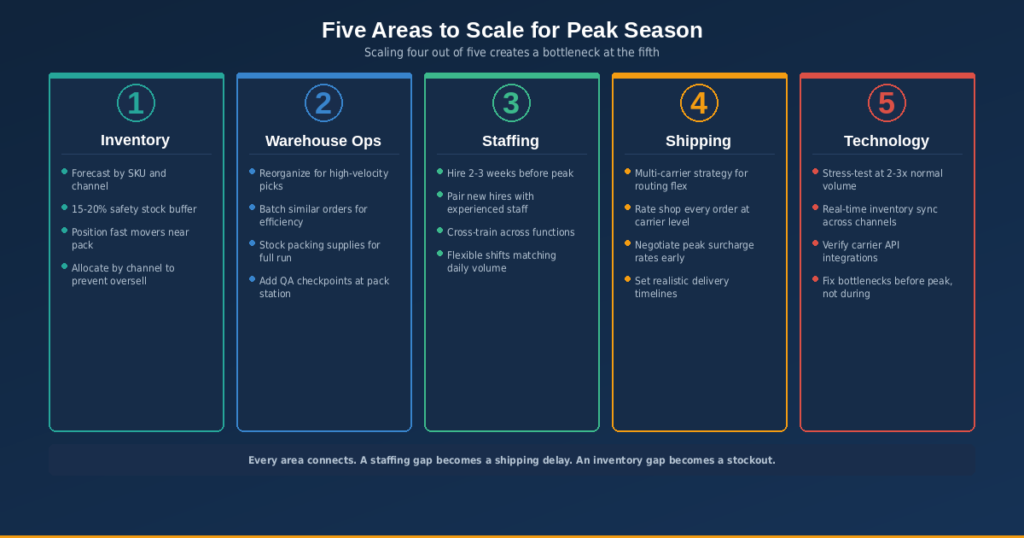
Peak season fulfillment scaling requires simultaneous expansion across five operational areas: inventory, warehouse operations, staffing, shipping, and technology. Scaling four out of five creates a bottleneck at the fifth.
Inventory
Peak inventory scaling starts with having enough of the right products in the right locations. Use demand forecasting data to determine reorder quantities by SKU. Position fast-moving products closest to packing stations in your warehouse to reduce pick time. If you sell across multiple channels (your website, Amazon, TikTok Shop, Etsy), allocate inventory by channel based on projected demand. Overselling on one platform while another has excess stock creates both lost sales and wasted storage costs.
Warehouse Operations
Warehouse throughput determines how many orders leave your facility each day. The order fulfillment workflow that handles 100 orders daily needs adjustment to handle 300. Reorganize your warehouse layout so high-velocity SKUs occupy the most accessible pick locations. Batch similar orders for more efficient picking routes. Verify that packing stations have enough supplies (boxes, tape, labels, filler material, branded inserts) to run continuously without restocking interruptions. Add quality assurance checkpoints at the pack station to catch errors before they become returns.
Staffing
Seasonal labor is one of the hardest areas to scale because the hiring timeline conflicts with the need timeline. Bring temporary workers on 2-3 weeks before peak. Pair each new hire with an experienced staff member for training. Use flexible shift scheduling that matches labor hours to daily order volume rather than running fixed shifts that over-staff slow days and under-staff busy ones. If seasonal workers perform well, flag them for rehire next year. Returning trained workers eliminate the productivity ramp entirely.
Shipping and Carriers
Carrier networks strain during peak season. Pickup windows tighten. Transit times stretch. Surcharges appear. A multi-carrier strategy gives you routing options when one carrier hits capacity. Rate shopping across carriers at the order level identifies the fastest, most cost-effective option for each package even when individual carrier rates spike. Communicate realistic delivery timelines to customers. Promising same-day and next-day shipping you cannot deliver during peak season is worse than setting a longer, accurate expectation.
Technology
System performance under peak load determines whether orders flow or back up. Your ecommerce platform, order management system, warehouse management system, and inventory sync between channels all need to perform at 2-3x normal throughput without lag. Test these systems before peak, not during. Integrations between your store, your fulfillment partner, and your carriers should update inventory, order status, and tracking information in real time. A 30-minute sync delay during peak can result in overselling dozens of units.
Scaling for Unpredictable Demand Spikes
Scheduled peak seasons give you months to prepare. Unscheduled demand spikes give you hours.
A product going viral on TikTok generates thousands of orders in a single day. An influencer mention spikes demand 10x with no warning. A flash sale that outperforms projections overwhelms a fulfillment operation built for steady-state volume. Social commerce conversion rates increased 40% year-over-year in 2024, and the trend shows no sign of slowing. These spikes are becoming more common, not less.
The infrastructure that absorbs viral spikes is the same infrastructure that handles holiday peaks: flexible warehouse capacity, multi-carrier shipping, real-time inventory sync, and the ability to add labor without a multi-week hiring process. The difference is that unpredictable spikes require this infrastructure to be always available, not activated seasonally. A 3PL provider maintains this infrastructure year-round across all of its clients. Your spike is a fraction of the 3PL’s total volume, making it absorbable in a way that would overwhelm your own operation.
What to Do After Peak Season Ends
Post-peak operations determine whether peak season was profitable or just busy. Most sellers focus on surviving the rush and neglect the four operational priorities that follow it.
Process the Returns Wave
The post-holiday return surge runs two to four weeks after Christmas. Returned items need receiving, inspection, grading (resellable, repackageable, or unsellable), inventory updates, and customer resolution (refund, exchange, or credit). A defined returns management workflow with clear SLAs keeps this wave from stacking up and delaying refunds that generate chargebacks.
Audit Performance
Pull data on every metric that matters: daily order volume, on-time shipment rate, average order-to-ship time, carrier transit performance, stockout events, return rate by SKU, and customer complaint volume. Compare actual results to your pre-season forecast. Where did reality diverge from the plan? Those gaps are the starting point for next year’s preparation. The most useful peak season data is collected during and immediately after the season, not reconstructed months later.
Right-Size Inventory
Peak season leaves excess inventory in some SKUs and zero stock in others. Identify slow-moving peak inventory and build a clearance plan before storage costs accumulate through Q1. Identify products that sold out early and adjust next year’s reorder quantities upward. Storage fees on unsold seasonal inventory can erase the margin gains from the products that did sell.
Retain Seasonal Staff
Seasonal workers who performed well are your most valuable asset for next year’s peak. Add them to a rehire list. Stay in contact. Returning trained workers skip the productivity ramp entirely and reduce your hiring lead time from weeks to days.
How a 3PL Makes Peak Season Scaling Possible
Building peak season capacity in-house requires warehouse space, equipment, technology, and labor that operate at full capacity for 2-3 months and sit underused for the remaining 9-10 months. The fixed costs stay the same whether you ship 100 orders a day or 1,000.
A 3PL operates on a variable cost model. You pay for the fulfillment you use. When volume spikes, the 3PL has the warehouse space, trained staff, and carrier relationships to handle the increase without you leasing additional space, hiring temporary workers, or negotiating carrier contracts. When volume drops back to baseline after peak, your costs drop with it. There is no idle infrastructure sitting on your balance sheet.
The benefits of outsourcing to a 3PL become clearest during peak season. Sellers get scalable warehouse capacity without capital investment, negotiated carrier rates that absorb surcharges better than individual shipper accounts, multi-carrier rate shopping that maintains delivery speed when individual networks strain, and returns processing infrastructure that handles the post-peak wave without a separate buildout.
ShipBuddies scales peak season fulfillment for ecommerce sellers through flexible warehouse operations, multi-carrier rate shopping, and real-time inventory management. Peak season orders process with the same accuracy and speed as baseline volume because the infrastructure is built for variable demand, not retrofitted when demand arrives.
Metrics to Track Through Peak Season
Daily order volume vs. forecast shows whether demand is tracking above, below, or at your projection. Adjust staffing, inventory replenishment, and carrier volume commitments in real time based on this comparison.
On-time shipment rate measures the percentage of orders that ship within the promised window. The benchmark is 95% or higher. Anything below that signals a bottleneck in picking, packing, or carrier handoff that needs immediate attention during peak.
Order-to-ship time tracks the gap between order placement and carrier pickup. This number should remain consistent even as volume increases. A rising order-to-ship time means your throughput is not keeping pace with inbound volume.
Carrier transit performance identifies which carriers consistently meet their delivery commitments during peak and which extend transit times. Use this data to adjust routing rules mid-season, shifting volume away from underperforming carriers.
Post-peak return rate by SKU reveals which products generated the most returns and why. This data feeds directly into next year’s product page improvements, sizing guide updates, and inventory forecasting adjustments. Use fulfillment analytics tools to centralize these metrics.
Frequently Asked Questions
When should I start preparing for peak season fulfillment?
Start six months before your expected peak. Use April and May for demand forecasting and fulfillment partner evaluation. Use July and August for inventory ordering, systems testing, and carrier negotiation. Use September and October for receiving inventory, hiring seasonal staff, and finalizing returns processes. Starting later compresses each phase and increases the risk of operational gaps during the rush.
How much extra inventory should I order for peak season?
Build a safety stock buffer of 15-20% above your demand forecast for core SKUs. This accounts for demand exceeding projections without creating massive overstock risk. For new or unproven products, use a smaller buffer and rely on speed of replenishment rather than excess inventory. Track sell-through rates weekly during peak and trigger reorders before stockouts occur.
What happens if a product goes viral during peak season?
Viral demand spikes require the same infrastructure as scheduled peaks: flexible warehouse capacity, multi-carrier shipping, and real-time inventory sync. A 3PL absorbs your spike across its total client volume, making a sudden 10x surge manageable. If you fulfill in-house, a viral spike on top of holiday volume can overwhelm an operation already running at capacity.
How do carrier surcharges affect peak season shipping costs?
Major carriers add peak season surcharges of $1 to $5 per package from October through January. These surcharges apply on top of standard rates and affect every shipment. A multi-carrier shipping strategy offsets surcharges by routing packages to carriers with lower peak pricing for specific zones and service levels. 3PLs negotiate volume-based rates that absorb surcharges more effectively than individual shipper accounts.
Can small ecommerce brands scale for peak season?
Yes. Small brands access peak season scalability through a 3PL that provides warehouse capacity, carrier relationships, and operational flexibility without the capital investment of building it in-house. The variable cost model means you pay for fulfillment used during peak and return to baseline costs afterward. No idle warehouse space, no seasonal staff layoffs, no underused technology.
Building Peak Season Into Your Growth Strategy
Peak season is not a disruption to survive. It is a revenue concentration event that generates 25-40% of annual sales for most ecommerce sellers. The brands that capture that opportunity are the ones that prepare early, scale across all five operational areas, plan for the unexpected, and treat post-peak operations with the same rigor as the peak itself.
The framework is consistent every year: forecast demand six months out, position inventory before receiving windows close, scale warehouse operations and staffing before the rush, diversify carriers to maintain speed and control costs, stress-test your systems, and plan for the returns wave that follows.ShipBuddies helps ecommerce sellers scale fulfillment for peak seasons without building permanent infrastructure. Flexible capacity, multi-carrier rate shopping, and real-time inventory management keep orders moving accurately and on time whether daily volume is 100 orders or 1,000. Request a quote to see how peak season fulfillment works with a 3PL partner.