
Last-mile delivery optimization is the process of improving the speed, cost, and reliability of the final stage of product delivery from a fulfillment center or distribution hub to the customer’s door. For ecommerce sellers, this final stretch determines whether customers come back or shop somewhere else.
The numbers make the stakes clear. Last-mile delivery accounts for up to 53% of total shipping costs. That means more than half of what sellers spend on shipping goes toward the shortest leg of the journey. At the same time, customer expectations around delivery speed keep climbing. Most shoppers now consider two- to three-day delivery a baseline, and a growing share expects same-day or next-day service.
This article breaks down why last-mile delivery costs so much, how it shapes customer experience, and the specific strategies ecommerce sellers use to bring costs down and speed deliveries up. Those strategies include warehouse placement, multi-carrier shipping, route optimization, and working with a third-party logistics (3PL) partner who handles last-mile logistics as part of a broader fulfillment operation.
What Is Last-Mile Delivery?
Last-mile delivery is the final leg of the shipping process, where a package moves from a local distribution hub or fulfillment center to the customer’s doorstep. It sits at the end of the order fulfillment workflow after receiving, inventory storage, picking, packing, and carrier handoff have already happened.
Despite covering the shortest physical distance, last-mile delivery is the most operationally complex part of the supply chain. Upstream logistics move goods in bulk between fixed points: ports, warehouses, distribution centers. Last-mile delivery does the opposite. It breaks consolidated shipments into individual packages and routes each one to a different residential address, across variable distances, through unpredictable traffic, with tight delivery windows.
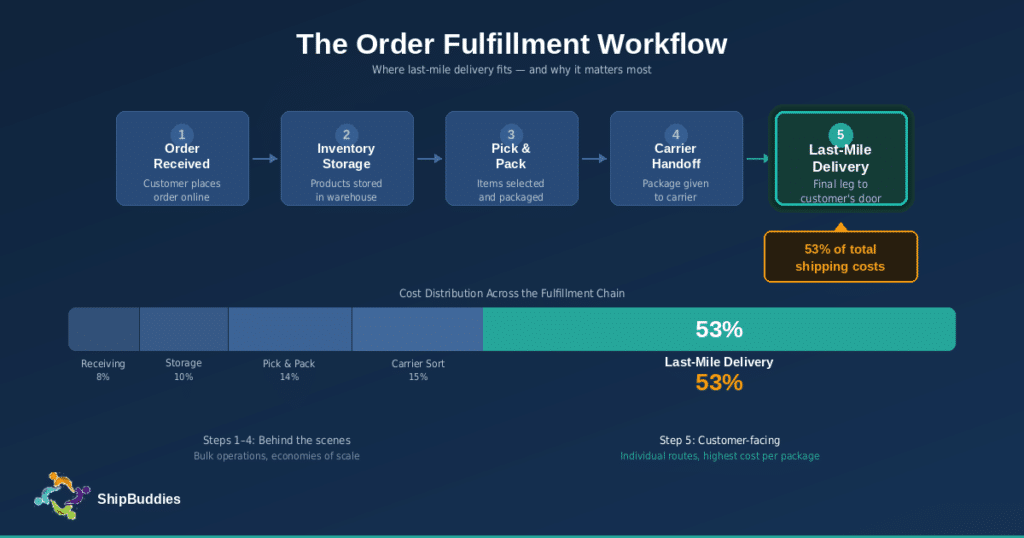
That complexity is what drives the cost. Understanding how last-mile delivery works within the broader order fulfillment workflow helps sellers see where optimization opportunities actually exist.
Why Last-Mile Delivery Is the Most Expensive Part of Shipping
Last-mile delivery costs more than any other stage of shipping because it replaces efficiency with individualization. Moving a container of goods from a port to a warehouse is relatively cheap per unit. Moving a single package from a warehouse to a customer’s front door is not.
Several factors drive these costs:
Residential delivery complexity. Each package goes to a different address, on a different route, at a different time. There is no economy of scale at the doorstep. Urban deliveries deal with traffic congestion and parking constraints. Rural deliveries cover long distances between stops. Both scenarios increase cost per package.
Failed deliveries. When a package can’t be delivered on the first attempt, because the customer isn’t home, the address is wrong, or the building is inaccessible, it costs roughly $20 per failed attempt. Industry data shows that about 75% of online shoppers have experienced a delivery failure. Each redelivery multiplies cost and erodes margin.
Delivery density. The number of deliveries per geographic area directly affects cost efficiency. High-density urban zones allow more stops per route. Low-density suburban and rural areas mean more miles between each drop-off, higher fuel costs, and fewer deliveries per driver per day.
Labor and fuel. Driver wages, vehicle maintenance, and fuel make up the largest share of per-delivery expenses. Out-of-route miles, where drivers deviate from planned routes, typically add 10% to total fleet mileage, inflating costs further.
For context, the average cost of a last-mile delivery ranges from about $10 for a small package in a dense area to $50 or more for a large item in a rural zone. When last-mile costs represent more than half of total shipping spend, even small improvements in efficiency have a measurable impact on margins, especially for sellers already dealing with DIM weight charges that inflate shipping expenses.
How Last-Mile Delivery Affects Customer Experience
Last-mile delivery is the only part of the fulfillment process the customer actually sees. Everything before it, warehousing, picking, packing, carrier sorting, happens behind the scenes. The delivery itself is the moment that shapes how customers feel about a brand.
Customer expectations around delivery have shifted significantly. Research shows that 90% of consumers now consider two- to three-day shipping the standard. Around 80% expect same-day delivery as an available option, and more than half of online shoppers abandon a cart if delivery is too slow or too expensive.
Speed matters, but so does communication. Real-time order tracking has become a baseline expectation. Customers want to know where their package is and when it will arrive. Businesses that provide accurate tracking and proactive delivery updates see fewer “where is my order” (WISMO) support calls and higher satisfaction scores.
Delivery accuracy plays an equally important role. Orders that arrive on time, undamaged, and at the correct address build trust. Orders that arrive late, go to the wrong location, or require multiple delivery attempts erode it. Over time, these experiences directly influence customer reviews, repeat purchase rates, and brand loyalty.
This is why fulfillment matters in ecommerce beyond operational efficiency. It’s a direct line to revenue.
Strategies to Optimize Last-Mile Delivery
Last-mile delivery optimization isn’t a single fix. It’s a combination of infrastructure decisions, carrier strategies, technology, and operational improvements that compound over time. The strategies below are ranked by impact for ecommerce sellers who ship through fulfillment partners rather than managing their own delivery fleets.
Position Inventory Closer to Customers
Warehouse placement is the single most effective lever for reducing last-mile delivery costs and transit times. The math is straightforward: shorter distances between fulfillment centers and customers mean lower shipping costs and faster deliveries.
Sellers who fulfill all orders from a single centralized warehouse face an inherent problem. Customers near the warehouse get fast, affordable delivery. Customers on the opposite coast pay more and wait longer. As order volume grows and the customer base spreads geographically, this gap widens.
Distributing inventory across multiple regional fulfillment centers solves this. When a customer in Atlanta orders from a seller with warehouses on both coasts and in the Midwest, the order ships from the closest location, cutting transit time and zone-based carrier charges.
Micro-fulfillment centers take this further. These smaller, strategically placed facilities in urban areas store fast-moving inventory closer to high-density delivery zones. They make same-day and next-day delivery feasible without requiring massive infrastructure investments.
For most ecommerce sellers, building a multi-warehouse network from scratch isn’t realistic. This is where a 3PL with distributed fulfillment locations provides the infrastructure without the capital commitment.
Use Multi-Carrier Shipping
No single carrier delivers every package equally well. USPS handles lightweight parcels and rural addresses efficiently. UPS and FedEx offer faster ground transit for heavier packages. Regional carriers often beat national carriers on price and speed within specific zones.
A multi-carrier shipping strategy compares rates, transit times, and service quality across carriers at the order level. Instead of defaulting to one carrier for all shipments, sellers, or their fulfillment partners, select the best carrier for each package based on destination, weight, size, and delivery speed requirements.
Rate shopping at the order level consistently reduces per-package shipping costs. It also builds redundancy into the delivery network. When one carrier experiences delays or capacity issues, orders shift to another without disrupting delivery timelines.
Invest in Route Optimization and Real-Time Tracking
Route optimization software uses algorithms and real-time data to calculate the most efficient delivery paths, factoring in traffic patterns, weather, delivery windows, and vehicle capacity. Businesses that implement AI-powered dynamic routing report fuel cost reductions of up to 30% and increases in deliveries per route of 20% or more.
Real-time GPS tracking serves two purposes. It gives operations teams visibility into fleet performance and delivery status. It also gives customers live updates on where their package is and when it will arrive, directly reducing WISMO support inquiries and increasing satisfaction.
Predictive analytics adds another layer. By analyzing historical delivery data, predictive models flag potential delays before they happen and recommend schedule adjustments. These systems reduce operational costs by 12–15% through better capacity planning and more accurate delivery time estimates.
Most ecommerce sellers don’t run their own delivery fleets, which means this technology investment falls on their fulfillment and carrier partners. Choosing partners who already use advanced routing and tracking technology is one of the fastest ways to improve last-mile performance without building systems from scratch.
Reduce Failed Deliveries
Failed deliveries cost approximately $20 per attempt, and each failed attempt triggers a cascade of additional expenses, redelivery scheduling, customer service contacts, and potential refunds. Improving the first-attempt delivery rate directly reduces these costs.
Address validation at checkout catches incorrect or incomplete addresses before packages ship. Smart lockers and pick-up/drop-off (PUDO) points give customers secure alternative delivery locations, which reduces failed attempts caused by customers not being home. Delivery window scheduling lets customers choose when they receive packages, increasing the odds of a successful first attempt.
Digital proof of delivery, photos, signatures, or timestamps, confirms successful deliveries and reduces disputes. Together, these operational improvements target the single most wasteful cost center in last-mile logistics.
Offer Flexible Delivery Options
Customers want choices. Research shows that 70% of consumers prefer flexible delivery options that balance speed and personalization. Some want same-day delivery and will pay for it. Others prioritize free shipping over speed. Offering a range, standard, express, same-day and next-day shipping, locker pickup, lets customers self-select based on their priorities.
Alternative delivery points, including smart lockers and retail partner locations, reduce the last-mile distance for carriers and lower failed delivery rates. They also provide a contactless option that a growing number of customers prefer.
The key is making these options available without building the infrastructure yourself. A fulfillment partner with carrier relationships, regional warehouse coverage, and integrated shipping technology offers these choices at scale.
How a 3PL Optimizes Last-Mile Delivery for Ecommerce Sellers
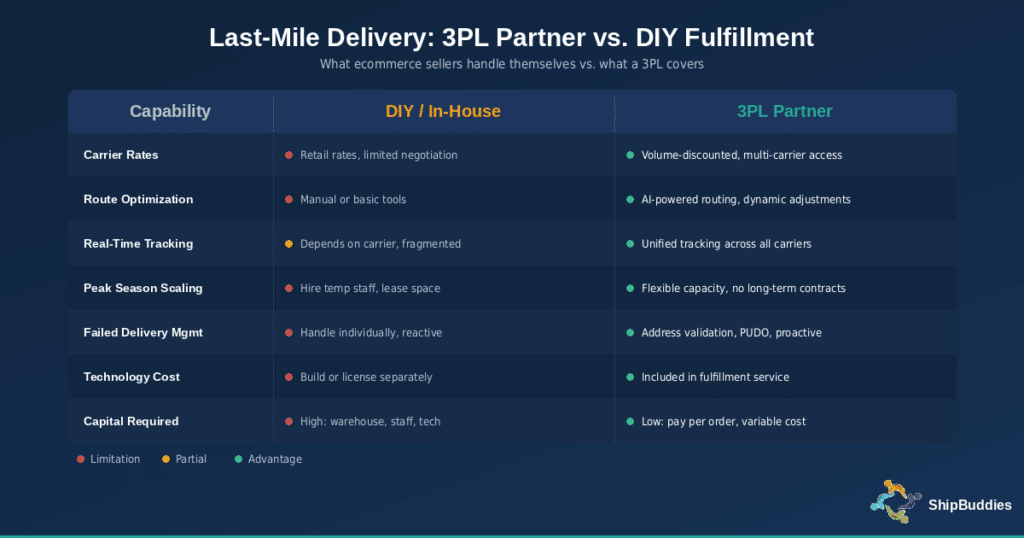
A third-party logistics provider (3PL) handles last-mile delivery optimization as part of a full-service fulfillment operation, warehousing, picking, packing, shipping, and returns. For ecommerce sellers, this means accessing the strategies described above without building the infrastructure, technology, or carrier relationships independently.
The most impactful advantage is the distributed warehouse network. A 3PL with fulfillment centers in multiple regions places inventory closer to customers across the country. This reduces delivery distances, lowers zone-based shipping charges, and makes faster delivery speeds achievable on standard carrier timelines.
Carrier relationships compound the benefit. 3PLs ship high volumes across multiple clients, which gives them negotiating power with carriers that individual sellers can’t match. They apply multi-carrier rate shopping at the order level, selecting the fastest or cheapest option for each package based on destination and service requirements.
Technology comes included. Most 3PLs operate order management systems with built-in carrier integrations, real-time tracking, and automated shipping rules. Sellers get routing optimization, customer tracking pages, and delivery notifications without licensing or building separate software.
Scalability rounds out the picture. During peak seasons, holiday surges, flash sales, viral social media spikes, a 3PL scales fulfillment capacity without sellers hiring temporary staff or leasing additional warehouse space. That flexibility directly supports the benefits of outsourcing to a 3PL for growing ecommerce brands.
ShipBuddies operates this way with multi-carrier shipping, and integrated tracking technology designed to reduce last-mile costs and speed up delivery for ecommerce sellers across Shopify, Amazon, WooCommerce, and other platforms. Understanding how 3PL services work in practice helps sellers evaluate whether a fulfillment partnership fits their growth stage.
Measuring Last-Mile Delivery Performance
Optimization without measurement is guesswork. Tracking the right metrics tells sellers whether their last-mile delivery is improving and where to focus next.
Cost per delivery is the most direct financial measure. It includes carrier charges, labor, fuel, and technology costs divided by completed deliveries. Industry benchmarks range from $8 to $12 for standard parcels, with optimization typically targeting a 15–25% reduction.
On-time delivery rate tracks the percentage of orders arriving within the promised window. This metric directly correlates with customer satisfaction and repeat purchase rates.
First-attempt delivery rate measures how often packages are delivered successfully on the first try. Each failed attempt costs roughly $20, so even a small improvement here has a significant financial impact.
Deliveries per driver per day varies by geography. Urban routes average 25–40 stops. Suburban routes run 15–25. Rural routes average 8–15. Route optimization increases these numbers without adding vehicles or drivers.
Regular analytics and reporting in fulfillment, tracking these metrics over time and benchmarking against industry standards, turns last-mile delivery from a cost center into a performance advantage.
Frequently Asked Questions
What percentage of shipping costs does last-mile delivery account for?
Last-mile delivery accounts for up to 53% of total shipping costs. This makes it the single most expensive segment of the supply chain, driven by the complexity of routing individual packages to residential addresses across variable distances and conditions.
How can ecommerce sellers reduce last-mile delivery costs?
The most effective approaches are distributing inventory across multiple fulfillment centers to shorten delivery distances, using multi-carrier rate shopping to find the best price per package, reducing failed deliveries through address validation and flexible delivery options, and partnering with a 3PL that handles these optimizations as part of their service.
What is the biggest challenge of last-mile delivery?
Balancing delivery speed with cost control. Customers expect fast, free shipping. Sellers need to deliver profitably. The tension between these demands, compounded by variable routes, urban congestion, rural distances, and unpredictable conditions, makes last-mile delivery the hardest part of ecommerce logistics to optimize.
How does a 3PL help with last-mile delivery?
A 3PL provides distributed warehouse networks, negotiated carrier rates, routing technology, and scalable fulfillment capacity, without sellers needing to own delivery fleets or build logistics infrastructure. This gives ecommerce brands access to the same last-mile optimization strategies that large retailers use, at a fraction of the fixed cost.
What is first-attempt delivery rate, and why does it matter?
First-attempt delivery rate is the percentage of packages delivered successfully on the first try. Each failed delivery attempt costs approximately $20 in redelivery expenses, customer service time, and potential refunds. Improving this metric directly reduces shipping costs and improves customer satisfaction.
Making Last-Mile Delivery a Competitive Advantage
Last-mile delivery is where shipping costs concentrate and where customer impressions form. For ecommerce sellers, optimizing this final stretch isn’t optional. It’s the difference between growing margins and watching them shrink with every order.
The framework is clear: position inventory closer to customers through distributed fulfillment, use multi-carrier shipping to find the right carrier for every package, reduce failed deliveries with address validation and flexible options, and track performance metrics to improve continuously.
Getting last-mile delivery right starts with the right fulfillment partner. ShipBuddies’ multi-carrier shipping optimization services put your inventory closer to customers, so deliveries arrive faster and cost less. Request a quote to see how it works for your business.