
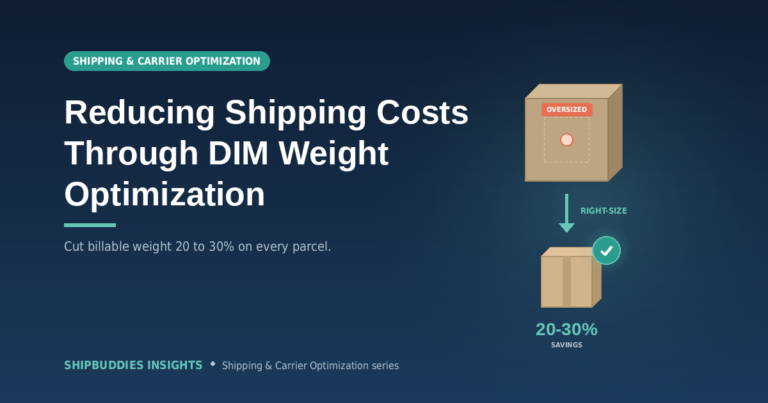
DIM weight pricing can double your shipping spend. Here is the five-layer framework that cuts billable weight, packaging cost, and carrier surcharges.
DIM weight optimization reduces shipping costs by lowering the billable weight on every package. Carriers calculate shipping charges using whichever is greater between actual weight and dimensional weight, and for most ecommerce packages, dimensional weight is the higher number. The formula is straightforward: DIM weight in pounds equals length times width times height in inches, divided by the DIM divisor (139 for FedEx and UPS domestic, 166 for USPS Priority Mail above one cubic foot).
Right-sizing packaging and eliminating excess void fill typically cut shipping spend by 20 to 30%.
The stakes increased sharply in August 2025. FedEx and UPS both began rounding up every fractional dimension to the next whole inch before applying the DIM formula. A box measuring 11.1 by 8.5 by 6.2 inches is now calculated as 12 by 9 by 7 inches, which inflates cubic volume by about 25%. Every pre-2025 packaging strategy ships at a higher billable weight than it did six months ago.
This article covers the full DIM weight optimization framework: how DIM weight is calculated, what changed in 2025, why right-sizing packaging is the biggest single lever, the five-layer framework that compounds savings, and how outsourced order fulfillment delivers the system at scale.
What DIM Weight Is and Why It Drives Shipping Costs
DIM weight (dimensional weight, or volumetric weight in international contexts) is the carrier-calculated weight based on package volume rather than scale weight. Carriers compare DIM weight to actual weight and bill on the greater of the two. That greater number is the billable weight, and it determines what appears on the invoice.
The formula is the same across major carriers. DIM weight in pounds equals length times width times height in inches, divided by a number called the DIM divisor. The divisor varies by carrier and by service.
| Carrier | Domestic Divisor | International Divisor | When DIM Applies |
|---|---|---|---|
| UPS | 139 | 139 (lbs) or 5,000 (kg) | All parcel shipments |
| FedEx | 139 | 139 (lbs) or 5,000 (kg) | All Express; Ground/Home above 1,728 cubic inches |
| USPS | 166 | Priority service only | Priority Mail above 1 cubic foot |
| DHL | 139 | 139 (lbs) or 5,000 (kg) | All Express shipments |
The lower the divisor, the higher the DIM weight. The FedEx and UPS divisor of 139 is the more aggressive number. USPS at 166 is friendlier on paper but only applies to Priority Mail above one cubic foot.
Let’s take a look at an example.
A 12 by 10 by 8 inch box weighing 2 pounds on the scale has a cubic volume of 960 cubic inches. Divided by 139, the DIM weight is 6.9 pounds, which rounds up to 7 pounds.
The carrier bills on 7 pounds, not 2 pounds. The shipper pays roughly 3.5 times the actual-weight rate.
Carriers price this way because trucks and aircraft fill on volume before they fill on weight. A truckload of feathers takes up the same space as a truckload of bricks but generates a fraction of the revenue at actual-weight pricing.
DIM weight ensures the carrier captures the revenue value of the space consumed, not just the mass moved.
For most lightweight ecommerce packages (apparel, accessories, supplements, small electronics), DIM weight is almost always the higher number. Dimensions drive the bill far more than product weight ever will. This is why shipping and carrier optimization starts with packaging decisions rather than carrier negotiation.
The input variable that matters most sits on the packing table.
The 2025 Ceiling Rounding Rule and What It Changed
On August 18, 2025, FedEx and UPS both implemented a change to how they measure packages for DIM weight calculation. Both carriers now round every fractional dimension up to the next whole inch before applying the DIM formula. A box measured at 11.1 by 8.5 by 6.2 inches is calculated as 12 by 9 by 7 inches.
The math compounds quickly. The original box has a cubic volume of 584 cubic inches. After rounding to 12 by 9 by 7, the cubic volume becomes 756 cubic inches. That is a 29% increase before a single product moves. Divided by the FedEx and UPS divisor of 139, the DIM weight moves from about 4.2 pounds (rounded to 5) to 5.4 pounds (rounded to 6). The billable weight increased roughly 20% from the rounding rule alone.
DHL Express applied the same ceiling rounding principle to international express shipments starting in 2026. The rule is now the parcel industry standard across the three carriers most US ecommerce brands use.
The Surcharge Cascade
The cascade does not stop at billable weight. Rounded dimensions push more packages over surcharge thresholds. UPS Additional Handling triggers when the longest side exceeds 48 inches or the second-longest side exceeds 30 inches. A box that measured 30.1 inches on its second-longest side now rounds to 31 inches and crosses the threshold.
FedEx applies a similar threshold and enforces a 40-pound minimum billable weight when Additional Handling triggers. A 5-pound product can suddenly bill as 40 pounds. Once the threshold is crossed, the savings opportunity for that package is gone for that shipment.
The GRI Compounds On Top
The annual General Rate Increase (GRI) sits on top of the rounding change. UPS announced a 5.9% GRI for 2026. FedEx published a similar number. These increases apply to billable weight, which means the rounding rule’s 20% inflation gets multiplied by the GRI on top.
The implication is straightforward: many packaging decisions made before August 2025 are now wrong. Boxes that were borderline are now over the line. Products that shipped at 5 pounds bill at 6 or 7. Surcharge exposure increased without any change to the products being shipped. The optimization framework below addresses each of these failure modes directly.
Right-Sizing Packaging Is the Single Biggest Lever
Right-sizing packaging means using the smallest package that still protects the product. It is the single biggest lever for reducing DIM weight because it attacks the input to every DIM calculation, not just the output. Industry research consistently places the savings range at 20 to 30% of total shipping spend.
The savings work because the DIM formula is multiplicative. Cutting any single dimension by 10% cuts the cubic volume by 10%. Cutting two dimensions by 10% each cuts the cubic volume by 19%. A box that fits the product, with minimal void fill, lowers the DIM weight on every shipment that leaves the warehouse.
For lightweight ecommerce products in oversized boxes, the savings are even larger. Apparel brands and document shippers who switch from boxes to appropriately protective polymailers see shipping cost reductions of 40 to 60% per package. The savings come from two sources: lower DIM weight on the package itself, and qualification for lower-cost envelope rates instead of parcel pricing.
The Box-vs-Polymailer Decision
Boxes make sense when products are fragile, irregularly shaped, premium-branded, or above roughly 5 pounds. Polymailers make sense for soft goods, flat goods, lightweight non-fragile items, and any product where unboxing presentation is not part of the brand promise. The savings on the polymailer side typically range from 15 to 60% depending on category.
Apparel and accessories see the largest gains. Hardgoods see smaller but still meaningful gains when right-sized into padded mailers. The middle ground (semi-fragile products in mailers with appropriate padding) is the area where most brands lose money to inertia. They keep shipping in boxes because that is what they have always done.
The 3-to-5 Box Library Sweet Spot
Most ecommerce operations work best with 3 to 5 standardized box sizes plus 1 or 2 polymailer options. Fewer than 3 box sizes forces too many products into oversized packaging. More than 5 sizes complicates the packing workflow without meaningful additional savings.
Multi-depth boxes (boxes with pre-scored fold lines at multiple heights) can collapse 3 or 4 standard sizes into a single SKU. This is the modern best practice for keeping inventory simple while still right-sizing.
The Void Fill Trap
Void fill (bubble wrap, air pillows, packing paper) is cheap material that masks the need for smaller packaging. A 14-inch box filled halfway with air pillows is a 14-inch box on the carrier invoice. The void fill costs less than $0.05 per package but adds $1 to $4 to the shipping bill on every shipment. This is one of the most common failure modes identified in common fulfillment audits. The fix is mechanical: smaller boxes, less fill, lower DIM weight.
The Five-Layer DIM Weight Optimization Framework
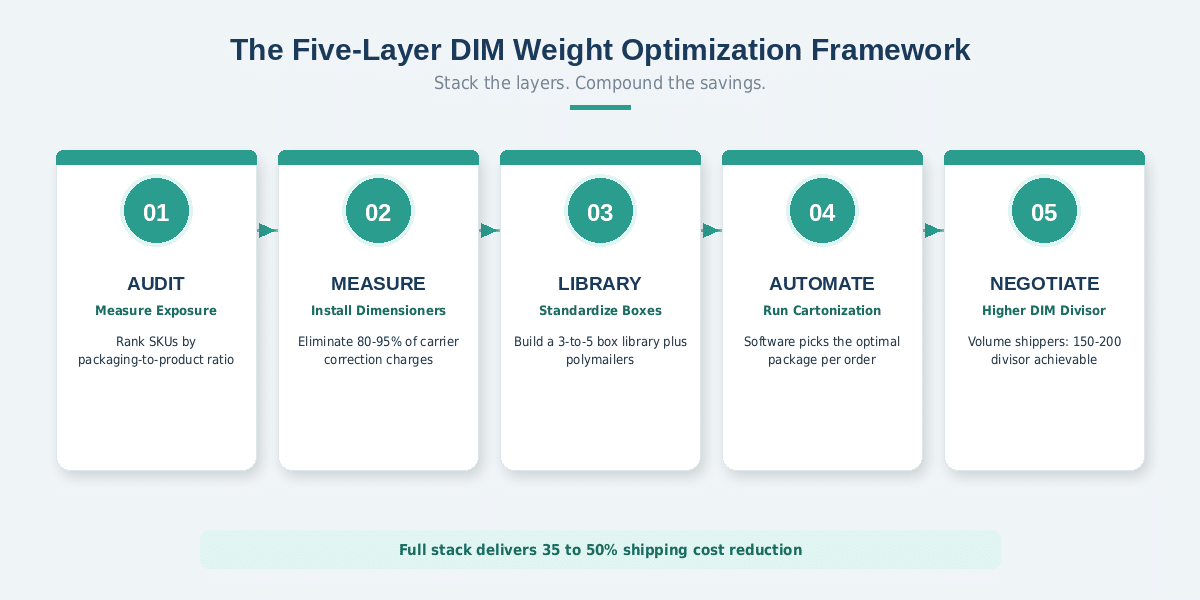
DIM weight optimization works best as a five-layer system rather than a single tactic. Brands that implement all five layers typically reduce shipping costs by 35 to 50%. Brands that stop after the first or second layer leave half the savings on the table. The layers must be implemented in order, because each layer depends on the data and infrastructure produced by the layer below it.
Layer 1: AUDIT
The audit measures current DIM weight exposure by SKU. The output is a list of products ranked by packaging-to-product ratio. The worst offenders are products with the most air inside the box. The audit identifies which SKUs deserve packaging redesign first. Without the audit, optimization efforts get spread thin across products that do not produce meaningful savings. Time to complete: 1 to 2 weeks for a typical SKU catalog.
Layer 2: MEASURE
The measure layer implements dimensioning at the packing station. NTEP-certified dimensioners capture exact length, width, and height for every package and feed the data directly to the shipping software. The result eliminates carrier correction charges, which are the surcharges carriers assess when their automated systems detect dimensions different from what the shipper declared.
Dimensioning eliminates 80 to 95% of correction charges. For a 10,000-package-per-month shipper running an 8% correction rate at $3.20 per correction, the savings reach $23,000 to $29,000 monthly.
Layer 3: LIBRARY
The library layer builds the standardized 3-to-5 box set plus polymailer options. Each SKU gets mapped to a specific package based on its dimensions and fragility profile. The library replaces guesswork at the packing table with a documented mapping. Packers stop asking which box this product fits in and start scanning a barcode that returns the answer.
Layer 4: AUTOMATE
The automation layer uses cartonization software that selects the optimal package for each order automatically. For multi-item orders, the software computes the smallest combination of boxes that holds the products. For single-item orders, the software returns the mapped package from the library. Automation eliminates the human guessing that creeps back in during volume spikes and removes the largest source of DIM weight inflation: defaulting to oversized boxes ‘just in case.’
Layer 5: NEGOTIATE
The negotiation layer applies once the operational base is in place. High-volume shippers (typically 500+ packages per month) can negotiate a higher DIM divisor with UPS and FedEx. Divisors of 150 to 200 are achievable for the right shippers. Each step up reduces DIM weight charges by 10 to 30% on top of the optimization layers below. The negotiation only works if the operational base is clean, because carriers will not move the divisor for shippers whose dimension data is unreliable.
How the Layers Compound
The layers compound. Implementing Layer 1 alone identifies the problem but does not fix it. Layers 1 through 3 typically deliver 20 to 30% savings. Layers 1 through 4 deliver 30 to 40%. All five layers deliver 35 to 50% for most ecommerce operations. This sequencing matters: brands that try to negotiate before they audit usually fail the negotiation. The same pattern applies to multi-carrier shipping strategies, which work best when the underlying DIM data is clean.
The Compound Math: Where the Real Savings Come From
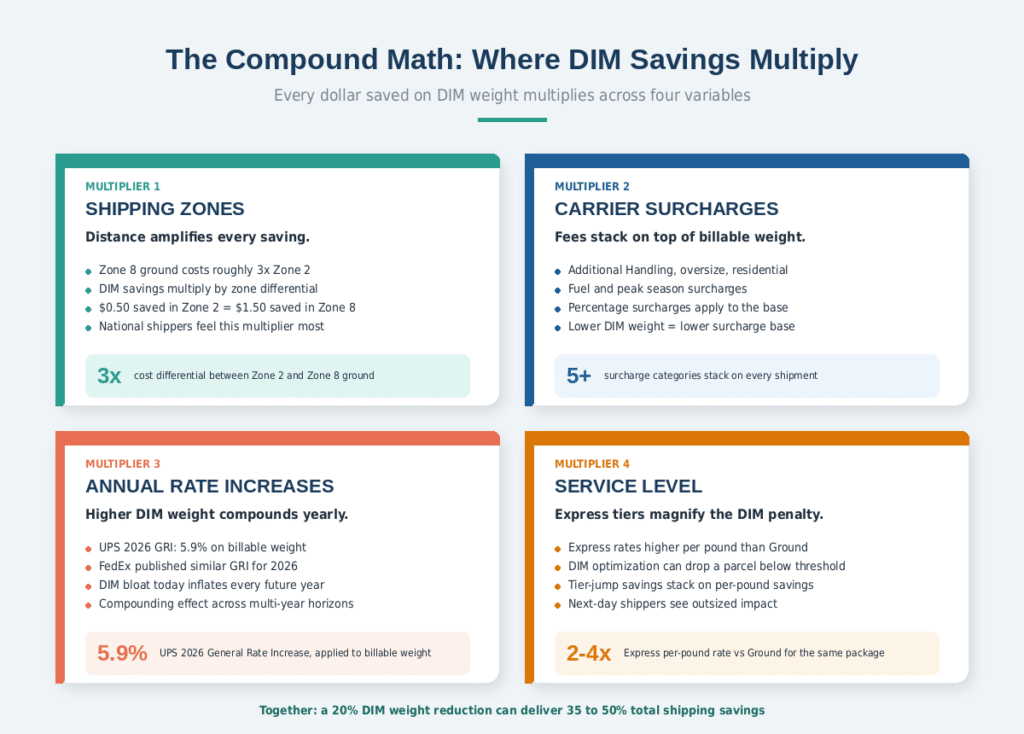
DIM weight does not exist in isolation. It multiplies through every other variable on a carrier invoice. This is where the real savings live and where most cost-reduction analyses go wrong. A 20% DIM weight reduction does not save 20% on shipping. It saves 20% across every multiplier that sits on top of billable weight.
Multiplier 1: Shipping Zones
A Zone 8 ground shipment (cross-country) costs roughly 3 times what the same package costs in Zone 2 (regional). DIM weight reduction multiplies into that zone differential on every shipment. A reduction that saves $0.50 on a Zone 2 package saves $1.50 on the same package shipped Zone 8. For brands shipping nationally, this multiplier alone changes the savings math significantly. The same pattern applies to last-mile delivery optimization, where zone-based pricing decisions interact directly with DIM-driven base rates.
Multiplier 2: Surcharges
Additional Handling, oversize, residential delivery, fuel surcharges, peak season surcharges, and dimension-based surcharges all stack on top of base rates calculated from billable weight. Some surcharges are flat dollars; others are percentage-based. Either way, reducing billable weight reduces the base on which the percentage surcharges apply.
Multiplier 3: Annual Rate Increases
UPS announced a 5.9% GRI for 2026. FedEx published a similar number. These increases apply to billable weight, which means a higher DIM weight today compounds into a more expensive shipment every year going forward. A package that bills at 6 pounds today bills at 6.35 pounds equivalent next year just from the rate increase, even if nothing about the package changes.
Multiplier 4: Service Level
Express services (next-day, two-day) charge a premium over ground for the same billable weight. DIM optimization that pushes a package below an Express tier threshold compounds the savings, because the per-pound Express rate is materially higher than the Ground rate. For brands offering same-day and next-day shipping, DIM optimization has outsized impact because the per-pound penalty for inefficient packaging is larger at the Express tier.
A Worked Example
A 1-pound product in an oversized 14 by 10 by 6 inch box ships at a DIM weight of 7 pounds (after rounding) on FedEx Ground.
The same product in a right-sized 9 by 6 by 3 inch box ships at a DIM weight of 2 pounds.
In Zone 2, the savings are roughly $2. In Zone 8 with Additional Handling triggered on the larger box, the savings can exceed $8 per shipment.
Across a thousand monthly shipments, the right-sized version saves $5,000 to $8,000 per month.
The implication is clear. DIM optimization is not a packaging exercise. It is a margin exercise. The optimization framework above attacks every multiplier in the cost equation. Brands that focus only on the base rate miss most of the savings.
How a 3PL Operationalizes DIM Optimization at Scale
A 3PL operationalizes DIM optimization by running the five-layer framework as part of its core fulfillment service. The framework is straightforward on paper. Executing it consistently, on every package, at every volume level, is where most in-house operations break down.
The in-house barriers are real. NTEP-certified dimensioners cost $5,000 to $25,000 per packing station. Cartonization software runs another $500 to $2,000 monthly. Staff training takes weeks. Integration with the order management system requires engineering time. Ongoing audit discipline requires dedicated headcount. The combined investment for an SMB usually exceeds the first year of expected savings, which is why most brands never get past Layer 3.
A 3PL amortizes the infrastructure across many clients. The dimensioner that costs $25,000 capitalizes across hundreds of brands. The cartonization software runs once and serves every order. The audit discipline is built into the operational playbook rather than depending on individual brand attention. The cost per package drops to a number that any ecommerce brand can absorb.
ShipBuddies operates the five-layer framework as part of its standard 3PL fulfillment service. The workflow runs out of a dedicated facility with trained packers, integrated dimensioning hardware, a documented box library, and cartonization logic that selects packaging on every order. Customers see consistent shipping costs across volume spikes, staffing changes, and product launches. The infrastructure does not depend on the brand’s bandwidth.
Volume aggregation produces an additional benefit at the carrier level. 3PLs ship at volumes that individual SMBs rarely reach, which often produces DIM divisors and surcharge waivers that an individual brand cannot negotiate alone. The Layer 5 benefit gets delivered automatically, without the brand having to initiate the conversation.
The financial case lines up with the operational case. The benefits of outsourcing fulfillment include predictable per-unit costs, access to specialized infrastructure, and no fixed labor overhead. For most brands between $1M and $50M in annual revenue, outsourced ecommerce fulfillment services deliver the framework faster and more reliably than building it in-house.
The strongest argument for the 3PL route is consistency. A DIM optimization program that runs cleanly on a quiet Tuesday but breaks during Black Friday is not actually saving money. ShipBuddies builds the consistency into the core service, which means the savings persist regardless of order volume.
Frequently Asked Questions
How does DIM weight affect shipping costs?
DIM weight (dimensional weight) sets the billable weight a carrier uses to charge for shipping. Carriers compare actual weight to DIM weight and charge based on the greater of the two. For most ecommerce packages (lightweight goods in standard boxes), DIM weight is the higher number, which means package dimensions drive the bill far more than product weight.
What is the DIM weight formula for 2026?
DIM weight equals length times width times height in inches, divided by the DIM divisor. UPS and FedEx use a divisor of 139 for domestic US shipments. USPS uses 166 for Priority Mail packages exceeding one cubic foot. DHL uses 139 (imperial) or 5,000 (metric). As of August 2025, both FedEx and UPS round each fractional dimension up to the next whole inch before applying the formula.
How can I reduce DIM weight charges?
Right-size your packaging so boxes match product dimensions. Standardize on 3 to 5 box sizes. Switch to polymailers for non-fragile soft goods. Audit packaging against products at the SKU level. Implement dimensioning at the packing station to eliminate carrier correction charges. For high volume, negotiate a higher DIM divisor with your carrier.
What changed with FedEx and UPS DIM weight rules in 2025?
On August 18, 2025, both FedEx and UPS began rounding up every fractional dimension to the next whole inch before applying the DIM formula. A box measuring 11.1 by 8.5 by 6.2 inches is now calculated as 12 by 9 by 7 inches, which increases cubic volume by roughly 25% and pushes billable weight up about 20%. The rule applies to all shipments and dramatically increases the importance of right-sizing.
Are polymailers cheaper than boxes for DIM weight?
Yes, for non-fragile products. Polymailers and padded flat envelopes conform to the contents rather than maintaining rigid dimensions, which often qualifies them for lower-cost envelope rates instead of parcel pricing. Apparel brands and document shippers can reduce shipping costs by 40 to 60% by switching from boxes to appropriately protective mailers.
How much can right-sizing packaging save on shipping?
Industry research shows right-sizing packaging reduces shipping spend by 20 to 30% on average. For lightweight products currently shipped in oversized boxes, the savings can reach 30 to 50% per package. The savings compound across shipping zones, surcharges, and annual General Rate Increases, so the total annual impact is usually larger than the per-package number suggests.
Do all carriers calculate DIM weight the same way?
No. The formula is the same (length times width times height divided by divisor), but the divisor varies. UPS and FedEx use 139 for US domestic. USPS uses 166 for Priority Mail above one cubic foot, and applies cubic pricing differently. DHL uses 139 for imperial measurements or 5,000 for metric. As of 2026, UPS, FedEx, and DHL Express all round fractional dimensions up before calculating.
Can a 3PL help reduce DIM weight charges?
Yes. A 3PL operationalizes the full DIM optimization framework (audit, dimensioning, box library, cartonization software, carrier negotiation) without the in-house build cost. 3PLs also aggregate shipping volume across clients, which often produces better carrier divisors than individual SMBs can negotiate alone. For most growing ecommerce brands, the 3PL route delivers the savings faster and more reliably than an in-house program.
The Bottom Line on DIM Weight Optimization
DIM weight optimization is one of the highest-impact cost-reduction projects available to ecommerce operators. The math is unambiguous. Every box that ships oversized inflates the billable weight, which inflates the zone-multiplied rate, which compounds against the annual GRI year over year. The August 2025 ceiling rounding rule made every old packaging strategy obsolete. The brands that adapted are now saving money. The brands that did not are paying for the rounding rule on every shipment.
The five-layer framework (Audit, Measure, Library, Automate, Negotiate) delivers 35 to 50% shipping cost reduction when implemented fully. Most growing ecommerce brands stop at Layer 3 because the infrastructure cost beyond that exceeds what an in-house team can justify. ShipBuddies runs the full framework as part of its core fulfillment service, which means brands access the operational system without building it.If your current shipping costs are growing faster than your order volume, the DIM weight equation is usually the cause. Contact ShipBuddies to discuss how outsourced fulfillment can protect your margins as you scale.