
Dietary supplement order fulfillment is the storage, picking, packing, and shipping of supplements by a third-party logistics provider, built around a catalog that arrives in six different physical formats and expires on a clock. A capsule bottle, a jar of gummies, a five-pound tub of powder, and a dropper bottle of liquid are four different handling problems, and every one of them carries a lot number, an expiration date, and a seal the customer will check before they swallow anything. ShipBuddies fulfills supplement brands with lot and expiration logging at receiving, first-expired-first-out picking, format-specific handling and packing, tamper-seal verification, subscription auto-ship, dimensional-weight rate-shopping on bulky formats, and 2-day options where they fit. ShipBuddies runs the fulfillment-side controls, and your brand owns DSHEA compliance, manufacturing, and label claims. This page covers what supplement fulfillment is, the challenges that set it apart, why brands outsource it, and how ShipBuddies runs the work.
Dietary supplement order fulfillment is a specialized form of order fulfillment for consumable products with a shelf life, a safety seal, and a physical format that changes from SKU to SKU. It covers single bottles, bundles and stacks, and recurring subscription shipments, and it adds the lot tracking, FEFO rotation, and seal discipline that supplements specifically need. Here is how the process works at ShipBuddies.
This process is built for supplements specifically. ShipBuddies applies its broader 3PL services to the category, and you can see the general version in our fulfillment process walkthrough.
It is worth being precise about where the line sits. Dietary supplements are regulated as food, and the brand carries the compliance weight: manufacturing standards, label claims, and everything that goes into what is inside the bottle. A fulfillment partner does not take that on and should not claim to. What a fulfillment partner owns is the part that happens after the product arrives: whether the lot was captured, whether the oldest stock ships first, whether the seal was intact when the box closed, and whether the right unit went to the right customer. Those controls are what this page is about.
Supplements look like simple products and fulfill like complicated ones. Six challenges define the work.
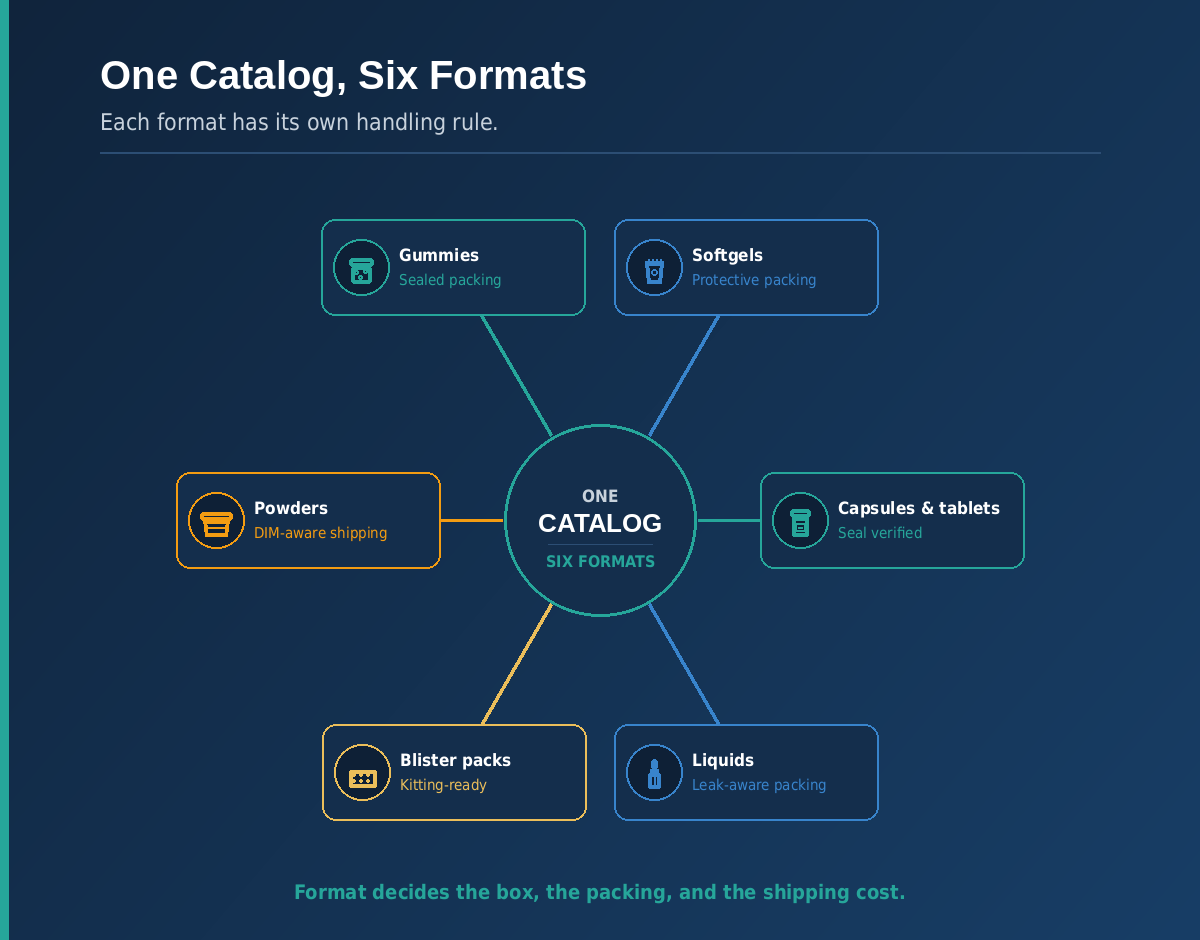
Most categories have one physical problem to solve. Supplements have six. A brand can ship a capsule bottle, a bag of softgels, a jar of gummies, a tub of pre-workout powder, a dropper bottle of tincture, and a strip of blister packs, all from the same catalog and sometimes in the same order. The table below maps the supplement product mix to its handling.
Format | Handling |
Capsules and tablets (bottles) | Lot and expiration logged, seal verified. |
Softgels | Lot and expiration logged, protective packing. |
Gummies (jars, pouches) | Lot and expiration logged, sealed packing. |
Powders (tubs, pouches) | Bulky, dimensional-weight shipping, seal verified. |
Liquids (tinctures, drops) | Leak-aware packing, protective handling. |
Blister packs and sachets | Protective packing, kitting-ready. |
A generalist operation treats all six as boxes with barcodes, and that works until the tub ships in an oversized carton and the tincture leaks into the gummies. Format is not a detail in this category. It determines the box, the packing, the shipping cost, and whether the order arrives intact. The same format-driven thinking carries into nutraceutical fulfillment, where functional foods and beverages add formats of their own.
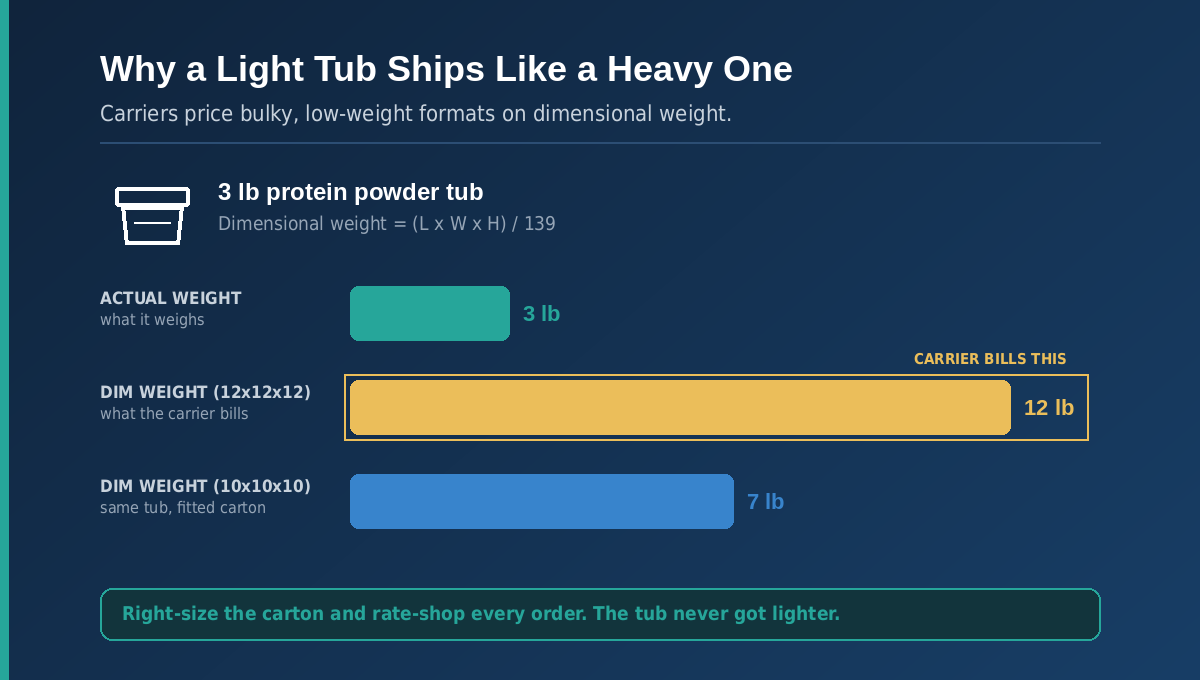
A tub of protein powder weighs a few pounds and takes up the space of something much heavier. Carriers price that space, not the weight, so a bulky tub in an oversized box is a shipment paying for air. Supplement brands with powder SKUs often discover their shipping line item is set by cubic inches they never thought about. discounted shipping rates come from right-sizing the box and rate-shopping every order, which is the single biggest cost lever in a category full of bulky, low-weight formats.
The math compounds on bundles. Two tubs and a shaker in one carton is a large box going a long way, and the difference between a fitted carton and a generic one shows up on every order, every month, for as long as the SKU sells. Getting the packaging right once pays continuously.
Supplements are consumables, and consumables carry dates. A unit that ships past its date is a refund, a complaint, and a customer who stops trusting the brand. The control is logging lot and batch numbers with expiration dates at receiving and picking first-expired-first-out, so the oldest stock moves before it ages out rather than sitting behind newer inventory.
The lot record does a second job that matters more. If a batch is ever in question, the brand needs to know which units went to which orders, and it needs to know quickly. That answer only exists if the lot was captured on the way in and carried through to the outbound order. A 3PL that tracks SKU counts but not lots cannot produce it, and by the time the question is asked, it is too late to start.
A supplement customer checks the seal before they open the bottle. That seal is the entire safety signal on a product someone is about to put in their body, and a unit that arrives with a broken or missing seal is not a minor packaging issue. It is a trust problem and a return, and it does not matter whether the seal failed at the manufacturer, in transit, or on the shelf.
The fulfillment-side control is verification: check the seal before the unit goes in the box, and pull anything compromised rather than shipping it and hoping. That check has to happen on every unit, not on a spot sample, because the one that gets through is the one that ends up in a photo.
One product line is never one SKU. A pre-workout comes in three flavors and two sizes. A capsule comes in 60-count and 120-count and a subscription-only 90-count. Add a men’s formula and a women’s formula and the catalog multiplies fast, and the resulting SKUs sit next to each other looking nearly identical, differing by a number on the label.
That similarity is where picking errors live. The difference between a 60-count and a 120-count is invisible at arm’s length and obvious to the customer who paid for the larger one. Barcode verification at the pick, rather than matching by label art, is what keeps count and flavor variants straight at volume.
Supplements sell on regimens. A customer taking a daily capsule expects the next bottle before the current one runs out, and a subscription that ships late does not just annoy them, it interrupts the routine the product depends on. That is how supplement subscriptions churn: not from a bad product, but from a box that showed up a week late.
Operationally, that means recurring cycles that batch predictably and ship on schedule, every cycle, without drift. The volume is knowable in advance, which is an advantage, but only if the operation actually plans against it rather than treating each cycle as a surprise.
Outsourcing supplement fulfillment hands the date discipline, the format handling, and the recurring cycles to a team that runs them daily. Five reasons drive the decision.
A specialized 3PL logs lot and batch numbers with expiration dates at receiving and picks first-expired-first-out, so older stock ships before it ages out and every unit traces back to its batch. The result is fewer expired-product incidents and a traceable record if a batch is ever questioned. Running this in-house means someone owns date discipline on every receiving day, and that is the task that slips first when the team is busy.
A specialized 3PL packs a tub differently than a tincture and a gummy jar differently than a blister pack, because each format fails in its own way. The result is orders that arrive intact across a mixed catalog, and a packing standard that holds on the ten-thousandth order rather than degrading as volume grows.
This is the knowledge that is expensive to build and easy to lose. An in-house team learns it one damaged shipment at a time, and then it lives in the head of whoever has been packing longest. A partner that runs supplement formats every day already has it, and it is written into the process rather than carried by one person.
A specialized 3PL right-sizes the carton and rate-shops every order with dimensional weight in mind, which is where the money is in a category built on tubs and pouches. The result is shipping cost that tracks the product rather than the empty space around it, on every order for the life of the SKU.
A specialized 3PL batches recurring cycles and ships them on schedule so subscribers get their refill before they run out. The result is the retention the subscription model was built for, protected by the one variable the brand can actually control.
The compounding matters here. A subscriber who receives twelve boxes on time is a year of revenue from one acquisition, and the cost of winning them back after two late shipments is far higher than the cost of shipping on time in the first place. Auto-ship reliability is a retention lever disguised as a logistics detail.
Supplement brands sell everywhere at once, and wholesale adds its own exposure: a retailer chargeback for a mislabeled or short shipment costs more than the order was worth. A 3PL with sales channel integrations runs DTC, Amazon with FBA prep, TikTok Shop, subscription apps, and wholesale from one inventory pool with real-time sync, so a viral SKU does not oversell across channels.
Here is what supplement fulfillment looks like at ShipBuddies, broken down by capability.
ShipBuddies connects to Shopify, WooCommerce, BigCommerce, Amazon with FBA prep, Walmart Marketplace, and TikTok Shop, works with subscription apps for recurring orders, and processes wholesale orders to retailers. Orders sync in real time from a single inventory pool, so a subscription refill and a wholesale pallet draw from the same accurate, lot-tracked stock.
Product is received with its lot or batch number and expiration date recorded, slotted according to its format, and rotated first-expired-first-out so the closest-to-expiration units ship first. Count and flavor variants are verified by barcode at the pick rather than by label. This is fulfillment-side tracking that supports batch traceability. Your brand owns DSHEA compliance, manufacturing, and label claims.
Seals are checked before units are packed, and anything compromised is pulled rather than shipped. ShipBuddies assembles bundles, stacks, sample packs, and subscription boxes per bill-of-materials with components pre-allocated so a kit does not stock out mid-assembly, and runs recurring auto-ship cycles on schedule. The same lot and expiration discipline runs across vitamin fulfillment.
Every order is rate-shopped with dimensional weight in mind and packed in a carton sized to the product, which matters most on tubs and bundles. Structured reverse logistics grades returns against the lot that shipped, restocks only sealed, in-date units, and pulls everything else, so nothing questionable goes back out to the next customer.
Yes. ShipBuddies logs lot and batch numbers with expiration dates at receiving and picks first-expired-first-out, so older stock ships first and every unit traces back to its batch. This is fulfillment-side tracking. Your brand owns DSHEA compliance, manufacturing, and label claims.
Yes, and each one is handled according to its format. Bottles and jars are packed protectively, powders ship in cartons sized to the tub, liquids are packed leak-aware, and blister packs and sachets are packed and kitted. A mixed order gets one box that protects all of it.
Tubs are light and bulky, so carriers price them on dimensional weight rather than actual weight. ShipBuddies right-sizes the carton and rate-shops every order with DIM weight in mind, which is the biggest cost lever on bulky supplement formats.
Yes. Seals are verified before units are packed, and anything with a broken or missing seal is pulled rather than shipped. The seal is the safety signal a supplement customer checks first, so it gets checked before the box closes.
Yes. ShipBuddies works with subscription apps and batches recurring cycles so refills ship on schedule, before subscribers run out. Bundles and subscription boxes are assembled per a defined bill-of-materials with components pre-allocated.
Returns are graded against the lot that shipped. Only sealed, in-date units are restocked, and anything opened, unsealed, or expired is pulled and handled per your policy, so nothing questionable reaches the next customer.
ShipBuddies gives supplement brands lot and expiration tracking with FEFO rotation, format-specific handling across capsules, gummies, powders, and liquids, tamper-seal verification, subscription auto-ship, and dimensional-weight cost control on bulky formats. Get a free quote and tell us about your formats, your subscription volume, and the channels you sell on.