
Baby products order fulfillment is the storage, picking, packing, and shipping of baby and infant products by a third-party logistics provider, across a catalog that spans three handling classes: dated consumables like formula and wipes, bulky gear like strollers and cribs, and small goods like clothing and toys.
Each class needs its own discipline, and baby products carry an added requirement. Because the category is recall-prone, every unit has to trace back to the orders it shipped in.
ShipBuddies handles baby products with lot tracking, expiration-date control and FEFO picking on consumables, recall-ready traceability, careful handling of fragile and bulky items, and 2-day shipping options. ShipBuddies runs the fulfillment-side controls.
Baby products order fulfillment is a specialized form of order fulfillment for a mixed-class catalog. It covers dated consumables, bulky gear, and small goods in one operation, and it adds the lot tracking and expiration control that a recall-prone category demands.
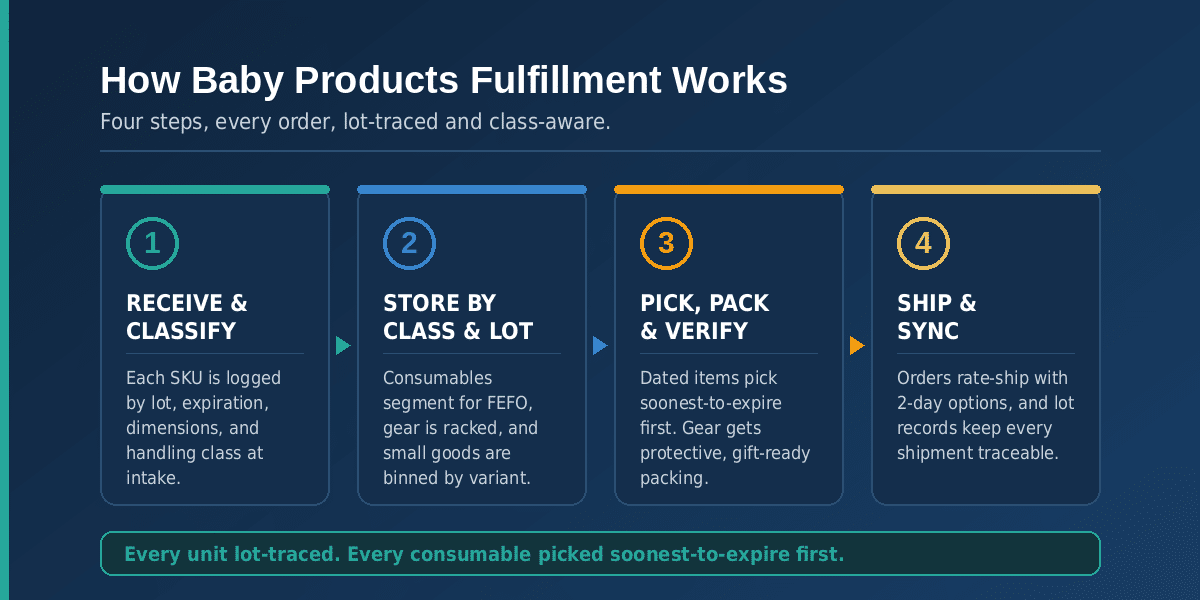
Here is how the process works at ShipBuddies.
This process is built for the baby catalog specifically. ShipBuddies applies its broader outsourced fulfillment to the category, and you can see the general version in our order fulfillment workflow walkthrough.
Baby products are harder to fulfill than most categories.
Six challenges affect almost every baby brand.
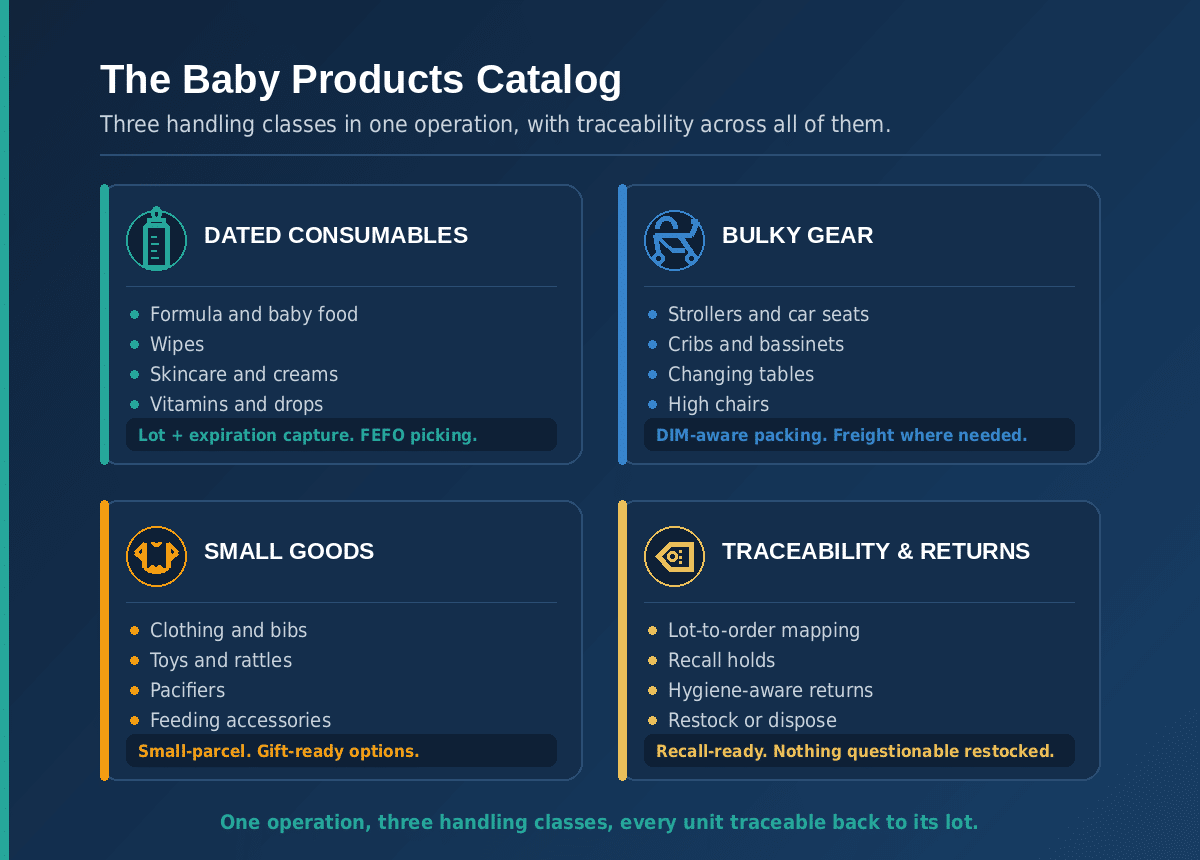
A baby catalog is really three catalogs in one. Each handling class ships and stores differently, and a workflow built for one class fails the others. The table below maps the three classes to their handling.
Class | Examples | Handling |
Dated consumables | Formula, baby food, wipes, skincare | Lot and expiration capture, FEFO picking, handled per product requirements. |
Bulky gear | Strollers, cribs, car seats, changing tables | Dimensional-weight-aware packing, freight where needed, protective handling. |
Small goods | Clothing, toys, pacifiers, feeding accessories | Small-parcel picking, gift-ready options, hygiene-aware returns. |
Formula, baby food, wipes, and skincare all expire, so they cannot ship in arrival order. First Expired, First Out picking sends the soonest-to-expire lot first, which keeps customers in fresh product and reduces the stock written off to expiration. The same expiration discipline runs across health care products fulfillment, where dated consumer goods need identical rotation.
Baby products get recalled more often than most categories, and a recall is only as fast as the records behind it. When a lot is affected, a brand has to know exactly which orders shipped with it. Lot-to-order traceability makes that immediate, and it lets the warehouse hold the rest of the affected lot before it ships, so a recall stays a targeted pull rather than a guess.
Strollers, cribs, and car seats are large, so they cube out and bill on dimensional weight, and some ship best by freight rather than parcel. Right-sized packaging and the right carrier choice keep these shipments from costing more than they should while still protecting the product.
A returned baby item cannot be blindly restocked. Feeding gear, pacifiers, and opened consumables need inspection against defined rules before anything re-enters sellable inventory, and some units have to be disposed of rather than restocked. Structured returns and reverse logistics applies those rules consistently and keeps inventory counts accurate.
Baby demand is seasonal in its own way. Spring registry season, holiday gifting, and back-to-school all drive spikes, and subscription staples like diapers and wipes add steady recurring volume on top. A fulfillment operation has to absorb both the spikes and the steady base without slipping.
Outsourcing baby products fulfillment hands a mixed-class catalog, expiration control, and recall traceability to a team that runs them daily. Five reasons drive the decision.
A specialized 3PL runs dated consumables, bulky gear, and small goods from one operation, with the storage and packing discipline each class needs. The result is a single partner for the whole catalog instead of separate solutions for each product type.
A specialized 3PL captures expiration dates at receiving and picks FEFO, so formula, food, and wipes ship fresh and aging stock gets flagged before it expires. The result is fewer short-dated shipments and less write-off.
A specialized 3PL lot-tracks from receiving, so an affected lot maps to the exact orders that carried it and the rest of that lot can be held immediately. The result is a recall that protects the brand and its customers fast, with records that hold up to scrutiny.
A specialized 3PL right-sizes packaging for strollers and cribs and picks the carrier that handles the dimensions best, with shipping optimization rate-shopping parcel and freight. The result is bulky shipments that cost what they should and arrive protected.
Baby brands sell across a DTC store, Amazon, marketplaces, and retail accounts like Target and Walmart. A 3PL with sales channel integrations unifies those orders in one inventory pool with real-time sync that prevents overselling across channels.
Here is what baby products fulfillment looks like at ShipBuddies, broken down by capability.
ShipBuddies connects to Shopify, WooCommerce, BigCommerce, Amazon, Walmart Marketplace, and TikTok Shop, and handles wholesale and EDI retailer purchase orders. Orders sync in real time from a single inventory pool, so DTC and retail draw from the same accurate stock.
Dated consumables are stored with lot numbers and expiration dates captured at receiving and segmented for FEFO. Bulky gear is racked for protected access, and small goods are binned by variant. Temperature-sensitive items are handled per the product’s stated requirements.
Every unit traces back to its lot and the orders it shipped in, so an affected lot can be mapped and held quickly. Returned baby items run through hygiene-aware inspection against defined rules, and units are restocked or disposed accordingly so nothing questionable re-enters sellable inventory.
Fragile and bulky items get protective packing sized to the product, and registry and shower orders can ship gift-ready. The same careful handling runs across pet supplies fulfillment, where mixed consumables and accessories need the same discipline.
Baby products order fulfillment is the storage, picking, packing, and shipping of baby and infant products by a 3PL, across dated consumables, bulky gear, and small goods. It adds lot tracking and expiration control to a standard fulfillment process so the catalog stays accurate and traceable.
ShipBuddies captures lot numbers and expiration dates at receiving and picks FEFO, so the soonest-to-expire lot ships first. Temperature-sensitive items are handled per the product’s stated requirements.
Because every unit is lot-tracked from receiving, ShipBuddies can map an affected lot to the exact orders that shipped with it and hold the rest of that lot before it ships. That keeps a recall a targeted pull with records that trace cleanly.
Bulky gear is packed in right-sized boxes to manage dimensional weight, and orders ship by the carrier or freight option that handles the size best while protecting the product.
Returns run through a hygiene-aware workflow. Each item is inspected against defined rules, and resalable units are restocked to the correct bin while questionable units are disposed of, so inventory stays accurate and clean.
Yes. ShipBuddies handles diaper and wipe subscriptions from the same inventory pool as one-time orders, and the operation absorbs registry-season and holiday spikes without slipping on the steady subscription base.
ShipBuddies gives baby brands one operation for a mixed-class catalog, with lot tracking, expiration control and FEFO on consumables, recall-ready traceability, hygiene-aware returns, and careful, gift-ready packing. Get a free quote and tell us about your catalog, your consumables, and the channels you sell on.