

The evaluation criteria, discovery questions, pricing structures, and red flags to check before you sign.
Choosing the right 3PL partner is one of the most consequential operational decisions an ecommerce brand makes, and most brands get it wrong at least once. According to GoBolt’s 2025 State of Logistics Report, which surveyed 263 brands across North America, 59% of companies have changed 3PL providers multiple times due to ongoing delivery issues. The wrong partner costs more than the quoted rate: brands routinely lose 15 to 25% of their fulfillment budget to hidden fees, shipping errors, and customer service overhead from preventable mistakes.
Choosing the right 3PL partner starts with documenting your own requirements: order volume, sales channels, product type, and growth plans. Then evaluate providers against criteria that matter: integrations, accuracy rates, pricing transparency, scalability, and service model. The right partner matches your requirements rather than selling a generic package.
This guide gives you the toolkit for that evaluation: the criteria worth scoring, the questions to ask on the discovery call, the pricing structures to understand, the red flags that predict a bad partnership, and an honest look at the warehouse-model question most providers dodge.
If you are earlier in the journey and still mapping the basics, start with our guide on what is a 3PL provider and come back. For everyone actively comparing 3PL fulfillment options, here is how to run the evaluation.
Start With Your Requirements, Not Their Sales Deck
Most brands run the 3PL evaluation backward. They collect quotes, sit through demos, and compare feature lists before they have written down what they actually need. The result is a decision driven by whichever provider presented best rather than whichever provider fits.
Flip the order. Before the first discovery call, document your requirements. A provider that is perfect for one brand is wrong for another, because fit is relative to requirements, not absolute.
The Requirements Checklist
- Monthly order volume, current and projected 12 months out
- Sales channels: Shopify, Amazon, TikTok Shop, WooCommerce, wholesale, or a mix
- Product type and handling needs: fragile, oversized, high-value, regulated
- SKU count and how often it changes
- Peak-season patterns: holiday concentration, promotion-driven spikes, viral exposure risk
- Special workflows: kitting, subscription cycles, B2B retailer compliance, branded packaging
- Geographic concentration of your customers
Then separate the list into non-negotiables and preferences. Non-negotiables are the capabilities without which a provider cannot serve you at all: if 70% of your revenue runs through TikTok Shop, native TikTok integration is a non-negotiable, and any provider without it is ruled out before pricing ever comes up. Identifying must-haves first saves weeks of evaluating providers who were never viable.
If you are still weighing whether to outsource at all, our breakdown of the benefits of outsourcing fulfillment covers the volume thresholds and time-cost signals that indicate a brand is ready. The common benchmark: outsourcing starts making sense at roughly 100+ orders per month, or when fulfillment consumes more than 25% of your time.
The Evaluation Criteria That Actually Matter
Once your requirements are documented, score each provider against the six criteria below. The scorecard table summarizes them; the subsections explain what good looks like.
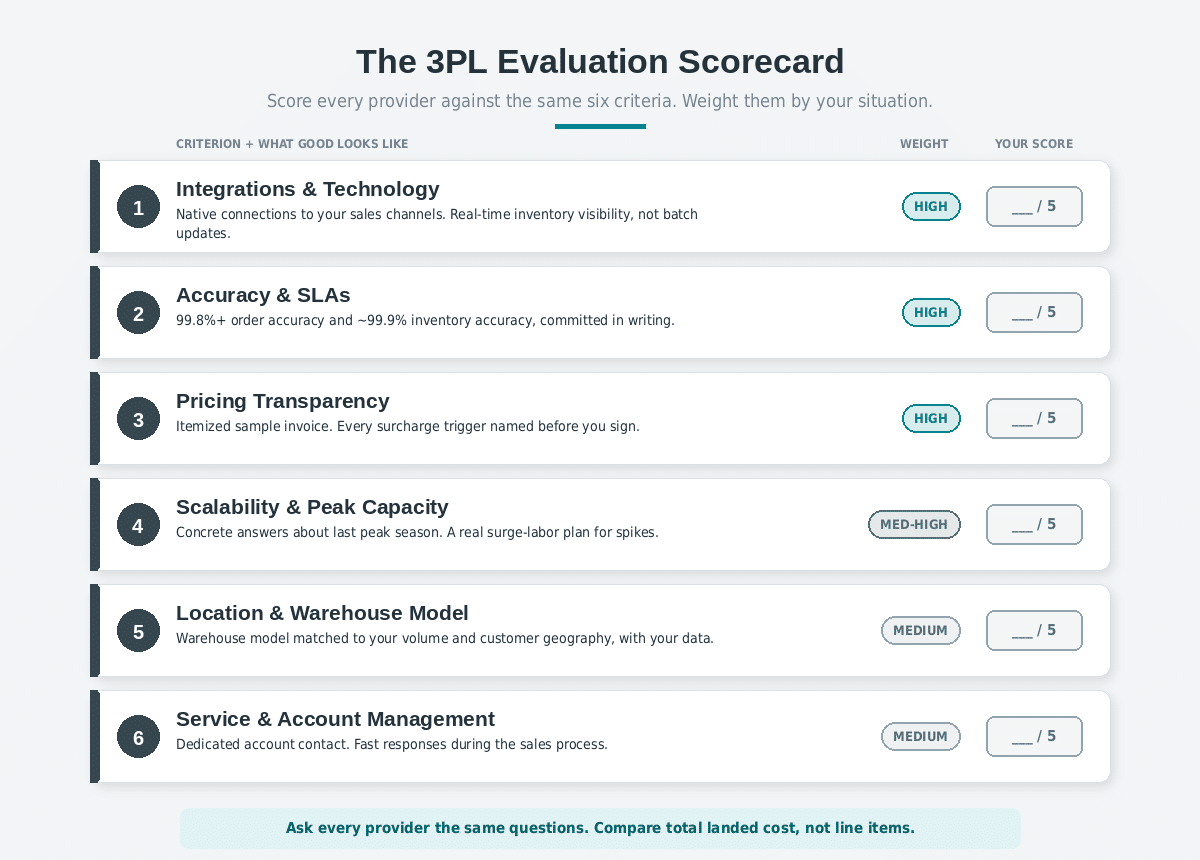
Weight the criteria by your situation: a brand selling on four channels weights integrations higher than a single-channel brand; a brand with heavy Q4 concentration weights peak capacity higher than one with flat demand.
| Criterion | Why It Matters | Weight | What Good Looks Like |
|---|---|---|---|
| Integrations & Technology | Bad integration creates manual work and sync errors | High | Native connection to your channels; real-time inventory visibility |
| Accuracy & SLAs | Errors cost refunds, reviews, and customers | High | 99.8%+ order accuracy, ~99.9% inventory accuracy, in writing |
| Pricing Transparency | Hidden fees erase headline savings | High | Itemized sample invoice; every surcharge trigger named |
| Scalability & Peak Capacity | Growth or a viral spike breaks weak operations | Medium-High | Concrete answers about last peak season; surge labor plan |
| Location & Warehouse Model | Affects transit times and zone-based cost | Medium | Model matched to your volume and customer geography |
| Service & Account Management | Determines how problems get resolved | Medium | Dedicated contact; fast responses during the sales process |
Integrations and Technology
At minimum, the provider should integrate natively with your primary sales platform and every marketplace you sell on. Native means orders flow automatically, tracking pushes back without manual entry, and inventory stays synchronized in real time. Real-time inventory sync is the difference between confident multi-channel selling and overselling stock you no longer have. Ask to see the client dashboard before signing. A provider proud of its technology shows it; a provider hiding a spreadsheet-based operation stalls.
Accuracy and SLAs
A promise of industry-leading service means nothing without numbers. Strong providers publish order accuracy of 99.8% or better and inventory accuracy near 99.9%, with defined same-day-dispatch cutoffs and returns-processing times. Get these commitments in the service level agreement. A provider that refuses to quantify accuracy gives you no baseline for accountability after you sign, and the refusal itself tells you what the real numbers look like.
Pricing Transparency
The provider should itemize receiving, storage, pick and pack, and shipping as separate line items on a sample invoice. Vague all-in numbers hide variability that surfaces after you sign. Pricing structures and the hidden-fee patterns to watch for get full treatment later in this guide.
Scalability and Peak Capacity
Ask how the provider handled last Black Friday: order volumes, ship-time performance, what broke and what they changed. Specific answers signal real operational maturity. Then ask the forward question: what happens if my volume triples in a quarter? A provider built for growth has a concrete answer involving surge labor, space flexibility, and onboarding bandwidth. A provider that waves the question off will be the bottleneck in your best month.
Location and Warehouse Model
Warehouse location affects transit time to your customers and zone-based shipping cost. But the more strategic question is the warehouse model itself: one facility or several, and which fits your volume and geography. That tradeoff deserves an honest treatment, which it gets in its own section below.
Service and Account Management
Find out whether you get a dedicated account contact or a ticket queue. Then watch how the provider treats you during the sales process, because that is the best service you will ever receive from them. Slow responses to a prospect predict slower responses to a client. The providers that treat order fulfillment as a service business rather than a warehousing business show it from the first email. One more matching consideration: if your business model has specialized workflows (subscription kitting, B2B retailer compliance, marketplace SLAs), evaluate whether the provider runs industry-specific fulfillment playbooks for your model or applies one generic process to every client.
The Questions to Ask on the Discovery Call
The discovery call reveals how a provider operates. The questions below separate serious operators from order-takers. Copy them into your notes and ask every provider the same set, so the answers are comparable.
Operations
- What is your published order accuracy rate, and is it in the SLA?
- What is your on-time ship rate over the last 12 months?
- What is your same-day cutoff time, and what happens to orders that miss it?
Technology
- Which platforms do you integrate with natively, without third-party middleware?
- Is inventory visibility real-time or batch-updated?
- Can I see the client dashboard before signing?
Pricing
- Can you walk me through an itemized sample invoice for an account like mine?
- What triggers a surcharge, and how much is each one?
- Are there volume minimums, setup fees, or long-term commitments?
Scale
- How did you handle last peak season? What broke, and what did you change?
- What happens if my volume triples in a quarter?
Service
- Will I have a dedicated account manager, and how senior?
- What is your average response time to a client issue?
References
- Can you connect me with a current client in my industry or at my volume tier?
The Tell
Pay attention to which direction the questions flow. A serious 3PL asks about your SKUs, your order profile, your packaging needs, and your customer geography before quoting a price, because the price depends on those answers.
A provider that jumps straight to pricing without understanding your operation is quoting a generic rate that will not survive contact with your actual business. That pattern is the single most reliable early signal, and it leads directly into the red flags covered below.
Understanding 3PL Pricing and Spotting Hidden Fees
3PL pricing varies more than almost any other business service, and the headline per-order number is rarely the number you end up paying. Total cost per order commonly ranges from $5 to over $20 depending on product size, order complexity, shipping distance, and volume (Simpl Fulfillment). Returns processing typically adds $3 to $5 per item. The structure matters as much as the rate.
The Four Pricing Models
| Pricing Model | How It Works | Best For | Watch Out For |
|---|---|---|---|
| Itemized | Separate fees for receiving, storage, pick/pack, shipping | Brands that want full cost visibility | Per-line surcharges that stack on complex orders |
| Flat-rate per order | One fee per order regardless of contents | Uniform products and predictable order profiles | Exclusions hidden in the fine print |
| All-inclusive | Bundled monthly price covering most services | Brands that value billing simplicity | Paying for services you do not use |
| Hybrid | Base rate plus itemized extras | Growing brands with mixed needs | The ‘extras’ column growing every quarter |
The Hidden Fee Patterns
The fees that surprise brands after signing follow predictable patterns: per-SKU receiving minimums, long-term storage penalties that activate after 90 or 180 days, charges for special projects like relabeling or quality checks, account management fees, and integration setup fees that appear only on the first invoice. None of these are illegitimate. All of them belong in the quote, not the third month’s invoice.
The defense is the total landed cost comparison. Providers shift costs between line items, so a low pick fee often hides a high storage rate and vice versa. Model your actual order profile (your SKU count, your order mix, your storage footprint) through each provider’s full fee schedule and compare the total cost per order. Our breakdown of the hidden costs of fulfillment walks through each fee category in detail with typical ranges.
Red Flags That Predict a Bad Partnership
Certain warning signs during evaluation reliably predict problems after signing. Brands that switched providers almost always report the signals were visible during the sales process and got rationalized away.
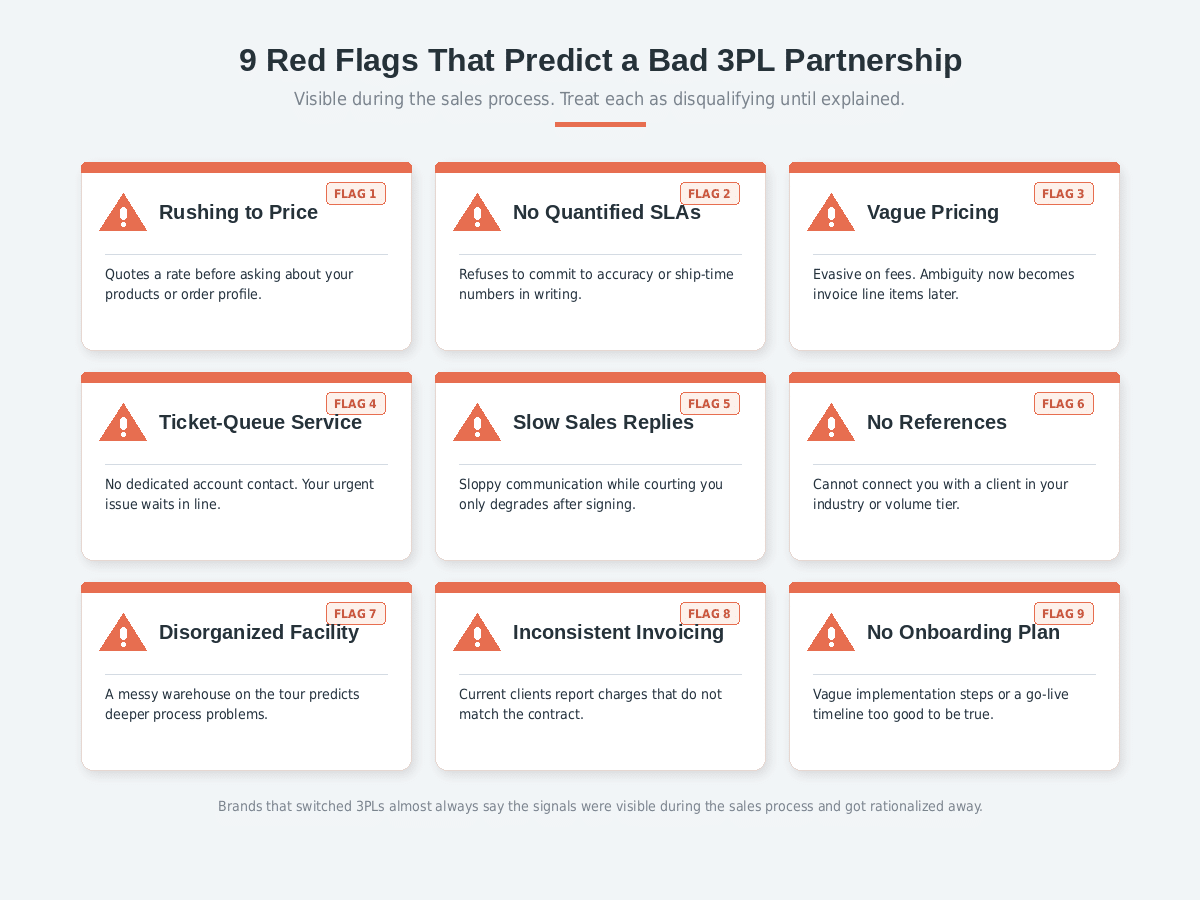
Treat each of these as disqualifying until the provider explains it convincingly.
- Rushing to a price quote without asking about your products or order profile. The quote cannot be accurate, and the provider does not care that it cannot.
- Refusing to quantify accuracy, ship time, or other SLA metrics. No numbers means no accountability.
- Vague or evasive answers on pricing and fees. Ambiguity in the sales process becomes line items on the invoice.
- No dedicated account contact, only a ticket queue. Your urgent problem becomes ticket #4,371.
- Slow or sloppy communication while they are trying to win your business. It only degrades after they have it.
- Unwillingness to provide references in your industry or volume tier. Happy clients are easy to produce; their absence says something.
- A disorganized facility on a site visit or virtual tour. A dirty warehouse predicts deeper process problems.
- Inconsistent invoicing reported by current clients, where charges do not match the contract.
- No clear onboarding plan, or a go-live timeline that sounds too good. Implementation chaos follows.
One more structural consideration before signing anything: confirm a 3PL is actually the right model for your stage. Some brands evaluating providers discover they are better served keeping fulfillment in-house for another year; others have outgrown standard 3PL service and need more strategic management. Our comparison of 3PL vs 4PL vs in-house fulfillment maps the tradeoffs by business stage.
Single-Warehouse vs Multi-Warehouse: Which Is Right for You
Here is the question most 3PL marketing avoids answering honestly: do you actually need multiple warehouses? The industry default says more nodes equal faster shipping and lower zone costs. The truth is more conditional, and the right answer depends on your volume and your customer geography, not on what the provider happens to sell.
When Multi-Warehouse Helps
Multi-warehouse fulfillment earns its complexity at high volume with geographically dispersed customers. If you ship tens of thousands of orders monthly, your customers spread coast to coast, and 2-day ground delivery nationwide is a competitive requirement, splitting inventory across nodes reduces average shipping zones and can cut transit times meaningfully. The zone savings at that scale outweigh the overhead.
When Single-Warehouse Is the Better Choice
For most small and mid-size brands, the math runs the other way. Splitting inventory across multiple nodes ties up more capital in safety stock, multiplies the risk of stockouts at individual locations, and doubles or triples the operational surface area where errors happen. Every additional facility is another team, another process variance, another place where your branded packaging gets applied slightly differently.
A single-warehouse operation offers what those brands actually need: operational consistency, simpler inventory management, one set of trained staff following one documented process, and lower error rates. The cost is a shipping zone or two on your most distant orders. For a brand shipping 2,000 orders a month, the consistency is usually worth far more than the zone.
The Honest Test
Before assuming multi-warehouse saves money, ask any provider proposing it to model your actual shipping costs both ways, using your real order data and customer ZIP codes. Include the cost of carrying split safety stock in the comparison. Brands that run this math are frequently surprised by how small the multi-node advantage is at their volume, and how much of the projected savings depended on assumptions about order distribution that do not match their reality.
How ShipBuddies Fits
Fair is fair: here is ShipBuddies scored against this guide’s own framework.
ShipBuddies is a single-warehouse 3PL. By the logic above, that makes it a strong fit for small and mid-size ecommerce brands that value operational consistency, and the wrong fit for brands that genuinely need coast-to-coast multi-node 2-day ground coverage. If you are in the second group, you need a different model, and no sales conversation changes that.
For the brands in the first group, the framework maps like this. Integrations: native connections to Shopify, Amazon, TikTok Shop, WooCommerce, and BigCommerce, with real-time inventory sync. Accuracy: published standards with defined same-day cutoffs, in writing. Pricing: itemized invoices with every fee category named upfront, no surprise line items in month three. Scalability: documented surge protocols for peak season and viral spikes. Service: a dedicated account contact who answers, not a ticket queue.
Every order ships from one disciplined facility, with one team trained on documented procedures, applying your branded packaging the same way every time. That operational consistency is the product. Brands evaluating ecommerce fulfillment services are encouraged to bring this guide’s discovery questions to the conversation. A provider that built its operation properly welcomes the scrutiny.
Frequently Asked Questions
How do you choose the right 3PL partner?
Start by documenting your own requirements: order volume, sales channels, product type, and growth plans. Then evaluate providers against criteria that matter: integrations, accuracy rates, pricing transparency, scalability, and service model. Ask specific discovery questions, request references, and watch for red flags. The right partner matches your requirements rather than selling a generic package.
What should you look for in a 3PL provider?
Look for native integration with your sales channels, a real-time inventory system, published accuracy and ship-time standards, transparent itemized pricing, proven ability to handle your volume and seasonal peaks, and a dedicated account contact. The best provider for you is the one whose capabilities match your specific operational requirements, not the one with the longest feature list.
What questions should I ask a 3PL before signing?
Ask for their published order accuracy rate, their same-day ship cutoff, which platforms they integrate with natively, an itemized sample invoice, how they handled last peak season, whether you get a dedicated account manager, and for references in your industry or volume tier. A serious provider answers all of these specifically.
What are red flags when choosing a 3PL?
Major red flags include rushing to a price quote without asking about your products, refusing to quantify accuracy or ship-time metrics, vague answers on fees, no dedicated account contact, slow communication during the sales process, unwillingness to provide references, and a disorganized facility on a site visit. Each predicts problems after you sign.
How much should a 3PL cost?
Total cost per order commonly ranges from $5 to over $20 depending on product size, order complexity, shipping distance, and volume. Returns processing commonly runs $3 to $5 per item. The important number is total landed cost per order, not individual line items, because providers shift costs between receiving, storage, pick/pack, and shipping.
Is a single-warehouse or multi-warehouse 3PL better?
It depends on your situation. Multi-warehouse helps high-volume brands with geographically dispersed customers who need coast-to-coast 2-day ground coverage. Single-warehouse is the better choice for most small and mid-size brands, where operational consistency, simpler inventory management, and lower error rates matter more than shaving a shipping zone. Ask a provider to model your actual costs both ways.
How long does it take to onboard with a 3PL?
Onboarding typically takes 2 to 6 weeks depending on SKU count, integration complexity, and inventory transfer logistics. A provider should give you a clear onboarding plan with milestones before you sign. An unrealistic go-live timeline or a vague onboarding process is a warning sign that implementation will be rocky.
What accuracy rate should a good 3PL guarantee?
A strong 3PL publishes an order accuracy rate of 99.8% or better and an inventory accuracy rate near 99.9%. These are measurable commitments, not marketing language. If a provider will not quantify accuracy in a service level agreement, you have no baseline to hold them accountable to after you sign.
Vet Hard Now or Switch Painfully Later
The 59% of brands that have switched 3PLs multiple times did not plan to. They picked the best presentation, the lowest headline rate, or the provider a friend recommended, and discovered the gaps after migration. The cost of thorough vetting is measured in weeks. The cost of a wrong choice is measured in lost inventory, missed peak seasons, angry customers, and a second migration.
The toolkit is straightforward. Document your requirements before the first call. Score every provider against the same weighted criteria. Ask the same discovery questions and compare the answers. Model total landed cost, not line items. Treat the red flags as disqualifying. And demand an honest answer on the warehouse-model question, with your real shipping data behind it.
ShipBuddies welcomes exactly this kind of evaluation. Bring the questions from this guide, ask for the itemized invoice and the accuracy numbers, and see how the answers compare. Contact ShipBuddies to start the conversation.