
Yoga equipment order fulfillment is the storage, picking, packing, and shipping of yoga products by a third-party logistics provider, built around the realities that make the category different: bulky but light items, material-sensitive mats, high variant counts, and starter-kit bundles.
The defining cost problem is dimensional weight. A rolled yoga mat weighs little but fills real space in a box, so carriers bill it on size rather than weight, and its length can trigger large-package surcharges on top.
ShipBuddies handles yoga equipment with dimensional-weight control on every bulky item, rolled-mat storage that prevents creasing, material-aware handling, starter-kit assembly, and rate-shopped shipping with 2-day options.
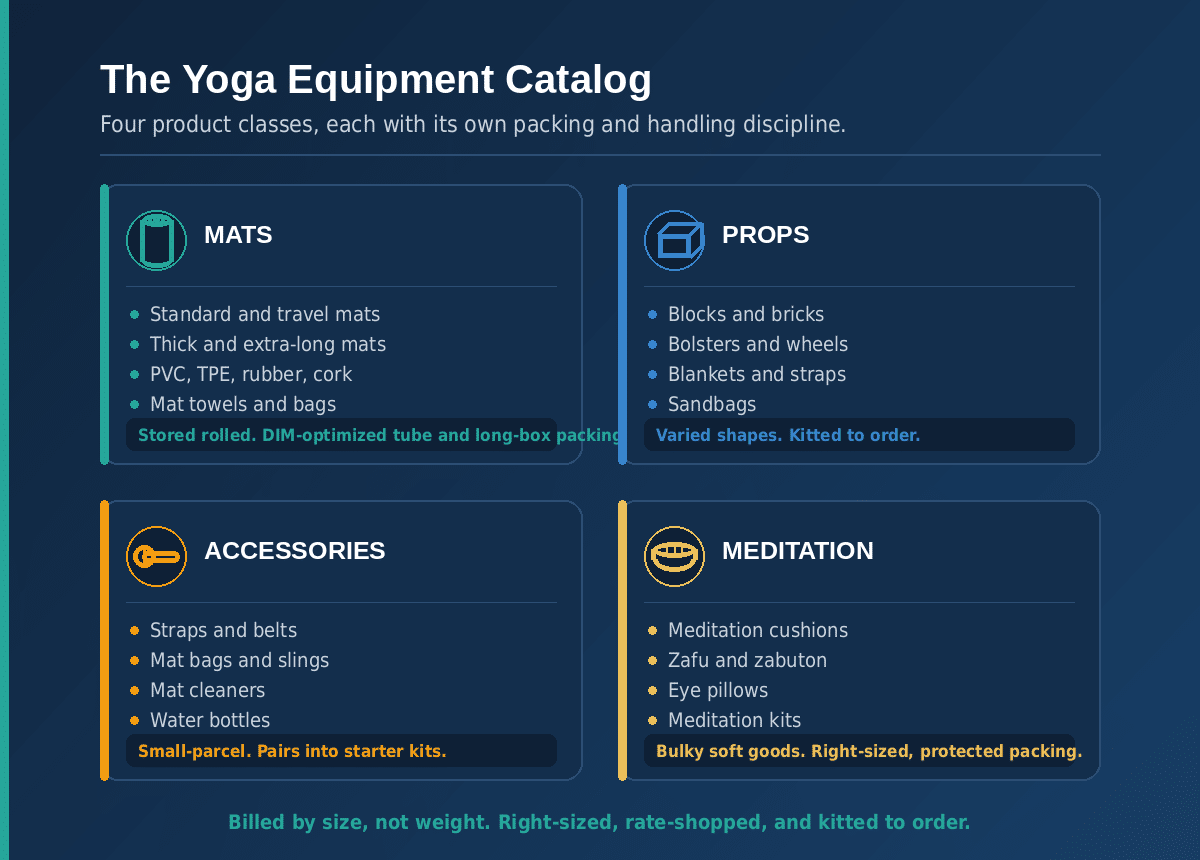
Yoga equipment order fulfillment is a specialized form of order fulfillment for products that are light, bulky, and material-varied. It covers mats, blocks, straps, bolsters, wheels, blankets, meditation cushions, towels, and mat bags, and it accounts for the dimensional-weight costs, crease-sensitive mats, and variant counts that a general warehouse is not built to handle.
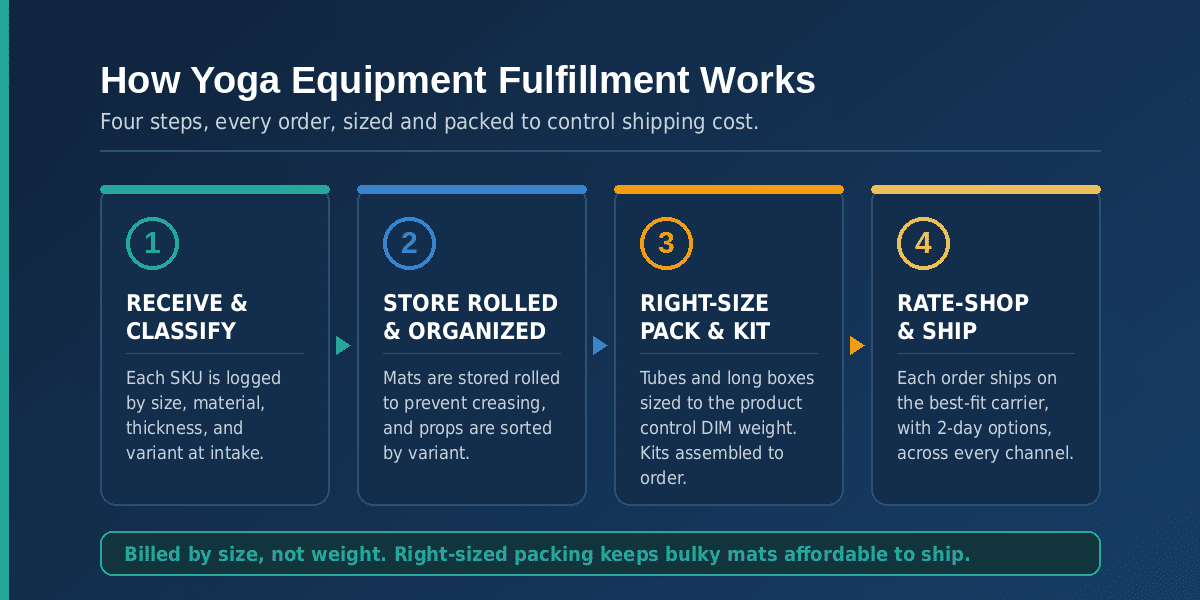
Here is how the process works at ShipBuddies.
This process is built for yoga gear specifically. ShipBuddies applies its broader outsourced fulfillment to the category, and you can see the general version in our order fulfillment workflow walkthrough.
Yoga equipment is harder to fulfill than most categories.
Six challenges affect almost every yoga brand.
A yoga mat costs more to ship than its weight suggests. Carriers charge on actual weight or dimensional weight, whichever is greater, and a rolled mat in an oversized box bills on its volume. Long mats also trigger large-package surcharges. The fix is right-sized packaging: a tube or a long, narrow box trimmed to the shortest safe length, which keeps the billed size down.
A creased mat is a returned mat. Yoga mats hold the shape they are stored in, so a mat folded under weight develops permanent crease lines that customers reject. Mats have to be stored and shipped rolled, with the roll secured so it does not loosen and shift in transit.
Yoga mats ship in several materials, and each handles differently. The table below maps the common materials to their handling notes.
Material | Handling note |
PVC | Durable and low-maintenance. Standard ambient storage and rolled packing. |
TPE | Lightweight and eco-friendly. Rolls compactly into right-sized tubes or boxes. |
Natural rubber | Heavier and heat-sensitive. Store away from heat and pack with sturdier protection. |
Cork | Edge-fragile. Roll carefully and protect the ends in transit. |
Jute | Textured natural fiber. Keep dry and rolled to hold its shape. |
Microfiber / travel | Thin and foldable. Light to ship, but creases if folded under pressure. |
This material discipline carries across related active categories. The same handling care applies to outdoor gear fulfillment, where material and bulk drive the same packing decisions.
One mat design becomes many SKUs. Thickness (travel at 1 to 2mm, standard at 4 to 6mm, and thick at 6mm and up), length (standard, long, and extra-wide), material, and color all multiply into a deep catalog. Each variant ships and stores differently, so a workflow built for a handful of SKUs cannot hold the count without errors.
Yoga sells in bundles. A starter set pairs a mat with blocks and a strap, and a studio order might combine mats, bolsters, and blankets. Assembling those kits accurately, per a defined bill-of-materials, takes a fulfillment partner that runs kitting as a standard service rather than a special request.
Returns run high in yoga because fit is personal. A mat feels too thick, a bolster too firm, or a strap too short, and the customer exchanges it. Structured returns and reverse logistics inspects returned gear, restocks resalable units to the right variant bin, and keeps inventory counts accurate.
Outsourcing yoga equipment fulfillment hands the dimensional-weight math, material handling, and kitting to a team that runs them daily. Five reasons drive the decision.
A specialized 3PL controls the dimensional-weight cost that defines yoga shipping. Right-sized tubes and boxes, trimmed to the product, keep the billed size down, and shipping optimization rate-shops carriers to find the best price for bulky, light parcels. The result is shipping that reflects the true size of the order rather than a padded oversized box.
A specialized 3PL stores mats rolled and handles each material by its needs, so natural rubber stays away from heat, cork edges stay protected, and no mat ships with a permanent crease. The result is gear that arrives in the condition the brand intended, which cuts the returns that damage drives.
A specialized 3PL assembles starter kits and studio bundles per a defined bill-of-materials, so a mat-plus-blocks-plus-strap set ships as one accurate unit. The result is bundle orders that go out complete and correct, without the brand assembling kits by hand.
Yoga brands sell across a DTC store, Amazon, marketplaces, and wholesale accounts like studios and gyms. A 3PL with sales channel integrations unifies those orders in one inventory pool with real-time sync that prevents overselling across channels.
Yoga buyers care about sustainability, and the unboxing is part of the brand. A specialized 3PL supports recycled and plastic-reduced packaging and branded inserts, so the package matches the values the brand sells on. The result is an unboxing that reinforces the brand instead of undercutting it.
Here is what yoga equipment fulfillment looks like at ShipBuddies, broken down by capability.
ShipBuddies connects to Shopify, WooCommerce, BigCommerce, Amazon, Walmart Marketplace, and TikTok Shop, and handles wholesale and EDI purchase orders from studios and gyms. Orders sync in real time with SKU-level inventory that accounts for material, thickness, length, and color, all from a single inventory pool.
Every mat is stored rolled to prevent creasing, and props are organized by variant so picks stay accurate across a deep catalog. Material-sensitive items like natural rubber are stored with their handling needs in mind.
Orders are packed in tubes or long, narrow boxes sized to the product, which controls dimensional weight and the large-package surcharges that long mats trigger. Starter kits and studio bundles get assembled per bill-of-materials so multi-item orders ship complete.
Every order ships via a rate-shopped carrier, with 2-day options available, across DTC, Amazon, and wholesale. Returns flow through a workflow that handles the size and thickness exchanges common in yoga and restocks resalable gear to the correct variant bin. The same operational rigor applies across sports equipment fulfillment, where bulk and variant handling work the same way.
ShipBuddies controls dimensional weight by packing mats in tubes or long, narrow boxes sized to the product, then rate-shops carriers for the best price. Because carriers bill bulky, light parcels on size, right-sizing the box and avoiding oversized packaging is what keeps the cost down.
ShipBuddies stores and ships mats rolled, never folded, with the roll secured so it does not loosen in transit. Mats hold the shape they are stored in, so rolled handling prevents the permanent crease lines that lead to returns.
Yes. ShipBuddies assembles starter kits and studio bundles per a defined bill-of-materials, so a mat-plus-blocks-plus-strap set or a multi-item studio order ships as one complete, accurate unit.
Yes. Long and extra-wide mats are packed in right-sized long boxes or tubes to manage the large-package surcharges that oversized parcels trigger, and they are rate-shopped to the carrier that handles the dimensions best.
Yes. ShipBuddies integrates with Amazon, Walmart Marketplace, Shopify, WooCommerce, BigCommerce, and TikTok Shop, and handles wholesale and EDI orders from studios and gyms. All channels draw from a single inventory pool with real-time sync that prevents overselling.
Returns flow through a structured workflow that handles the size and thickness exchanges common in yoga. Returned gear is inspected, and resalable units are restocked to the correct variant bin so inventory counts stay accurate.
ShipBuddies gives yoga brands dimensional-weight control on bulky gear, crease-free rolled-mat handling, material-aware storage, starter-kit kitting, and rate-shopped shipping with 2-day options. Get a free quote and tell us about your catalog, your materials, and the channels you sell on.