
Smartphone accessories live or die on fitment. A case or screen protector has to match an exact phone model, the catalog explodes across model, color, and finish, and near-identical adjacent models make mis-picks easy. Then every fall a new phone launches, demand spikes, and last season’s fitment starts turning into dead stock.
ShipBuddies provides specialized smartphone accessories order fulfillment for ecommerce brands selling cases, screen protectors, mounts, grips, cables, audio, and more, including model-fitment discipline that prevents lookalike substitution, SKU density control across every variant, obsolescence and phase-out management, and pre-launch staging for new phone releases.
Learn how our 3PL services apply to your product line.
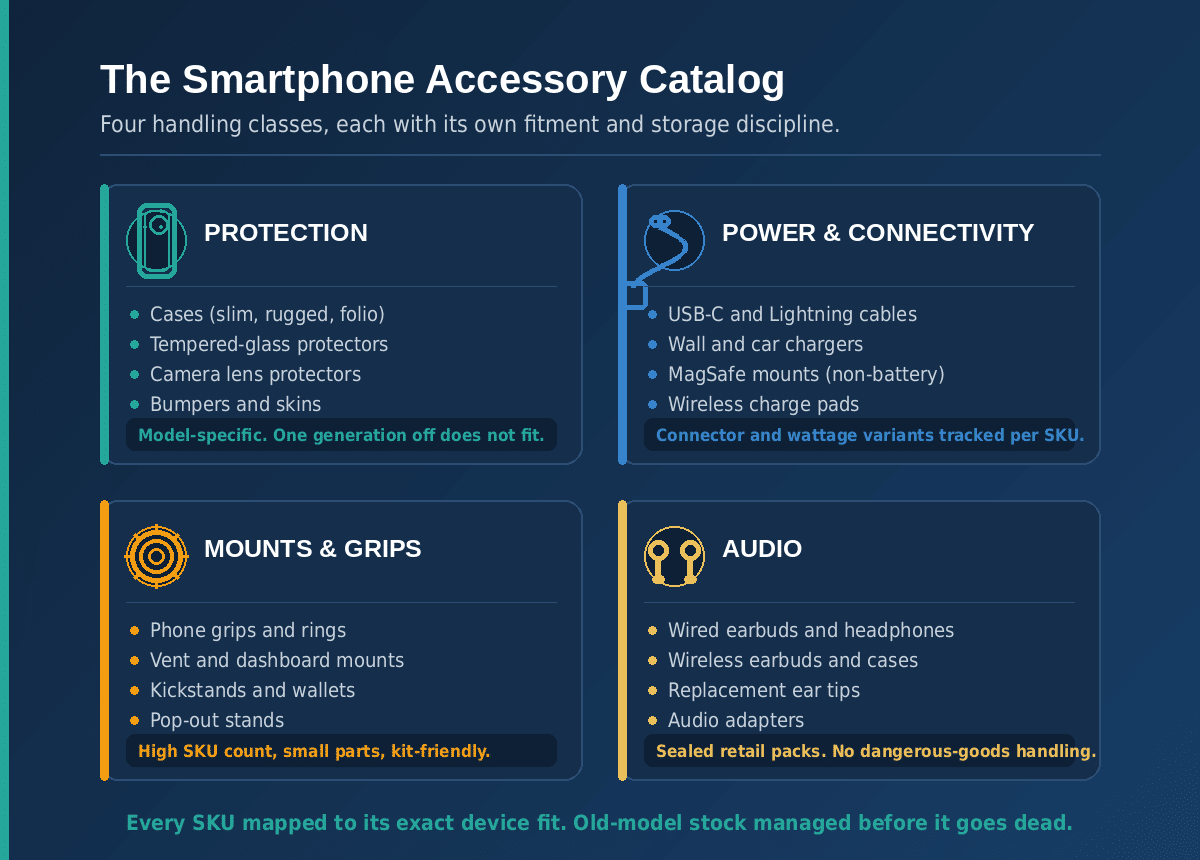
Smartphone accessories order fulfillment is a specialized third-party logistics service that handles storage, picking, packing, and shipping of phone accessories for ecommerce sellers, including cases, screen protectors, mounts, stands, grips, charging cables, styluses, MagSafe accessories, lens kits, and audio.
It accounts for the realities of the category, including the device-model compatibility that cases and screen protectors demand, the lookalike substitution risk that near-identical adjacent models create, the SKU explosion that model, color, and finish variants generate, the annual obsolescence that turns last season’s fitment into dead stock, and the launch-driven demand spikes that new phone releases trigger.
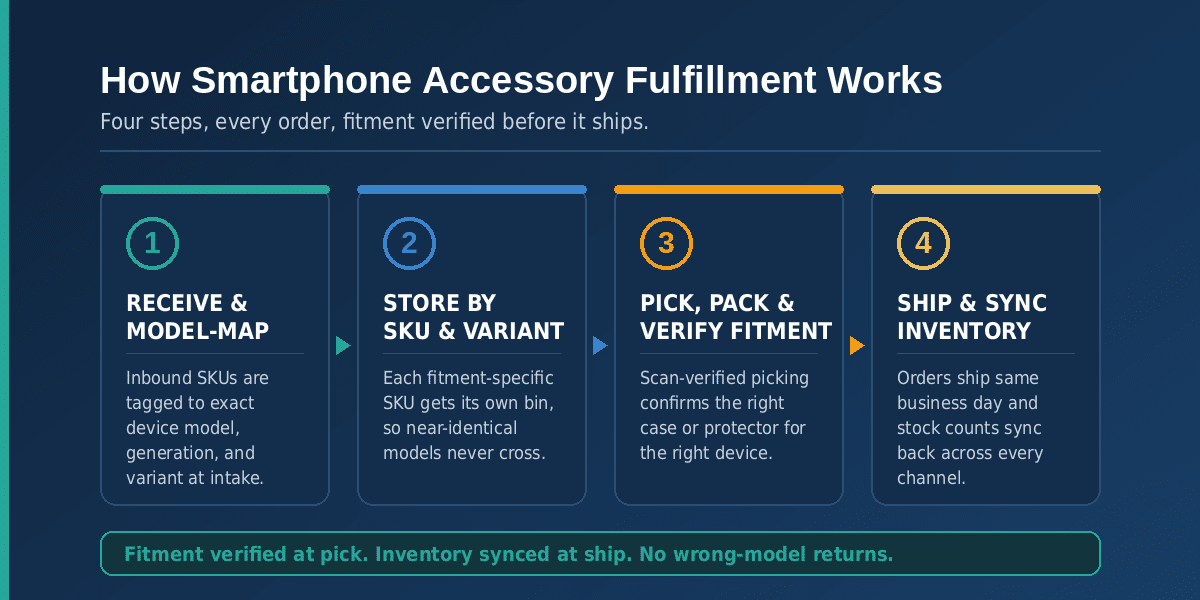
The wrong fulfillment partner shows up as an iPhone 15 case shipped to a customer who ordered for the 15 Pro, a catalog of thousands of lookalike SKUs that get crossed at the pick face, and a warehouse full of last year’s models nobody flagged for phase-out. The right partner shows up as model-mapped bin discipline, pick verification that catches lookalike substitutions, and a phase-out process that moves aging fitment before it becomes dead stock. Here is how the process works at ShipBuddies.
This process is built specifically for smartphone accessories. To see the broader version, read our fulfillment workflow walkthrough.
Smartphone accessory ecommerce is harder to fulfill than most categories.
Six specific challenges affect almost every accessory brand.
A phone case or screen protector is useless if it does not fit the exact device. An iPhone 15 case does not fit an iPhone 15 Pro, and a Galaxy S24 protector does not fit an S24 Ultra. Fitment is binary: it either matches the model or it does not. A 3PL that does not track device-model compatibility at the SKU level ships accessories that do not fit, and every mismatch becomes a return.
Adjacent phone models look almost identical, and so do their accessories. A case for one model and the case for the next size up can be nearly indistinguishable at the pick face. Without bin discipline and pick verification built around model compatibility, lookalike SKUs get substituted for one another, and the customer receives a case that looks right but does not fit. Lookalike substitution is the most common and most preventable error in accessory fulfillment.
A single case design might ship in 20 phone models, 8 colors, and 3 finishes, which compounds into hundreds of SKUs from one product. Multiply that across a full catalog and a brand has thousands of near-identical SKUs. A 3PL workflow built for a few dozen SKUs cannot hold that density, and the pick face becomes a substitution minefield. Verify any prospective partner offers full ecommerce integrations across every channel you sell on.
Phone manufacturers refresh their lineups every year, and the moment a new model lands, accessories for older models start aging out. Fitment that sold all year becomes dead stock that ties up space and capital if nobody flags it for phase-out. A 3PL that treats every SKU as evergreen leaves a brand sitting on obsolete inventory while new-model demand goes unserved.
When a major phone launches, accessory demand for the new model spikes within days, and brands that cannot get new-model fitment received, onboarded, and shipping fast miss the window when buyers are most motivated. A 3PL that onboards new SKUs slowly leaves a brand flat-footed at exactly the moment the category peaks.
Phone accessories are high-volume, low-cost items, and brands sell them across Amazon (the dominant accessory channel), a Shopify or WooCommerce DTC store, marketplaces like Walmart and TikTok Shop, and wholesale accounts like repair shops and kiosks. Each channel has different packaging and routing requirements, and the low average order value means picking has to be efficient. A 3PL that handles only DTC, or that picks slowly, cannot make the category’s economics work.
Each challenge above maps to a specific reason to outsource. A specialized 3PL solves the problems an in-house operation or generalist fulfillment service cannot.
A specialized 3PL tracks device-model compatibility at the SKU level, separates near-identical adjacent-model accessories into distinct bins, and verifies model and variant at the pick to catch lookalike substitutions before they ship. The result is accessories that actually fit the customer’s phone, and far fewer of the fitment returns that lookalike errors create. Read more about how we handle returns and reverse logistics for fitment-driven categories.
A specialized 3PL handles the thousands of near-identical SKUs that model, color, and finish variants generate with bin labeling and location logic built for high density. The result is pick accuracy that holds up even when the catalog is a wall of lookalike cases, instead of degrading as SKU count climbs.
A specialized 3PL flags aging fitment against the model lifecycle and moves it through phase-out before it becomes dead stock, so a brand is not paying to store obsolete inventory. The result is a catalog that stays current and shelf space that goes to the models customers are actually buying.
A specialized 3PL onboards new-model SKUs fast and stages inventory ahead of a phone launch, so a brand is shipping new-model fitment the moment demand spikes rather than scrambling to catch up. The result is capturing the launch window when buyers are most motivated. Read more about shipping optimization for launch-driven volume.
A 3PL that integrates only with Shopify misses Amazon, where most accessory volume lives, plus marketplaces and wholesale. Look for a partner that unifies Amazon, DTC, marketplace, and wholesale orders from a single inventory pool, with real-time sync that prevents overselling and efficient small-parcel picking that fits the category’s low average order value.
Here is what smartphone accessories fulfillment looks like at ShipBuddies, broken down by capability.
ShipBuddies connects directly to Shopify, WooCommerce, BigCommerce, Amazon, Walmart Marketplace, TikTok Shop, and Faire, and handles wholesale and EDI retailer purchase orders. Orders sync in real time with SKU-level inventory updates that account for device model, color, and finish. Amazon, DTC, marketplace, and wholesale orders draw from a single inventory pool.
Every accessory SKU is logged at intake with device-model compatibility, color, and finish, and mapped to a dedicated bin. Near-identical adjacent-model accessories get separated by bin labeling and location logic so lookalikes do not sit together. Aging fitment gets flagged against the model lifecycle for phase-out.
Orders go through barcode-verified picking at the model and variant level, which catches the lookalike substitutions (wrong model, wrong color, wrong finish) that high-density accessory catalogs generate. Small, light accessories get efficient small-parcel packing that fits the category’s low average order value, and bundles like case-plus-screen-protector get assembled per bill-of-materials.
New-model SKUs get onboarded fast and staged ahead of a phone launch so fitment ships the moment demand spikes. Aging models move through phase-out before they become dead stock. Returns flow through a workflow that handles wrong-model fitment returns and restocks resalable units accurately.
Every SKU is logged with device-model compatibility at intake and mapped to a dedicated bin, and picking is barcode-verified at the model and variant level. That catches the lookalike substitutions (an iPhone 15 case going out for a 15 Pro order) that near-identical adjacent models create, so accessories actually fit the customer’s phone.
Yes. Model, color, and finish variants compound into thousands of near-identical SKUs, and ShipBuddies handles that density with bin labeling and location logic that keeps lookalike SKUs separated and pick accuracy intact as SKU count climbs. Read more about our ecommerce integrations across every channel.
Aging fitment gets flagged against the model lifecycle and moved through phase-out before it becomes dead stock, so a brand is not paying to store obsolete accessories. New-model SKUs get onboarded fast and staged ahead of a launch so fitment ships the moment demand spikes.
Yes. ShipBuddies integrates with Amazon, Walmart Marketplace, Shopify, WooCommerce, BigCommerce, TikTok Shop, and Faire, and handles wholesale and EDI orders. Amazon, DTC, marketplace, and wholesale orders draw from a single inventory pool with real-time sync that prevents overselling.
Returns flow through a workflow that handles wrong-model fitment returns (a common driver in accessories) and restocks resalable units accurately so they go back to the correct model-mapped bin. Read more about returns and reverse logistics for accessory brands.
Smartphone accessory brands need a fulfillment partner who tracks model fitment so cases ship to the right phone, controls the SKU density that lookalike catalogs create, manages obsolescence before it becomes dead stock, and stages new-model inventory ahead of a launch. ShipBuddies builds operations around the way accessory brands actually sell, with the model-fitment discipline, SKU control, lifecycle management, and launch readiness that the category requires. Request a quote today and find out what specialized smartphone accessories fulfillment looks like.