
Beverages are heavy, fragile, and unforgiving. A single broken bottle generates a refund, a reship, and often a lost customer. ShipBuddies provides specialized beverage order fulfillment for ecommerce brands, including engineered packaging to cut damage rates, carrier rate shopping for heavy parcels, and subscription-ready workflows for the recurring orders that drive most beverage DTC. Learn how our 3PL services apply to your product line.
Beverage order fulfillment is a specialized third-party logistics service that handles storage, picking, packing, and shipping of drink products for ecommerce sellers. It accounts for the physical realities of beverages, including liquid weight that drives shipping cost, fragile glass and pressurized containers that fail in transit, best-by dates that require strict rotation, and the high subscription volume common to coffee, tea, kombucha, and similar brands. Generic fulfillment workflows that work for dry goods do not work for beverages.
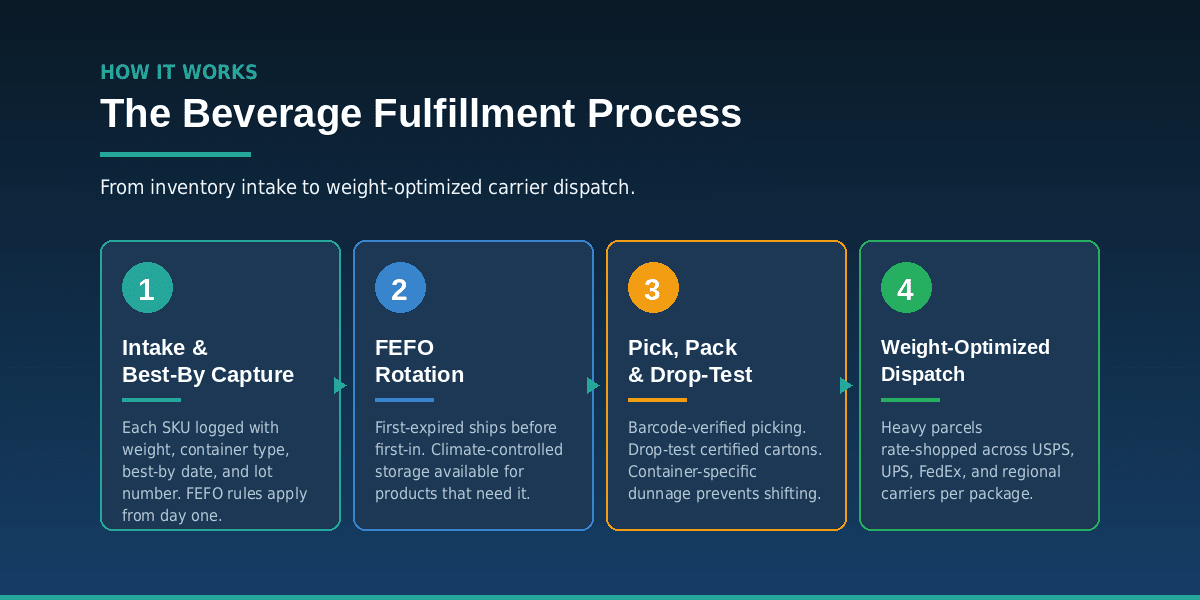
The wrong fulfillment partner shows up as damage rates above industry norms, surprise shipping costs that erode margin, and missed best-by enforcement that triggers refunds. The right partner shows up as a damage rate under 1.5%, predictable carrier costs, and orders that arrive intact and in date. Here is how the process works at ShipBuddies.
This process is built specifically for beverages. To see the broader version, read our fulfillment workflow walkthrough.
Beverage ecommerce is harder to fulfill than most categories. Six specific challenges affect almost every beverage brand.
Beverages are heavy. A 12-pack of 12 oz cans weighs roughly 10 to 12 pounds. A six-pack of glass bottles can hit 8 pounds. Carriers calculate shipping based on actual weight, which means a single case of beverages traveling Zone 8 can cost more than the product margin itself. Without aggressive carrier rate shopping, sellers lose money on every order.
Glass bottles break. Aluminum cans dent under pressure or seal failure. Carbonated beverages develop pressure changes during transit, especially in extreme temperatures, that cause leaks and ruptures. The industry damage rate target is below 1.5%, and brands above that bleed margin in refunds and reships. Generic packaging is not enough.
Beverages have shelf life, often 6 to 18 months depending on category. FIFO (first-in-first-out) ships whatever arrived first. FEFO (first-expired-first-out) ships whatever expires first. The two are not the same, and FEFO is what protects you from shipping near-expiry product. A 3PL that cannot enforce FEFO at the system level creates returns and recall risk.
Coffee, tea, kombucha, and functional beverage brands lean heavily on subscription models. A subscription brand might run 70% of orders through monthly recurring shipments, which require coordinated batching, cadence-aware inventory planning, and integration with subscription apps like Recharge or Bold Subscriptions. A 3PL without subscription tooling slows everything down.
A beverage SKU often exists in multiple configurations: single bottle, four-pack, six-pack, twelve-pack, and case. Each configuration has different inventory rules and picking workflows. Without clear SKU-level differentiation, picking errors and oversells become routine.
Most beverage brands sell on a Shopify or WooCommerce DTC store, run subscriptions through that store, and list on Amazon for marketplace volume. Some add TikTok Shop for trending products. Inventory has to sync across all of it in real time, or oversells happen the moment one channel sells out faster than the others. Verify any prospective partner offers full ecommerce integrations for every channel you sell on.
Each challenge above maps to a specific reason to outsource. A specialized 3PL solves the problems an in-house operation or generalist fulfillment service cannot.
A specialized 3PL with carrier-rate-shopping technology compares USPS, UPS, FedEx, and regional carrier rates per shipment, accounting for actual weight on heavy parcels. Volume-based discounts that small sellers cannot negotiate alone get applied to your shipments. The result is a per-package cost that reflects what the carrier actually charges the 3PL, not what a single-brand shipper would pay at retail rates. Read more about shipping optimization for heavy parcels.
Cutting damage from 3% to 1% on a brand shipping 5,000 orders per month means 100 fewer broken-bottle complaints, refunds, and reships. A specialized 3PL uses drop-tested cartons, inner dunnage matched to container type, and packaging configurations validated for each multi-pack SKU. Damage data gets tracked by SKU so weak packaging shows up before it costs you money.
Subscription orders run on a different cadence than one-off DTC orders. The right 3PL integrates directly with Shopify subscription apps (Recharge, Bold, ReCharge, Ordergroove), batches subscription shipments efficiently, and syncs upcoming charge dates with inventory levels so you do not overcommit on a flavor that is about to stock out.
A 3PL with system-enforced FEFO ships oldest-dated stock first regardless of intake order. Lot numbers stay tied to each SKU so a recall scenario can isolate affected orders within hours, not days. This is the difference between a contained recall and a brand-damaging one. Returns also matter: see how we handle returns and reverse logistics for beverage sellers.
Beverage buyers are loyal but unforgiving. A broken bottle, a leaking can, or a near-expiry product on arrival generates a refund and often a churned subscriber. Specialized handling protects the unboxing experience, the brand, and the lifetime value you spent acquisition dollars to build.
Here is what beverage fulfillment looks like at ShipBuddies, broken down by capability.
ShipBuddies connects directly to Shopify, WooCommerce, BigCommerce, Amazon, TikTok Shop, and the major subscription app integrations including Recharge, Bold Subscriptions, and ReCharge. Orders sync in real time with SKU-level inventory updates that account for multi-pack configurations. Subscription cadence syncs with inventory so upcoming charges never outpace stock.
Every beverage SKU is logged with best-by date and lot number at intake. FEFO rules ship the earliest-expiring stock first, every time, system-enforced. Lot numbers stay tied to orders so a recall can isolate affected shipments within hours. Climate-controlled storage is available for products that require temperature ranges outside ambient.
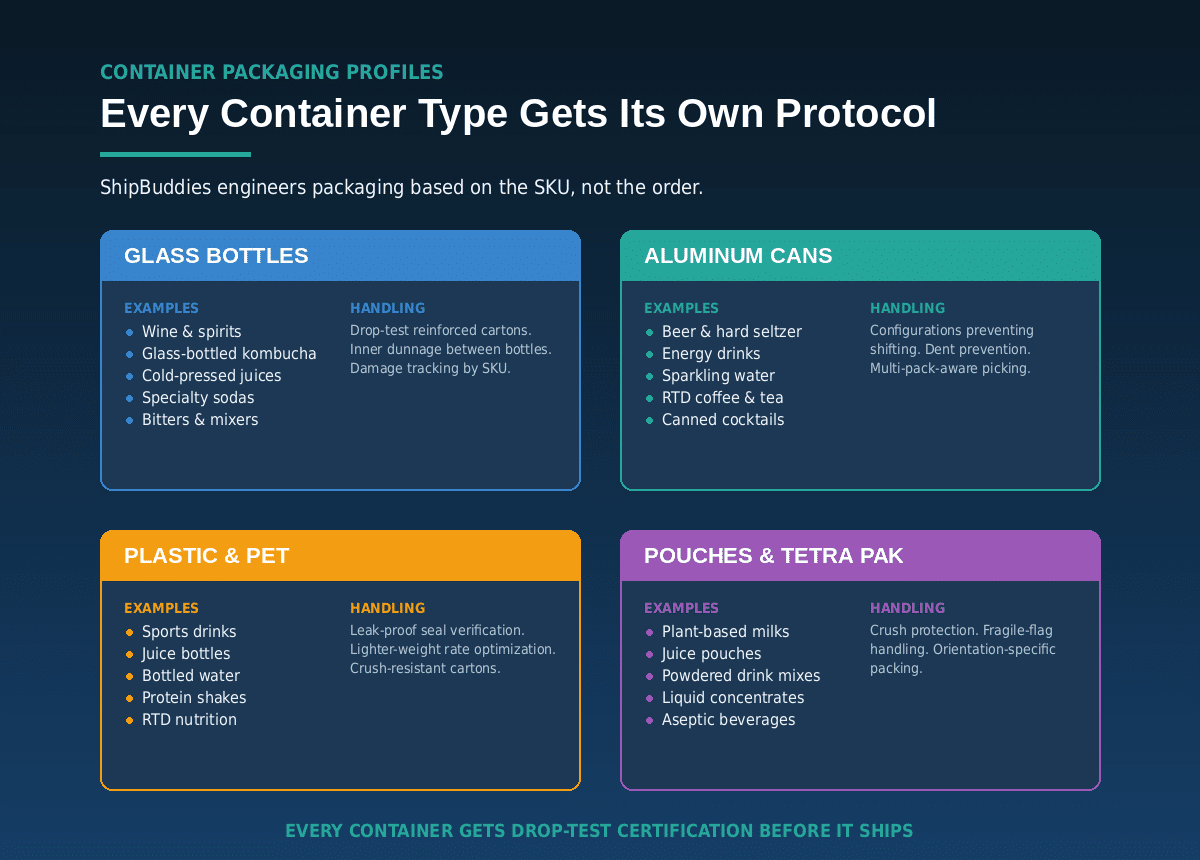
Orders go through barcode-verified picking with multi-pack configuration awareness. Packaging is matched to the SKU profile: glass bottles get inner dunnage and reinforced cartons rated for drop testing, cans get configurations that prevent shifting and dent damage, and pouches get crush protection. Damage rates are tracked per SKU so weak packaging gets caught and corrected before it scales.
Every order gets rate-shopped across USPS, UPS, FedEx, and regional carriers. The lowest qualifying rate wins per package, accounting for actual weight rather than DIM weight on most beverage shipments. Volume discounts apply automatically to your orders.
Industry damage rates above 1.5% indicate a packaging or handling problem. ShipBuddies uses drop-tested cartons, container-specific inner dunnage, and SKU-level damage tracking to keep rates below industry benchmarks. When a SKU starts trending toward damage problems, packaging gets adjusted before it scales.
Yes. ShipBuddies integrates with Recharge, Bold Subscriptions, ReCharge, and Ordergroove. Subscription orders batch on cadence, inventory syncs against upcoming charge dates, and your customers get the same shipping experience whether the order is a one-time purchase or a recurring shipment.
Every SKU gets logged with best-by date and lot number at intake. FEFO rules ship the earliest-expiring stock first, system-enforced. If a recall happens, lot tracking isolates affected orders within hours so you can act fast. Read more about how we handle returns and reverse logistics tied to recall protocols.
Yes. Singles, four-packs, six-packs, twelve-packs, and case quantities can each exist as distinct SKUs with their own inventory and picking rules. Barcode verification at the picking stage prevents configuration mix-ups.
Beverages ship by actual weight, not DIM weight, which makes carrier selection critical. ShipBuddies rate-shops every order across USPS, UPS, FedEx, and regional carriers, applying volume discounts and choosing the lowest-cost compliant carrier per package. Read more about shipping optimization for heavy parcels.
Beverage brands need a fulfillment partner who treats damage rates as a measurable problem, not a cost of doing business. ShipBuddies builds packaging around your specific SKUs, ships heavy parcels at rate-shopped carrier prices, and runs subscription workflows that match how beverage DTC actually works. Request a quote today and find out what specialized beverage fulfillment looks like.