
Battery order fulfillment is the storage, picking, packing, marking, and shipping of batteries by a third-party logistics provider, including the dangerous-goods handling that lithium batteries legally require. Lithium-ion and lithium-metal batteries are Class 9 dangerous goods under United States DOT rules and international IATA rules, so they cannot ship in a plain box.
ShipBuddies fulfills batteries with hazmat-trained staff, UN-specification packaging, the required Lithium Battery Mark and Class 9 labeling, Class 9 storage with hazard segregation, and carrier agreements for ground and air. We work from each product’s classification and UN38.3 documentation, so every shipment leaves packed, marked, and routed for its battery type.
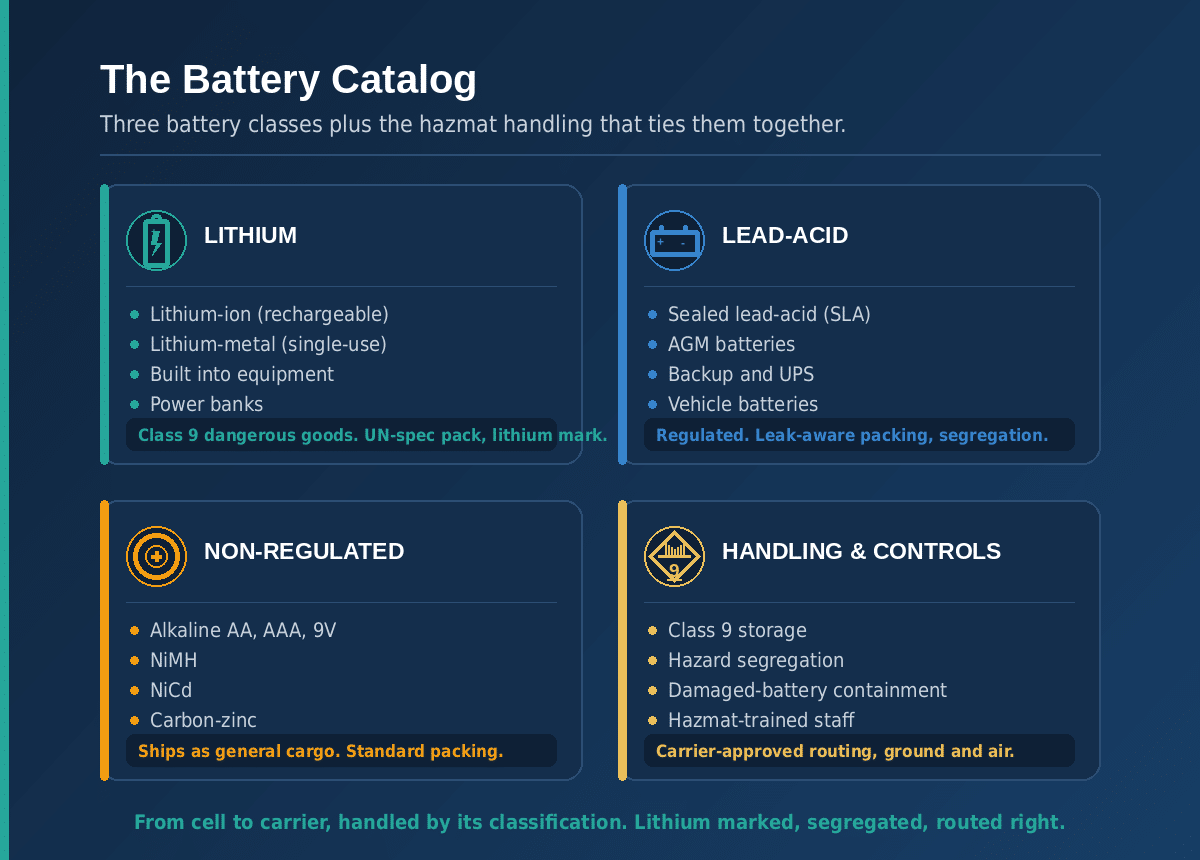
Battery order fulfillment is a specialized form of order fulfillment for products that are often regulated as dangerous goods. It covers regulated batteries like lithium-ion, lithium-metal, and lead-acid, and non-regulated batteries like standard alkaline cells, and it adds the hazmat packing, marking, documentation, and storage that the regulated types require.
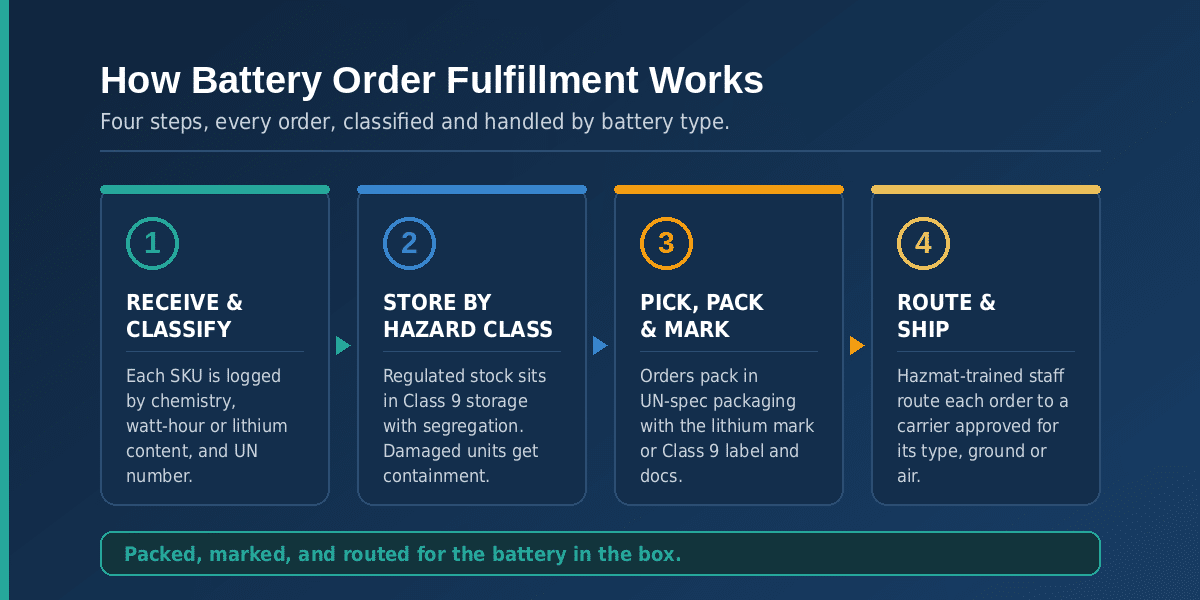
Here is how the process works at ShipBuddies.
This process is built for batteries specifically. ShipBuddies applies its broader outsourced fulfillment to the category, and you can see the general version in our order fulfillment workflow walkthrough.
Batteries are harder to fulfill than almost any other category.
Six challenges define the work.
Lithium-ion and lithium-metal batteries store a lot of energy in a small space, which is why they carry a real fire risk from thermal runaway. The DOT and IATA classify them as Class 9 dangerous goods, so shipping them in a standard box is both unsafe and against the law. The table below maps the common battery types to their regulatory status and handling.
Battery type | Regulatory status | Handling |
Lithium-ion (rechargeable) | Class 9 dangerous goods, rated by watt-hour | UN-spec packaging, Lithium Battery Mark, certified handling. |
Lithium-metal (single-use) | Class 9 dangerous goods, rated by lithium content | UN-spec packaging, Lithium Battery Mark, certified handling. |
Lead-acid | Regulated for corrosivity and spillage | Leak-aware packing, hazard segregation. |
Alkaline (AA, AAA, 9V) | Generally not regulated as dangerous goods | Standard packing, ships as general cargo. |
NiMH and NiCd | Lower regulatory burden in most cases | Standard handling per the product’s classification. |
Two lithium batteries can ship under different rules. Requirements scale with watt-hour rating for lithium-ion and with lithium content for lithium-metal, and small cells under certain thresholds may qualify for reduced requirements with proper labeling, while standalone batteries face the strictest rules. The same care applies to batteries built into devices, which is part of why smartphone accessories fulfillment routes its battery-containing items here.
A battery that ships freely by ground can be heavily restricted by air. The DOT governs ground transport in the United States, and IATA governs air, with stricter limits. Some lithium shipments move on Cargo Aircraft Only, and many move best by ground. Routing each order correctly takes knowledge of both rule sets.
Hazmat packaging is not optional. Regulated batteries require UN-specification packaging that has been tested to contain the hazard, the correct Lithium Battery Mark or Class 9 label, and accurate shipping documentation. The wrong packaging or a missing mark can mean a rejected shipment, a fine, or a carrier account loss.
Batteries cannot sit anywhere on a shelf. Regulated stock needs Class 9 storage with segregation from incompatible materials, and damaged, defective, or recalled batteries need separate containment so a single failing cell cannot become a warehouse fire. This is a storage discipline, not just a packing one.
Most general 3PLs cannot ship batteries at all. They lack the certified staff, the UN-spec packaging, the Class 9 storage, and the carrier hazmat agreements the category requires. A battery brand that signs with a generalist often discovers mid-onboarding that its products cannot ship, which is an expensive way to learn the difference.
Outsourcing battery fulfillment to a hazmat-capable 3PL hands the certified handling, packaging, and storage to a team built for it. Five reasons drive the decision.
Under DOT rules, only trained and certified staff may pack, mark, and sign off on a hazmat shipment, with recertification on a set schedule. A hazmat-capable 3PL keeps that training current, so the people preparing battery orders are qualified to do it.
A hazmat-capable 3PL stocks UN-specification packaging and applies the correct Lithium Battery Mark, Class 9 label, and shipping papers for each shipment. The result is orders that leave packed and marked to the rules for their battery type, rather than guesses that get rejected.
Not every carrier accepts every battery class, and the agreements that allow regulated shipping take time to establish. A hazmat-capable 3PL maintains carrier hazmat agreements for ground and air, so each order routes to a carrier approved to move it.
A hazmat-capable 3PL stores regulated batteries in Class 9 conditions with hazard segregation and handles damaged or defective units in proper containment. The result is inventory held in a way that controls fire risk rather than ignoring it.
Battery shipping costs more than standard parcels, so the savings come from doing it right at scale. shipping optimization rate-shops approved carriers for the best price on each order, which controls cost without trading away the compliant handling the category demands.
Here is what battery fulfillment looks like at ShipBuddies, broken down by capability.
ShipBuddies handles lithium-ion and lithium-metal batteries as Class 9 dangerous goods, lead-acid batteries under their corrosivity and spillage rules, and non-regulated alkaline, NiMH, and NiCd cells as standard cargo. Each type is logged and handled by its own classification, whether it ships standalone, packed with equipment, or built into a device.
Hazmat-trained staff pack regulated batteries in UN-specification packaging, apply the Lithium Battery Mark or Class 9 label the shipment requires, and prepare the shipping documentation each carrier needs. ShipBuddies works from each product’s classification and UN38.3 documentation, so the packing and marking match the battery in the box.
Regulated batteries are stored in Class 9 conditions with hazard segregation, and damaged, defective, or returned batteries go into proper containment rather than back onto a shelf. Structured returns and reverse logistics inspects returned batteries and routes each one to restock or safe disposition by its condition.
ShipBuddies routes each battery order to a carrier approved for its class and connects to your sales channels through sales channel integrations, including Amazon FBM and FBA prep for battery products. The same hazmat discipline runs across electronics fulfillment, where many devices ship with batteries inside.
Yes. Lithium-ion and lithium-metal batteries are classified as Class 9 dangerous goods under DOT and IATA rules because of their fire risk. They require UN-specification packaging, the correct Lithium Battery Mark or Class 9 label, certified handling, and carriers approved to move them.
ShipBuddies handles lithium-ion, lithium-metal, and lead-acid batteries as regulated goods, and alkaline, NiMH, and NiCd cells as non-regulated cargo. Each type is handled by its own classification, whether it ships standalone, packed with equipment, or inside a device.
It depends on the battery and the rules. Air shipping of lithium batteries is heavily restricted under IATA, with some moving on Cargo Aircraft Only and many moving best by ground. ShipBuddies routes each order to a carrier and method approved for its battery type.
Yes. ShipBuddies fulfills battery orders as FBM with hazmat-compliant packing and routing, and prepares battery inventory for FBA. This is a common reason battery brands work with a hazmat-capable 3PL rather than a generalist.
Regulated batteries are held in Class 9 storage with hazard segregation from incompatible materials. Damaged, defective, or recalled batteries are moved into proper containment, separated from sellable stock, to control fire risk.
Returned batteries are inspected and routed by condition. Sellable units are restocked, and damaged or defective units go into containment for safe disposition rather than back onto the shelf.
ShipBuddies fulfills battery brands with hazmat-trained staff, UN-specification packaging, Class 9 storage, the right marking and documentation, and carrier agreements for ground and air, all worked from your product’s classification. Get a free quote and tell us about your battery types, your watt-hour ratings, and the channels you sell on.