


Same-day and next-day shipping have moved from competitive advantage to baseline expectation. Customers who once considered two-day delivery fast now expect orders at their door within 24 hours, and 43% will abandon a cart if shipping feels too slow.
But here is the part most sellers miss: same-day shipping and same-day delivery are not the same thing. One means the order leaves your warehouse the day it is placed. The other means the customer receives it that day. Confusing the two leads to broken promises and bad reviews.
This article breaks down what same-day and next-day shipping actually mean, why customer expectations have shifted so fast, how to decide whether expedited shipping makes sense for your business, and how to set it up without destroying your margins. It also covers how order cutoff times work, what tiered shipping strategies look like in practice, how a shipping optimization services partner can make speed affordable, and what metrics to track once you launch.
What Same-Day and Next-Day Shipping Actually Mean
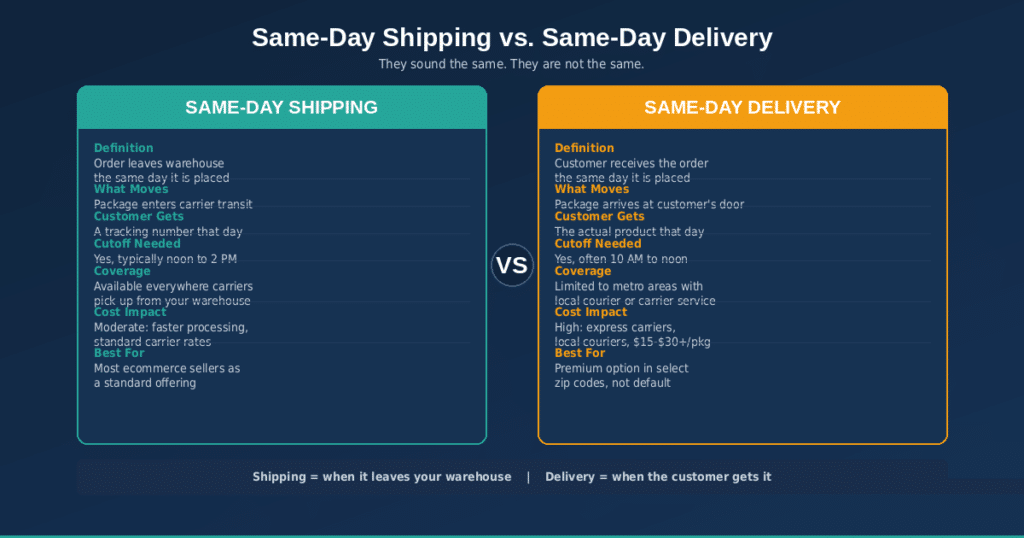
Same-day shipping means an order leaves the warehouse on the same day the customer places it. If someone orders a product at 9 AM, same-day shipping means it ships before the warehouse closes that evening. It does not mean the customer receives it that day.
Same-day delivery goes further. It guarantees the product arrives at the customer’s door on the same calendar day. This requires fast fulfillment, local inventory, and a carrier or courier that can complete last-mile delivery within hours.
Next-day shipping means the order ships by the following business day. If a customer orders on Monday, the package leaves the warehouse by Tuesday. Depending on the carrier and shipping zone, actual delivery may take one to three additional days.
The distinction matters because customers read “same-day” on your product page and assume delivery, not just shipment. If your fulfillment process supports same-day shipping but not same-day delivery, your product page needs to say so clearly. Misaligned expectations are the fastest path to negative reviews and return requests.
Why Customer Expectations Changed So Fast
Amazon Prime is the short answer. When Amazon introduced free two-day shipping, it reset the standard for every online retailer. Two-day delivery is no longer a perk. It is what customers assume they will get, even from brands they have never ordered from before.
The numbers confirm the shift. 62% of shoppers expect orders to arrive in under three business days, even when they choose free shipping. 67% of US shoppers specifically value two-day shipping as a deciding factor. And the bar keeps rising. 55% of consumers now say they are willing to pay extra for same-day delivery.
This does not mean every ecommerce brand needs to match Amazon. It means every brand needs to understand what its specific customers expect, communicate delivery timelines clearly, and offer shipping options that meet those expectations without crippling profitability.
The shift also reflects broader changes in how people shop. Social commerce platforms like TikTok drive impulse purchases where speed is part of the buying psychology. When someone sees a product in a video and clicks “buy,” they want it soon. A five-day delivery window can kill that momentum.
Same-Day Shipping vs. Same-Day Delivery: The Operational Difference
This distinction trips up more sellers than almost any other shipping concept. Understanding the operational gap between these two terms determines whether your fulfillment process can support what your marketing promises.
Same-Day Shipping Requirements
Same-day shipping requires three things: a clear order cutoff time, fast pick-and-pack operations, and a carrier pickup schedule that aligns with your processing window. If your warehouse can pick, pack, and hand off orders to a carrier by end of day, you can offer same-day shipping.
Most brands set cutoff times between noon and 2 PM local time. Orders placed before the cutoff ship that day. Orders placed after ship the next business day. The cutoff must account for order fulfillment workflow time, meaning the gap between when an order enters your system and when it is ready for carrier pickup.
Same-Day Delivery Requirements
Same-day delivery requires everything above plus local carrier coverage and inventory positioned close to the customer. The delivery window is measured in hours, not days. This typically limits same-day delivery to metro areas where local couriers, gig-economy delivery platforms, or carrier same-day services operate.
Major carriers offer same-day services. FedEx SameDay, UPS Express Critical, and USPS Priority Mail Express all provide options. But the cost per package is significantly higher than standard ground shipping. For most ecommerce sellers, same-day delivery works best as a premium option available in select zip codes, not as a default for every order.
How to Decide Whether Expedited Shipping Makes Sense
Not every brand needs same-day or next-day shipping. The decision depends on your product type, customer base, order value, and competitive landscape.
Products Where Speed Matters Most
Time-sensitive products benefit most from expedited shipping: perishable goods, health and wellness items, seasonal merchandise, gifts, and anything tied to an event or deadline. Fashion and beauty products also benefit because purchase intent fades quickly. A customer who wants a dress for Saturday’s event will not wait five days.
Products where safety, accuracy, or customization matter more than speed (custom furniture, industrial equipment, or made-to-order items) rarely need same-day options. For these categories, accurate delivery estimates matter more than raw speed.
The Cost-Benefit Question
Expedited shipping costs more per order. The question is whether the increase in conversion rate, average order value, and customer retention offsets that cost. A simple framework: compare your current cart abandonment rate with industry benchmarks. If slow shipping is a likely contributor, test expedited options on a subset of orders and measure the impact.
Another approach: offer expedited shipping as a paid option. 55% of consumers say they will pay for same-day delivery. Charging for speed lets you meet expectations without absorbing the full cost. Some brands reserve free expedited shipping for orders above a certain threshold, which also increases average order value.
Setting Up Same-Day and Next-Day Shipping
Moving from standard shipping to expedited options requires changes across your fulfillment workflow, carrier relationships, and customer communication. Here is what each piece involves.
Order Cutoff Times
Your cutoff time is the latest a customer can place an order and still qualify for same-day or next-day shipping. It depends on your warehouse processing speed, carrier pickup schedules, and any quality checks in your order fulfillment workflow.
Display the cutoff time clearly on your product pages. A countdown timer showing “Order within 3 hours for same-day shipping” creates urgency and sets the right expectation. After the cutoff, automatically switch the displayed option to next-day shipping so customers always know what they are getting.
Carrier Selection and Service Tiers
No single carrier is the best choice for every expedited shipment. A multi-carrier shipping strategy lets you match each order to the fastest, most cost-effective service tier based on destination, package weight, and delivery speed.
For next-day delivery, ground shipping often works for orders within one or two shipping zones of your warehouse. Beyond that, you may need air or express services, which cost more. Rate shopping at the order level, comparing carrier options in real time, keeps costs down while maintaining speed.
Inventory Accuracy
Expedited shipping only works if the product is in stock and ready to pick. Overselling, backorders, or inventory discrepancies turn a same-day shipping promise into a delayed-shipping apology. Real-time inventory sync between your ecommerce platform and your warehouse management system eliminates the gap between what your website shows and what your warehouse actually has.
Communication and Tracking
Customers who pay for speed expect visibility. Automated shipping confirmations with tracking numbers, real-time status updates, and proactive delay notifications are not optional for expedited orders. Transparency reduces “where is my order” support tickets and builds trust even when something goes wrong.
Tiered Shipping Strategies That Protect Margins
Offering a single shipping speed to every customer is the most expensive approach. A tiered strategy gives customers choices while protecting your margins.
A standard tiered structure looks like this: free standard shipping (3-5 business days) available on all orders, free two-day shipping for orders above a minimum threshold, paid next-day shipping available at checkout, and paid same-day delivery available in select metro zip codes. This structure works because 88% of consumers prioritize free shipping over speed. Most customers will choose the free option. The subset who need it faster will pay for the upgrade. And the threshold for free two-day shipping pushes average order values up.
Some brands take the membership approach, similar to Amazon Prime. A paid loyalty program that includes free expedited shipping generates recurring revenue and increases customer lifetime value. Members of paid shipping programs are 59% more likely to shop with that brand over competitors.
The key is matching your tiers to what your fulfillment infrastructure can actually support. Promising same-day and next-day shipping you cannot consistently deliver is worse than not offering it at all.
How a 3PL Makes Expedited Shipping Possible
Most ecommerce sellers cannot build the infrastructure for expedited shipping on their own. The warehouse operations, carrier relationships, technology integrations, and staffing flexibility required to ship same-day or next-day are expensive to build and complex to maintain.
A 3PL provider absorbs that complexity. 3PLs process orders at volume, which means faster pick-and-pack times, earlier carrier pickups, and negotiated rates on express services that individual sellers cannot access.
The benefits of outsourcing to a 3PL become especially clear during peak seasons. Black Friday, holiday surges, and viral product spikes require the ability to scale fulfillment capacity without hiring temporary staff or leasing warehouse space. A 3PL already has the capacity and the systems to handle volume swings.
ShipBuddies processes same-day shipments for ecommerce sellers by combining tight warehouse operations with multi-carrier rate shopping. Orders placed before the cutoff are picked, packed, and handed to carriers the same day. Sellers do not need to manage sellers to warehouse staff, negotiate carrier contracts, or monitor pickup schedules.
Measuring Expedited Shipping Performance
Once you offer expedited shipping, track these metrics to evaluate whether it is working:
On-time shipment rate measures the percentage of orders that ship within the promised window. For same-day shipping, this means orders that leave the warehouse on the day they are placed. The benchmark is 95% or higher. Anything below that signals a process bottleneck in picking, packing, or carrier handoff.
Order-to-ship time tracks the gap between when a customer places an order and when it enters carrier transit. For same-day operations, this should be under 4-6 hours for orders placed before the cutoff.
Cart abandonment rate should decrease after introducing expedited options. If it does not, the issue may be cost (shipping price too high) rather than speed. Test different pricing structures to find the point where conversions improve.
Carrier transit performance tracks whether carriers deliver within the expected window after pickup. Use analytics and reporting in fulfillment tools to identify carriers that consistently miss transit targets, and adjust your carrier mix accordingly.
Cost per expedited order compares the incremental cost of expedited shipping against the revenue and margin on those orders. If expedited orders generate higher average order values or better retention, the cost may be justified even if per-order margins are lower.
Frequently Asked Questions
What is the difference between same-day shipping and same-day delivery?
Same-day shipping means the order leaves the warehouse on the day it is placed. Same-day delivery means the customer receives the order that same day. Shipping refers to when the package enters carrier transit. Delivery refers to when it reaches the customer’s door. Most ecommerce sellers can offer same-day shipping more easily than same-day delivery.
How much does same-day shipping cost for ecommerce sellers?
Costs vary by carrier, package size, and destination. Same-day carrier services from FedEx, UPS, and USPS typically cost $15-$30 or more per package, compared to $5-$10 for standard ground. Working with a 3PL that negotiates volume rates can reduce these costs. Many sellers offset the expense by charging customers for the expedited option or setting minimum order thresholds.
Do customers actually want same-day delivery?
55% of consumers say they are willing to pay for same-day delivery. However, 88% prioritize free shipping over speed when given a choice. The most effective strategy is offering both: free standard shipping as the default and paid expedited options for customers who need it faster.
What is an order cutoff time?
An order cutoff time is the latest point in the day when a customer can place an order and still qualify for same-day or next-day shipping. Most ecommerce brands set cutoffs between noon and 2 PM. The cutoff depends on how long your warehouse needs to pick, pack, and hand the order to a carrier before the last pickup of the day.
Can small ecommerce brands offer same-day shipping?
Yes. Small brands can offer same-day shipping by partnering with a 3PL that handles fulfillment operations. The 3PL provides the warehouse infrastructure, carrier relationships, and processing speed needed for same-day shipments. Sellers do not need their own warehouse or logistics staff to make it work.
Meeting Speed Expectations Without Losing Control
Customer expectations for shipping speed are not going back to where they were. Two-day delivery is the floor, and same-day options are becoming standard for brands that want to compete.
The path forward is not to match Amazon’s infrastructure. It is to understand what your customers actually expect, offer clear shipping tiers that give them choices, set order cutoffs that your operations can reliably meet, and use data to track whether expedited options are improving conversions and retention.
ShipBuddies helps ecommerce sellers offer same-day and next-day shipping through fast warehouse operations, multi-carrier rate shopping, and real-time order processing. If shipping speed is costing you customers, request a quote to see how faster fulfillment changes your numbers.