
Ecommerce fulfillment cost reduction is the process of systematically lowering the expenses tied to storing, picking, packing, shipping, and returning products without degrading delivery speed, order accuracy, or customer experience. For growing brands, fulfillment cost reduction becomes urgent because inefficiencies that are tolerable at 100 orders per month become margin-destroying at 1,000.
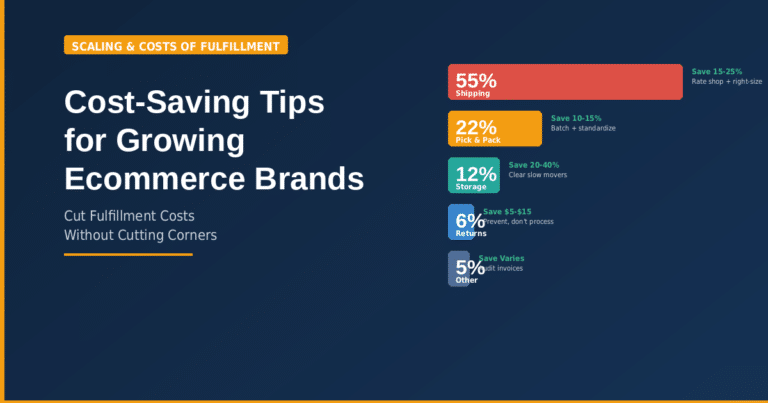
The most effective approach to cutting fulfillment costs is to start where the money is. Shipping accounts for 50-60% of total fulfillment expense. Packaging optimization, multi-carrier rate shopping, and carrier invoice auditing produce the largest dollar savings per hour of effort. Storage, pick and pack, and returns processing follow in order of impact.
Fulfillment costs consume up to 70% of average order value for many ecommerce sellers, and the average cost to fulfill a single order is approximately $8.50. A complete fulfillment cost breakdown shows exactly where that money goes. This article focuses on what to do about it: specific, prioritized tactics organized by cost category, starting with the changes that save the most money.
The tips below cover shipping cost optimization (packaging, rate shopping, invoice auditing, negotiation), storage fee reduction, pick and pack efficiency, return prevention, free shipping threshold strategy, and when outsourcing fulfillment to a 3PL produces better unit economics than doing it yourself.
Start Where the Money Is: Shipping Costs
Shipping is the single largest fulfillment expense, typically accounting for 50-60% of the total cost per order. Reducing shipping costs by even 10-15% produces a larger dollar impact than eliminating waste in any other category.
Right-Size Your Packaging
Oversized packaging is the most common source of unnecessary shipping expense. Carriers charge based on dimensional weight (DIM weight), which is calculated by multiplying length x width x height and dividing by 139 for domestic shipments.
You can use our free DIM weight calculator to check out your DIM weight pricing.
When the DIM weight exceeds the actual weight of the package, the carrier charges based on DIM weight. A lightweight product shipped in a 12x10x8 inch box gets charged for 7 pounds of dimensional weight. The same product in an 8x6x4 inch box drops to 1.4 pounds. That difference, repeated across thousands of shipments, adds up fast.
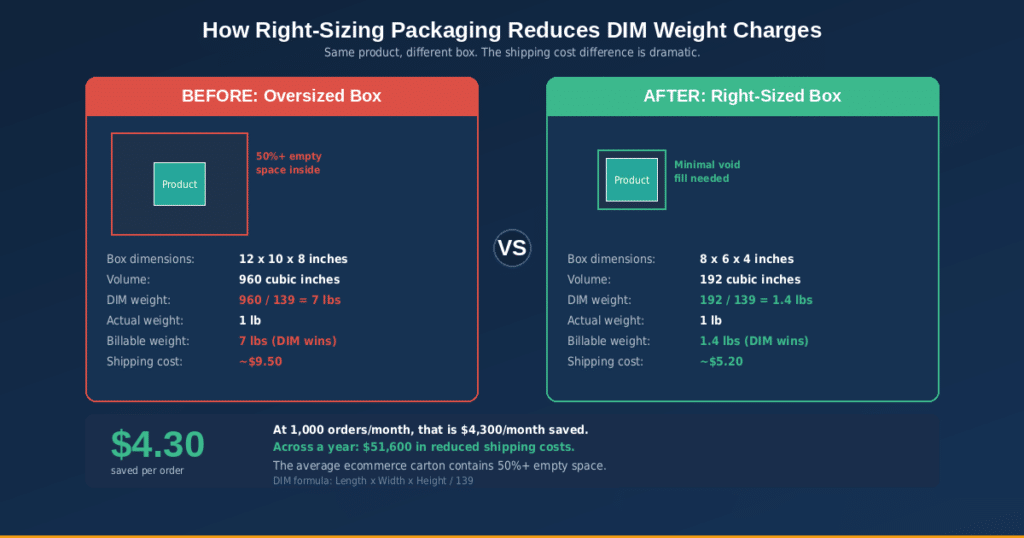
The fix is a packaging audit. Analyze your top 20 SKUs by shipping volume. Compare the actual product dimensions against the box sizes you use. Stock 4-6 box sizes that match your most common product configurations instead of defaulting to one or two oversized options. The average ecommerce shipping carton contains over 50% empty space. Eliminating that wasted space reduces shipping costs by 20-40% on affected orders while also cutting packaging material expense.
Rate Shop Every Shipment Across Carriers
No single carrier offers the best rate for every package, every destination, and every service level. A multi-carrier shipping strategy compares rates across UPS, FedEx, USPS, and regional carriers for each individual order and routes the package to the cheapest option that meets the delivery window. Rate shopping at the order level reduces per-shipment costs by 15-25% compared to shipping everything through a single carrier at default rates.
The savings compound at volume. A seller shipping 1,000 packages per month at an average shipping cost of $8.00 who reduces that cost by 20% through rate shopping saves $1,600 per month, or $19,200 per year, without changing anything about the product, the customer experience, or the delivery speed.
Audit Your Carrier Invoices
Carrier billing errors are more common than most sellers realize. The most frequent errors include incorrect DIM weight calculations (carrier-measured dimensions differ from actual), duplicate charges for the same shipment, surcharges applied incorrectly (residential delivery charged on a commercial address), and service level downgrades that were still billed at the original rate.
Review your carrier invoices monthly. Compare billed dimensions and weights against your actual package data. Flag shipments where the billed weight exceeds the actual weight by more than 10%. File claims for overcharges within the carrier’s dispute window (typically 15-60 days depending on carrier). Sellers who audit invoices regularly recover 2-5% of their total shipping spend in billing corrections.
Negotiate Carrier Rates as Volume Grows
Carrier rates are not fixed. As your shipping volume increases, your leverage improves. Contact your carrier account representative at each volume milestone (500, 1,000, 2,500, 5,000 shipments per month) and request rate reviews. Ask specifically about base rate reductions, DIM divisor adjustments (a higher divisor reduces DIM weight calculations), and reduced surcharges for residential delivery, fuel, and peak season.
Having an active multi-carrier strategy strengthens your negotiating position. When a carrier knows you can shift volume to a competitor, rate conversations become more productive. 3PL providers negotiate carrier rates across their entire client base, which gives them volume leverage that individual sellers cannot match. Those negotiated rates, typically 10-30% below published retail rates, are one reason outsourced fulfillment often costs less than in-house.
Reduce Storage Costs Without Cutting Inventory
Storage fees are a recurring monthly expense that compounds silently when inventory sits unsold. The goal is not to reduce inventory levels below what you need but to eliminate the storage costs that do not produce revenue.
Clear Slow-Moving SKUs Before Surcharges Hit
Most 3PLs and fulfillment centers charge long-term storage surcharges on inventory that remains unsold beyond 30, 60, or 90 days. These surcharges can double the monthly storage rate on affected items. Run a SKU velocity report monthly. Identify products with sell-through rates below your threshold. For slow movers, run clearance promotions, bundle them with popular items, or remove them from the fulfillment center before surcharges apply. Every month a dead SKU sits in storage, it erodes the margin earned by the products that do sell.
Match Storage Pricing to Your Inventory Profile
Storage pricing models vary: per pallet ($8-$40/month), per cubic foot ($0.45-$0.75/month), or per bin ($1-$2.50/month). The right model depends on your inventory. If you carry a small number of high-volume SKUs, pallet pricing is usually cheapest. If you carry many low-volume SKUs, bin-based pricing avoids paying for a full pallet when you only need a shelf. If your provider’s pricing model does not match your inventory profile, you are overpaying.
Time Inbound Shipments to Avoid Peak Surcharges
Many fulfillment centers increase storage rates during Q4 (October through January). If you are scaling fulfillment for peak seasons, receive inventory before the surcharge window opens. Getting your peak inventory into the warehouse in September costs less per pallet than receiving it in November, and it avoids the receiving bottlenecks that slow down inbound processing when everyone is trying to stock up at the same time.
Lower Pick, Pack, and Packaging Expense
Pick and pack costs are driven by labor time per order. Every operational change that reduces the time between receiving an order and handing a sealed package to the carrier reduces cost.
Standardize Box Sizes
Stocking fewer box sizes speeds up the packing process, reduces training time for warehouse staff, and cuts materials cost. Analyze your order data to identify the 4-6 box configurations that cover 80-90% of your orders. Eliminate specialty sizes that are used on fewer than 5% of shipments. Standardization also reduces DIM weight overcharges because packers are less likely to grab an oversized box when the correct size is the only option available. The order fulfillment workflow runs faster when packers do not have to choose between a dozen box options on every order.
Batch Similar Orders
Order batching groups similar orders (same SKU, same destination zone, same box size) and processes them together in a single pick run. This reduces the number of trips through the warehouse, cuts pick time per order, and allows packers to set up for a specific box configuration and process multiple orders without reconfiguring. Batching is most effective for sellers with a high volume of single-SKU orders or a small catalog with predictable order patterns.
Reduce Packaging Materials Without Increasing Damage
More packaging does not mean fewer damages. Packages are usually damaged by carrier handling (drops, crushes, misloads), not by insufficient padding inside the box. A smaller, well-fitted box with minimal void fill protects the product better than an oversized box stuffed with filler. Switch from bubble wrap to paper-based void fill where product fragility allows. Replace custom tissue paper and branded filler with a single branded insert card. These changes reduce materials cost per order by $0.25-$1.00 without increasing the damage rate.
Cut Return Costs by Preventing Returns
Every return costs $5 to $15 to process (receiving, inspection, restocking, refund) plus the lost margin on the refunded order. The cheapest return is the one that never happens.
The most common reasons customers return ecommerce products are: item does not match the description, wrong size or fit, product quality below expectations, and damaged during shipping. Each reason points to a specific fix.
Product page accuracy. If returns cite “not as described” or “different than expected,” the product page is the problem. Add more photos (including lifestyle images showing scale), accurate measurements, material descriptions, and weight. User-generated reviews with photos help customers self-select before buying.
Sizing and fit tools. Apparel and footwear sellers lose the most to size-related returns. A fit quiz, size comparison chart, or measurement guide reduces sizing returns. Track which sizes get returned most and update guides accordingly.
Exchanges over refunds. When a return is unavoidable, steering the customer toward an exchange instead of a refund retains the revenue. Make exchanges the most visible option in your return flow. Offer free shipping on exchanges even if you charge for refund returns. Brands that prioritize exchanges retain up to 50% of revenue that would otherwise be refunded. A clear returns management process reduces both the per-return cost and the overall return rate over time.
Use Free Shipping Thresholds to Offset Costs
A free shipping threshold is the minimum order value a customer must reach to qualify for free shipping. It is one of the most effective tools for offsetting fulfillment costs because it increases average order value while meeting customer expectations for free delivery.
63% of shoppers have abandoned a purchase because of high shipping costs. Offering free shipping above a threshold converts those abandoners while protecting margins on orders that can absorb the shipping expense.
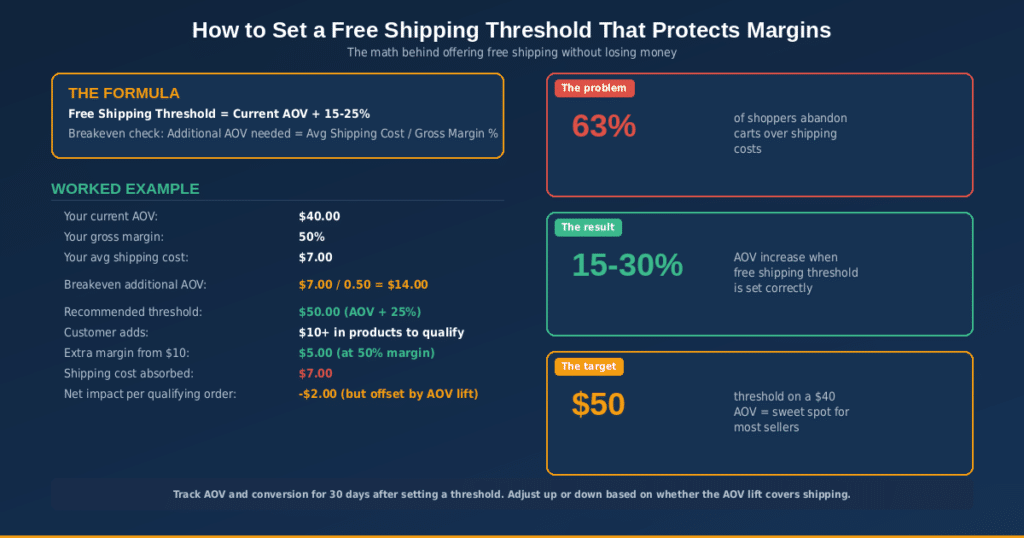
How to set the threshold. Start with your current average order value (AOV). Set the free shipping threshold 15-25% above your AOV. If your AOV is $40, set the threshold at $50. This encourages customers to add items to reach the threshold, increasing the order value enough to cover (or partially cover) the shipping cost. Track the impact on AOV and conversion rate for 30 days. Adjust the threshold up or down based on whether the increase in AOV offsets the shipping expense you absorb.
The math: if your average shipping cost is $7.00 and your gross margin is 50%, you need $14.00 in additional order value to break even on offering free shipping. A threshold set at AOV + $15-$20 gives you that buffer. Sellers who implement thresholds correctly see AOV increases of 15-30% with minimal impact on conversion rate.
When to Outsource Fulfillment to Reduce Costs
In-house fulfillment costs $7-$15 per order for small businesses. 3PL fulfillment costs $4-$10 per order. The gap comes from three structural advantages a 3PL provider has over a self-fulfilling seller: negotiated carrier rates, shared infrastructure costs, and operational specialization.
Carrier rates are the largest advantage. 3PLs ship across all of their clients’ volume, which gives them leverage to negotiate rates 10-30% below what individual sellers pay on their own accounts. For a seller spending $8,000 per month on shipping, a 20% carrier discount saves $1,600 per month, or $19,200 per year.
Shared infrastructure costs are the second advantage. A 3PL spreads warehouse lease, equipment, WMS licenses, and management overhead across many clients. You pay your share through per-order and per-pallet fees. In-house fulfillment forces you to carry 100% of those fixed costs regardless of your order volume.
The benefits of outsourcing to a 3PL become most visible when a growing brand crosses 200-500 orders per month. Below that range, the 3PL’s minimum spend requirements may exceed what a garage-based operation costs. Above that range, the carrier discounts, operational efficiency, and eliminated fixed costs almost always produce a lower cost per order than in-house fulfillment.
Frequently Asked Questions
What is a good fulfillment cost per order?
The industry average is approximately $8.50 per order. The most efficient operations achieve 8-10% of gross product sales. If your fulfillment cost per order exceeds 15% of your average order value, identify the highest-cost component (usually shipping) and target it for reduction first.
What is the fastest way to reduce fulfillment costs?
Audit your packaging and carrier invoices. These two actions require no new technology or process changes and produce immediate results. Right-sizing packaging reduces DIM weight charges by 20-40% on oversized shipments. Carrier invoice auditing recovers 2-5% of total shipping spend through billing corrections. Together, they are the fastest path to lower fulfillment costs.
How much can a 3PL save on shipping costs?
3PLs negotiate carrier rates 10-30% below published retail rates because they ship across all of their clients’ combined volume. For a seller spending $8,000 per month on shipping, a 20% discount saves $1,600 per month. Additional savings come from rate shopping across carriers, optimized packaging, and eliminated fixed overhead costs.
How do I reduce DIM weight charges?
Audit your top 20 SKUs by shipping volume. Compare actual product dimensions against the box sizes you use. Stock 4-6 box sizes matched to common product configurations. Eliminate oversized boxes that create empty space. A 1-2 inch reduction in each dimension can drop a package into a lower billable weight tier. The DIM weight formula is length x width x height divided by 139 for domestic shipments.
Should I offer free shipping to reduce cart abandonment?
Yes, but with a threshold. Set the free shipping minimum 15-25% above your current average order value. This increases order value enough to offset (or partially offset) the shipping cost you absorb. 63% of shoppers abandon purchases over shipping costs, so offering free shipping above a threshold converts those customers while protecting your margins on qualifying orders.
Protecting Margins as You Scale
Fulfillment cost reduction is not a one-time project. It is an ongoing discipline that becomes more important as order volume grows. A $1 savings per order is invisible at 100 orders a month but saves $12,000 a year at 1,000 orders a month. The compounding math rewards sellers who treat fulfillment cost management as a continuous process.
Start with shipping (the biggest bucket). Right-size packaging. Rate shop every shipment. Audit invoices. Negotiate rates. Then move to storage, pick and pack, and returns. Measure cost per order monthly. Compare it against your average order value. Target whichever component is disproportionately high.ShipBuddies helps growing ecommerce brands reduce fulfillment costs through multi-carrier rate shopping, right-sized packaging recommendations, transparent pricing with no hidden fees, and the carrier rate leverage that comes from aggregated shipping volume. Request a quote to see how your cost per order compares to what it could be with a 3PL partner.