
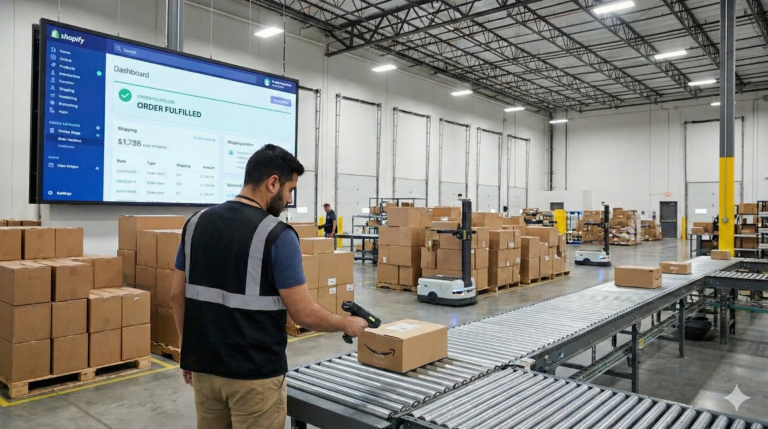
Shopify order fulfillment is the end-to-end process of receiving, storing, picking, packing, and shipping orders placed through a Shopify store, including inventory management, carrier selection, and returns processing. Effective fulfillment practices reduce errors, speed delivery, and increase customer satisfaction, all of which directly impacts reviews, repeat purchases, and revenue growth.
Research confirms the stakes: 48% of cart abandonments stem from shipping costs, 25% of customers cancel orders due to slow delivery, and stores offering free shipping see up to 30% higher conversion rates. These numbers reveal that fulfillment quality determines whether customers complete purchases and return for more.
This guide explains what Shopify order fulfillment involves, compares three fulfillment options (self-fulfillment, Shopify Fulfillment Network, and 3PL providers), details eight best practices that improve speed and accuracy, shows how to measure fulfillment performance, and identifies when partnering with a 3PL provider makes sense. The practices covered apply whether you pack orders yourself or outsource to professionals.
What Is Shopify Order Fulfillment?
Shopify order fulfillment covers every logistics step between a customer clicking “buy” and receiving their package. The process includes five core functions: receiving inventory into storage, processing incoming orders through the Shopify admin, picking products from shelves or bins, packing items securely for transit, and shipping packages via carriers to customers.
Each function connects to Shopify’s backend systems. Orders appear in your admin dashboard the moment they’re placed. Inventory counts update as products sell. Shipping labels generate through Shopify Shipping or integrated carrier accounts. Tracking information syncs automatically to customer order pages.
Returns handling extends the fulfillment cycle. When customers send products back, the fulfillment operation receives the return, inspects the item, and either restocks sellable inventory or processes damaged goods. Fast returns processing keeps inventory accurate and customers satisfied.
The complexity of Shopify order fulfillment scales with business size. A store shipping 30 orders weekly operates differently than one shipping 300 orders daily. Systems, staffing, and potentially external partners evolve as volume grows, but the core functions remain constant regardless of scale.
The Fulfillment method determines how these functions execute.
Three Shopify Fulfillment Options Compared
Three methods exist for handling Shopify order fulfillment: self-fulfillment, Shopify Fulfillment Network, and third-party logistics providers. Each method offers different levels of control, cost structures, and scalability.
| Method | Best For | Control | Cost Structure | Scalability |
| Self-Fulfillment | Small stores under 50 orders/month | Complete | Low startup, high labor | Limited |
| Shopify Fulfillment Network | Shopify-only sellers with steady volume | Low | Variable per order | Medium-High |
| 3PL Provider | Multi-channel brands scaling operations | Medium-High | Variable, often flexible | High |
Self-fulfillment places all logistics responsibilities on the store owner. You store inventory, pack every order, print shipping labels, and deliver packages to carriers. This method provides complete control over the customer experience. You choose packaging, inspect every item, and handle special requests directly. The limitation appears when order volume exceeds available time. Packing boxes until midnight signals that self-fulfillment has reached its ceiling.
Shopify Fulfillment Network (SFN) outsources logistics to Shopify’s warehouse partners. Inventory ships to their facilities, and their staff handles picking, packing, and shipping when orders arrive. SFN integrates natively with Shopify admin, eliminating third-party software connections. The trade-off is reduced control—SFN uses standardized packaging and processes that limit customization options.
3PL providers offer professional fulfillment services for ecommerce operations of all sizes. These companies store inventory, fulfill orders across multiple sales channels, and provide services like branded packaging and returns management. Unlike SFN, most 3PLs accommodate custom requirements and support selling on Shopify, Amazon, TikTok Shop, and wholesale simultaneously from unified inventory.
The right choice depends on order volume, sales channel diversity, and how much operational control you require.
8 Best Practices for Shopify Order Fulfillment
Eight practices consistently improve Shopify order fulfillment performance across all three methods. These practices reduce errors, accelerate shipping, lower costs, and increase customer satisfaction. Implementation varies by fulfillment method, but the principles apply universally.
1. Keep Inventory Synced in Real-Time
Real-time inventory synchronization prevents the two most damaging fulfillment failures: overselling and stockouts. When stock levels update instantly across all sales channels, you avoid selling products you don’t have and missing sales on products you do have.
Overselling creates immediate problems. A customer orders a product that already sold on another channel. You must cancel their order, refund payment, and send an apology email. The customer leaves disappointed, possibly leaving a negative review. On platforms like TikTok Shop, seller-fault cancellations accumulate violation points that threaten account standing.
Shopify’s native inventory tracking handles single-channel operations adequately. Multi-channel sellers need additional tools. Apps like Syncio, Trunk, and SKULabs synchronize inventory across Shopify, Amazon, Etsy, eBay, and other platforms. When a product sells anywhere, counts update everywhere within seconds.
The most effective approach uses pooled inventory, one stock count serving all channels rather than separate allocations per platform. Pooled inventory eliminates the scenario where Amazon shows “out of stock” while Shopify has 50 units sitting idle because they were allocated elsewhere.
Accurate inventory enables accurate promises to customers.
2. Optimize Product Picking Zones
Strategic product placement reduces picking time and minimizes errors during Shopify order fulfillment. Where products sit in storage directly affects how quickly and accurately orders ship.
The core principle positions high-velocity products closest to packing stations. If 20% of SKUs generate 80% of orders, those items should require minimal walking distance. A bestselling product stored in a back corner wastes time on every order containing it.
Zone organization extends beyond proximity. Group products by category so pickers can locate items intuitively. Store frequently co-purchased items near each other to reduce travel within single orders. Mark locations clearly with SKU numbers or product names visible from picking paths.
These optimizations matter more as volume increases. Reducing average pick time by 30 seconds seems minor until you multiply it across 200 daily orders. That’s nearly 17 hours of labor saved monthly. For self-fulfillment operations, the savings translate to personal time. For 3PLs, efficient picking means faster turnaround and lower per-order costs.
Picking efficiency enables batch processing.
3. Process Orders in Batches
Batch processing groups similar orders together for simultaneous handling, reducing errors and improving throughput during Shopify order fulfillment. Instead of processing orders individually as they arrive, batching creates efficiency through repetition.
Effective batching strategies include the following:
- By shipping speed: All express orders processed together, then standard orders in separate batch
- By product: All orders containing the same SKU picked in one warehouse pass
- By destination region: Geographic grouping for specific carrier pickups or zone-based routing
Each approach reduces context-switching and creates natural quality checkpoints.
Priority rules work within batch structures. Express shipments, VIP customers, and time-sensitive orders get flagged for immediate processing while standard orders accumulate for scheduled batch runs. This balance ensures urgent orders ship fast without sacrificing efficiency on routine fulfillment.
Shopify Flow enables automated batching for Shopify Plus merchants. The automation tags orders based on defined criteria, shipping method, product type, customer segment, organizing them into processing groups without manual sorting. Standard Shopify plans achieve similar results through apps like Mechanic or manual filtering in the orders dashboard.
Batched orders ship faster when customers know what to expect.
4. Set Transparent Processing Times at Checkout
Displaying clear processing and delivery timelines at checkout reduces cart abandonment and sets accurate expectations for Shopify order fulfillment. Customers abandon purchases when they cannot determine arrival dates.
Processing time is the window between order placement and carrier pickup. how long your operation takes to pick, pack, and hand off packages. This differs from shipping transit time, which carriers control. Customers need both numbers to calculate when orders arrive.
Shopify’s order processing settings allow configuring handling times that display during checkout. If standard processing takes 1-2 business days, state it explicitly. Products requiring customization or made-to-order manufacturing need longer estimates with clear explanations.
Transparency extends beyond checkout. Update customers proactively when timelines change. Holiday seasons, flash sales, and supply chain disruptions extend processing windows. Communicating delays before customers ask prevents support tickets and preserves trust.
Product pages benefit from processing time information too. Displaying “Usually ships within 24 hours” or “Ships in 3-5 business days” helps customers self-select based on their urgency before reaching checkout.
Automation reduces the processing time customers wait through.
5. Use Shopify Flow for Fulfillment Automation
Shopify Flow automates repetitive fulfillment tasks through trigger-based workflows, reducing manual effort and human error in Shopify order fulfillment. When specific events occur, Flow executes predefined actions instantly.
Practical fulfillment automations include the following:
- Tag orders containing fragile items for special handling instructions
- Route high-value orders through additional quality checks before shipping
- Generate alerts when inventory drops below reorder thresholds
- Flag express shipments for priority processing in the fulfillment queue
- Add internal notes to orders requiring custom packaging or inserts
- Notify team members via Slack or email when specific order conditions occur
A concrete example: create a workflow that triggers when an order contains fragile items. Flow automatically adds an internal note instructing packers to use extra padding, tags the order for quality inspection before shipping, and updates the packing slip with handling instructions. The entire sequence executes without human initiation.
Flow availability depends on what Shopify plan you are using. Shopify Plus includes Flow natively. Standard plans access similar functionality through third-party apps like Mechanic, Arigato, or MESA, though interfaces and capabilities vary.
Automation handles the routine; carrier options handle customer preferences.
6. Offer Multiple Shipping Options
Providing shipping choices reduces cart abandonment and improves satisfaction during Shopify order fulfillment. Different customers prioritize differently. Some want fastest delivery, others prefer the lowest cost shipping option they can get.
A functional shipping menu includes three tiers: economy (5-7 business days), standard (3-5 business days), and express (1-2 business days). Price each option based on actual carrier costs plus margin. Customers who see only expensive express shipping often abandon carts; adding an economy option keeps budget-conscious buyers in the purchase flow.
Free shipping thresholds drive larger orders. Setting a threshold slightly above average order value encourages customers to add items. “Free shipping over $75” on a store with $60 average orders incentivizes the incremental purchase. Stores using free shipping thresholds see up to 30% higher conversion rates than those without.
Carrier diversification supports shipping options. Using multiple carriers – USPS, UPS, FedEx, DHL, regional services – allows optimizing each shipment for cost and speed based on weight, dimensions, and destination. Rate shopping tools automatically select the best carrier for each package.
Shipping options address outbound logistics; returns handling addresses the reverse flow.
7. Streamline Returns Processing
Fast, simple returns processing improves customer loyalty and inventory accuracy during Shopify order fulfillment. Returns are inevitable in ecommerce, but how you handle them determines whether customers buy again.
Customer-facing simplicity starts with clear policies and easy execution. Include return instructions in every shipment. Offer prepaid return labels or simple label generation through your website. State policies clearly: timeframes, condition requirements, refund methods. Complicated return processes generate support tickets and frustrate customers.
Operations-side efficiency requires systematic receiving and inspection. Establish a dedicated returns station. Process returns daily rather than letting them accumulate. Inspect items immediately, categorizing as resellable, refurbishable, or unsellable. Restock sellable inventory the same day to return it to available stock.
3PL providers handle returns as integrated services, receiving packages, inspecting contents, updating inventory, and processing refunds according to your policies. This delegation frees internal resources while maintaining consistent customer experiences.
Returns get products back; packaging affects how products go out.
8. Use Branded Packaging for Better Unboxing
Custom packaging transforms delivery into a brand experience. The package is your last physical touchpoint before customers interact with products. It shapes first impressions.
Branded packaging elements include the following:
- Custom boxes or mailers featuring your logo and brand colors
- Tissue paper in brand colors for product wrapping
- Branded packing tape that reinforces identity on the outside
- Thank-you cards with personalized messages
- Promotional inserts for future purchases or referral programs
The investment level depends on margins and brand positioning. Luxury products justify elaborate unboxing; commodity items need functional protection more than presentation.
Social sharing amplifies packaging investments. Customers photograph and post memorable unboxing experiences, generating organic exposure. Products arriving in generic brown boxes rarely inspire sharing.
One important consideration: Shopify Fulfillment Network uses standardized packaging with limited customization. Brands prioritizing unboxing experience need 3PL partners who accommodate custom packaging requirements.
Packaging costs affect per-order economics. Oversized boxes waste money through dimensional weight charges and excess materials. Right-size packaging to protect products without unnecessary space that increases shipping costs.
Implementation of these practices requires measurement.
How Do You Know When Fulfillment Practices Are Working?
Fulfillment performance becomes visible through specific metrics that quantify speed, accuracy, and cost. Tracking these numbers reveals whether Shopify order fulfillment practices produce results. It will also quickly identify where problems emerge.
Four metrics matter most for fulfillment health:
- Order Fulfillment Cycle Time (OFCT) measures total elapsed time from order placement to customer delivery. The formula: OFCT = Sourcing Time + Processing Time + Delivery Time. Sourcing time applies only when products require procurement after ordering; stocked inventory has zero sourcing time. Lower OFCT means faster delivery. This should be tracked weekly, and you will want to investigate increases.
- Order Accuracy Rate reveals how often orders ship correctly, right products, right quantities, right addresses. Calculate as correct orders divided by total orders, expressed as percentage. Target 99% or higher. Every incorrect shipment requires costly correction and damages customer trust.
- On-Time Shipping Rate shows how consistently you meet stated processing windows. If you promise 1-2 day processing, this metric tracks what percentage actually ship within that timeframe. Consistently missing targets indicates capacity constraints or overpromising.
- Cost Per Order aggregates fulfillment expenses, including labor, packaging materials, shipping, and storage, divided by order volume. This number should decrease or stabilize as volume grows, reflecting efficiency gains from scale. Rising cost per order signals problems requiring investigation.
These metrics can help guide your decision about the fulfillment method you currently employ and if it is time for a change.
When to Switch from Self-Fulfillment to a 3PL
Self-fulfillment works until operational demands exceed available capacity. Recognizing the transition point prevents fulfillment from constraining growth during scaling.
Four signs indicate readiness for a 3PL partnership:
- Volume exceeds personal capacity. Working nights and weekends to ship orders means fulfillment consumes time better spent on product development, marketing, or strategy. Calculate your hourly value and compare it against 3PL per-order costs. The math often favors outsourcing earlier than expected.
- Error rates increase. Rushed packing causes mistakes. If order accuracy drops below 98% or customer complaints about wrong items increase, professional warehouse operations with quality control systems prevent further damage.
- Multi-channel expansion complicates operations. Adding Amazon, TikTok Shop, or wholesale to existing Shopify sales multiplies complexity. Managing inventory across platforms, meeting different requirements, and maintaining consistent shipping speeds becomes exponentially harder.
- Growth opportunities pass by. Turning down wholesale accounts, avoiding promotions, or delaying product launches because fulfillment cannot handle increased volume means logistics constrains business potential rather than supporting it.
The transition requires finding the right partner.
How ShipBuddies Optimizes Shopify Fulfillment
ShipBuddies provides Shopify order fulfillment services for ecommerce brands ready to scale beyond self-fulfillment limitations. The service addresses specific needs of growing Shopify stores through four core capabilities:
- Direct Shopify integration synchronizes orders automatically. The moment a customer completes checkout, the order appears in ShipBuddies’ warehouse system. No manual exports, no delays, no missed orders. Inventory counts update in your Shopify admin as products ship.
- Multi-channel inventory management serves Shopify, Amazon, TikTok Shop, and other platforms from a single stock pool. When products sell on any channel, inventory updates everywhere in real-time, preventing overselling and eliminating channel-specific inventory allocations.
- Strategic fulfillment location enables 2-3 day delivery to most US customers. Fast shipping improves conversion rates and customer satisfaction without requiring you to manage warehouse operations, hire staff, or negotiate carrier contracts.
- Branded packaging options preserve your unboxing experience. Custom boxes, inserts, and branded materials ship with every order. Capabilities that standardized fulfillment networks cannot match.
Ready to implement Shopify order fulfillment best practices with professional support? Request a quote from ShipBuddies to explore how outsourced fulfillment accelerates your growth.
Frequently Asked Questions
What is Shopify order fulfillment?
Shopify order fulfillment is the complete process of storing inventory, processing orders, picking products, packing shipments, and delivering packages to customers who purchase through a Shopify store. The process also includes returns handling. Sellers can manage fulfillment themselves, use Shopify Fulfillment Network, or partner with third-party logistics providers.
What are the best fulfillment practices for Shopify stores?
Eight practices improve Shopify fulfillment: keeping inventory synced in real-time, optimizing product picking zones, processing orders in batches, displaying transparent processing times at checkout, automating workflows with Shopify Flow, offering multiple shipping options, streamlining returns processing, and using branded packaging. These practices reduce errors, speed delivery, and increase customer satisfaction.
Should I use Shopify Fulfillment Network or a 3PL?
Choose Shopify Fulfillment Network for Shopify-only selling with standardized fulfillment needs and native platform integration. Choose a 3PL for multi-channel selling across Shopify, Amazon, and other platforms, custom packaging requirements, specialized services like kitting, or greater operational flexibility. Evaluate based on your sales channels, customization needs, and growth trajectory.
How do I calculate order fulfillment cycle time?
Order Fulfillment Cycle Time equals Sourcing Time plus Processing Time plus Delivery Time. Sourcing time is duration to obtain products (zero for stocked inventory). Processing time covers picking, packing, and carrier handoff. Delivery time is carrier transit to customer. Lower OFCT indicates faster fulfillment performance.
What is real-time inventory sync?
Real-time inventory sync automatically updates stock counts across all connected sales channels the instant a sale, return, or adjustment occurs. When a product sells on Shopify, inventory immediately updates on Amazon, TikTok Shop, and other platforms. This prevents overselling unavailable products and ensures accurate availability display everywhere.
When should I switch from self-fulfillment to outsourcing?
Switch when order volume exceeds your capacity, error rates increase from rushed packing, multi-channel expansion complicates operations, or fulfillment prevents pursuing growth opportunities. Calculate your time’s value against 3PL per-order costs. The financial case for outsourcing often materializes earlier than expected.
How does Shopify Flow help with fulfillment?
Shopify Flow automates fulfillment tasks through trigger-based workflows. Examples include automatically tagging rush orders for priority handling, generating inventory alerts at reorder points, routing orders by product type or destination, and flagging high-value shipments for quality checks. Flow is native to Shopify Plus; standard plans use third-party automation apps.
What fulfillment KPIs should I track?
Track Order Fulfillment Cycle Time (order to delivery duration), Order Accuracy Rate (percentage shipped correctly), On-Time Shipping Rate (orders meeting processing promises), and Cost Per Order (total fulfillment cost divided by volume). These metrics reveal fulfillment health and highlight improvement areas.
Putting Best Practices Into Action
Shopify order fulfillment best practices work together as a system. Real-time inventory sync enables accurate promises. Optimized picking zones accelerate batch processing. Transparent timelines reduce abandonment while automation handles routine tasks. Multiple shipping options satisfy different customer priorities. Streamlined returns maintain inventory accuracy. Branded packaging creates memorable experiences.
Measurement confirms what works. Tracking cycle time, accuracy, on-time rates, and costs reveals performance trends and identifies problems early. These metrics also signal when self-fulfillment reaches its limits and professional support makes sense.
ShipBuddies helps Shopify sellers implement these practices without building warehouse operations from scratch. Get a quote and discover how professional fulfillment supports your store’s growth.