
Kava is a category that runs on subscription, freshness, and traceability. Buyers care which strain they are getting, when the lot was processed, and whether their monthly box ships on time.
ShipBuddies provides specialized kava order fulfillment for ecommerce brands, including lot-level tracking on every bag, FEFO rotation that ships freshest stock first, subscription-app integration with Recharge and Bold, and B2B wholesale fulfillment for the kava bar and lounge accounts that anchor a meaningful portion of category revenue. Learn how our 3PL services apply to your product line.
Kava order fulfillment is a specialized third-party logistics service that handles storage, picking, packing, and shipping of dry kava products (powder, instant, micronized, root chips, tea bags) for ecommerce sellers. It accounts for the realities of the category, including the lot-level traceability that kava inventory requires, the FEFO rotation that protects freshness, the SKU complexity of strain and origin variants (Fiji, Vanuatu, Hawaiian, Tongan), the subscription cadence that drives most kava DTC, and the kava bar wholesale accounts that anchor a meaningful portion of category revenue.
Generic fulfillment workflows that work for low-variant dry goods do not handle kava correctly.

The wrong fulfillment partner shows up as missed subscription cadences, stale lots shipped first, and inventory drift between strain variants. The right partner shows up as on-cadence subscription deliveries, freshness-first rotation, and lot-level traceability that protects your brand and your subscribers. Here is how the process works at ShipBuddies.
This process is built specifically for kava. To see the broader version, read our fulfillment workflow walkthrough.
Kava ecommerce is harder to fulfill than most dry consumable categories. Six specific challenges affect almost every kava brand.
A kava brand typically offers multiple strain and origin variants (Fiji Waka, Borogu, Vanuatu, Hawaiian, Tongan) across multiple grinds (powder, instant, micronized, root chips) and multiple bag formats (1oz, 4oz, 8oz, 1lb, bulk). That compounds quickly into dozens of SKUs that need distinct picking rules. Without strain-level discipline at picking, a customer who ordered Fiji Waka receives Vanuatu, and the brand absorbs a refund and a churned subscriber.
Kava buyers care about which lot their product comes from, and brands need to know which lots shipped to which customers. A 3PL that cannot capture lot numbers at intake, tie them to each SKU, and report lot disposition on outbound shipments leaves the brand exposed when batch quality questions arise. Lot tracking is not optional for kava inventory.
Kava brands lean heavily on subscriptions. A typical kava brand might run 50 to 70 percent of its volume through monthly or bi-weekly recurring orders, with thousands of orders all batching on the same cadence dates. A 3PL without subscription tooling, integration with apps like Recharge or Bold, and the ability to batch by cadence creates missed deliveries on the dates that matter most to retention.
Dry kava has a best-by date, typically 12 to 18 months depending on form and storage. FIFO (first-in-first-out) ships whatever arrived first. FEFO (first-expired-first-out) ships whatever expires first. The two are not the same, and FEFO is what protects you from shipping near-expiry product. A 3PL that cannot enforce FEFO at the system level creates returns and reputation risk.
Most kava brands run a Shopify or WooCommerce DTC store with subscriptions, serve wholesale accounts (kava bars, kava lounges) through direct relationships or Faire, and sometimes list on TikTok Shop for trending products. Each channel has different packaging, picking, and shipping requirements.
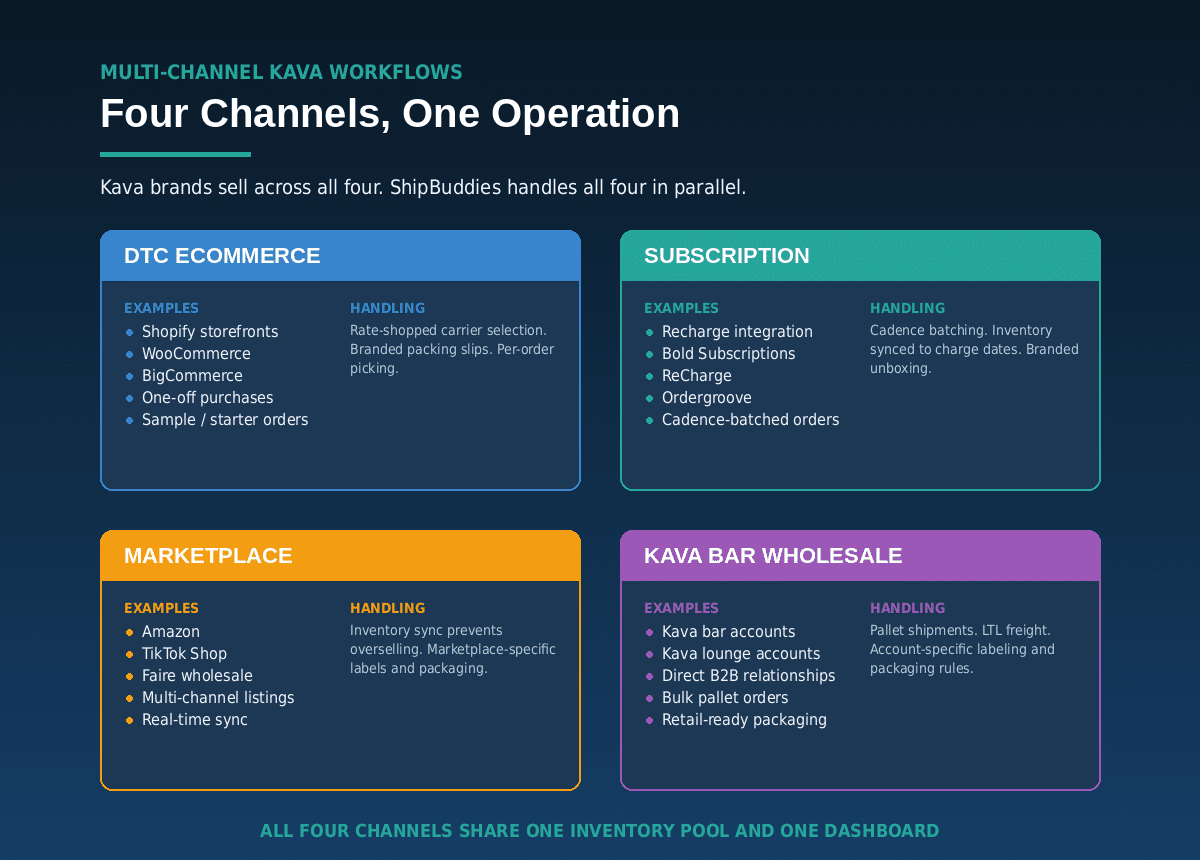
A 3PL that handles only DTC misses the wholesale operation that often represents a meaningful share of revenue. Verify any prospective partner offers full ecommerce integrations across every channel you sell on.
Kava brands commonly sell sampler packs (one bag of each strain, three or four strains per pack) and curated subscription boxes that rotate strain selection each month. Sampler and subscription assembly requires bill-of-materials discipline so every pack ships with the correct strains in the correct configuration. Without it, the variety pack that should have included Fiji Waka ships with two bags of Vanuatu and a refund follows.
Each challenge above maps to a specific reason to outsource. A specialized 3PL solves the problems an in-house operation or generalist fulfillment service cannot.
A specialized 3PL captures lot numbers at intake and ties them to each SKU through dispatch. Lot disposition reports show which lots shipped to which orders. The result is the traceability that batch quality questions, customer complaints, and any post-sale follow-up require, without the brand having to maintain a parallel tracking system. Read more about how we handle returns and reverse logistics tied to lot-level visibility.
A 3PL with system-enforced FEFO ships oldest-dated stock first regardless of arrival order. Best-by dates get captured at intake and drive picking decisions, so subscribers receive the freshest stock the brand has on hand. Generic fulfillment that defaults to FIFO ships older lots when newer ones are available, which hurts the brand on a category where freshness is a core buyer concern.
Subscription orders run on a different cadence than one-off DTC. The right 3PL integrates directly with Shopify subscription apps including Recharge, Bold Subscriptions, ReCharge, and Ordergroove. Subscription orders batch on cadence, inventory syncs against upcoming charge dates, and your subscribers receive their kava on the schedule they signed up for.
Kava brands that serve kava bars and lounges need a partner who handles wholesale accounts alongside DTC. The right 3PL processes pallet shipments, LTL freight, and retail-ready packaging without slowing down the DTC and subscription workflow that runs in parallel. Read more about shipping optimization for wholesale operations.
A 3PL that integrates only with Shopify misses Faire, TikTok Shop, and the direct B2B channels that kava brands actually use. Look for a partner that connects to all of them with real-time inventory sync that prevents overselling when a wholesale order draws from the same SKU pool as DTC.
Here is what kava fulfillment looks like at ShipBuddies, broken down by capability.
ShipBuddies connects directly to Shopify, WooCommerce, BigCommerce, Amazon, TikTok Shop, and Faire, alongside Shopify subscription apps including Recharge, Bold Subscriptions, and ReCharge. Orders sync in real time with SKU-level inventory updates that account for strain, grind, and bag-format variants. Wholesale and B2B orders flow through the same dashboard as DTC and subscription orders.
Every kava SKU is logged at intake with lot number, best-by date, strain or origin variant, and bag format. FEFO rules ship the oldest-dated stock first, system-enforced. Strain variants get bin-level discipline so a Fiji Waka order never picks from the Vanuatu shelf. Lot disposition reports tie each outbound order to the lot it shipped from.
Orders go through barcode-verified picking with strain and grind variant awareness, which prevents the most common kava fulfillment errors (wrong strain, wrong grind, wrong bag size). Multi-bag samplers, subscription kits, and variety boxes get assembled per your specifications. Branded inserts, brewing instructions, and custom packing slips get applied as part of the picking flow.
Wholesale accounts run alongside DTC in the same operation. Pallet shipments, LTL freight, and retail-ready packaging get processed for the kava bar, lounge, and direct wholesale accounts that anchor much of the category. Account-specific packaging and labeling rules stay tied to each wholesale customer so retail-ready orders ship correctly every time.
Yes. Every shipment logs lot number and best-by date at intake, with lot numbers tied to each SKU through dispatch. Lot disposition reports show which lots shipped to which orders, so the traceability that batch quality questions and post-sale follow-up require is built into the operation.
Yes. ShipBuddies integrates with Recharge, Bold Subscriptions, ReCharge, and Ordergroove. Subscription orders batch on cadence, inventory syncs against upcoming charge dates, and your subscribers receive their kava on the schedule they signed up for.
Yes. Wholesale orders for kava bar, lounge, and direct accounts run alongside DTC and subscription orders in the same operation. Pallet shipments, LTL freight, and retail-ready packaging are processed without disrupting the DTC workflow. If something does come back from a wholesale account, our returns and reverse logistics workflow handles it on the same cadence as your outbound orders.
Each strain and origin variant logs as a distinct SKU with bin-level discipline. Barcode-verified picking at the strain level prevents the mis-picks (Fiji shipped instead of Vanuatu, powder shipped instead of micronized) that compound across thousands of orders.
Yes. Multi-bag samplers, variety packs, and curated subscription boxes get assembled per bill-of-materials so every pack ships with the correct strains in the correct configuration. Read more about shipping optimization for sampler and variety operations.
Kava brands need a fulfillment partner who treats lot tracking as the foundation of the operation, enforces FEFO so freshness stays first, handles wholesale accounts alongside DTC, and integrates with the platforms kava brands actually use. ShipBuddies builds operations around the way kava brands actually sell, with the lot-level traceability, strain discipline, and B2B wholesale capability that the category requires. Request a quote today and find out what specialized kava fulfillment looks like.