
Coffee is a subscription business. Roughly 70 percent of premium coffee revenue runs through monthly recurring orders, and the brands that win are the ones that ship fresh, well-packaged, on cadence, every time. ShipBuddies provides specialized coffee order fulfillment for ecommerce roasters and coffee brands, including roast-date capture at intake, FEFO rotation that protects freshness, subscription-app integration with Recharge and Bold, and B2B wholesale fulfillment for the cafe and office accounts that round out most coffee revenue. Learn how our 3PL services apply to your product line.
Coffee order fulfillment is a specialized third-party logistics service that handles storage, picking, packing, and shipping of dry coffee products (whole bean, ground, pods, instant, and cold brew concentrate) for ecommerce sellers. It accounts for the realities of the category, including roast-date sensitivity, FEFO rotation that protects freshness, the high subscription cadence that drives most coffee DTC, the high SKU complexity from roast and grind variants, and the multi-channel mix of DTC, marketplace, and wholesale that most coffee brands run simultaneously. Generic fulfillment workflows that work for shelf-stable dry goods do not handle coffee correctly.
The wrong fulfillment partner shows up as missed subscription cadences, stale inventory shipped first, and overselling across channels. The right partner shows up as on-cadence subscription deliveries, freshness-first rotation, and inventory that stays accurate whether the order came from Shopify, Amazon, or a cafe wholesale account. Here is how the process works at ShipBuddies.
This process is built specifically for coffee. To see the broader version, read our fulfillment workflow walkthrough.
Coffee ecommerce is harder to fulfill than most categories. Six specific challenges affect almost every coffee brand.
Coffee is the most subscription-dominated DTC category. A premium coffee brand might run 60 to 80 percent of its volume through monthly or bi-weekly subscriptions, with thousands of orders all batching on the same cadence dates. A 3PL without subscription tooling, integration with apps like Recharge or Bold, and the ability to batch by cadence creates missed deliveries on the dates that matter most.
Coffee buyers care about freshness more than buyers in almost any other category. Specialty buyers check roast dates on arrival. A 3PL that cannot capture roast-date at intake, enforce FEFO rotation, and tie lot numbers to each SKU ships stale inventory first and creates returns plus reviews that hurt the brand for years.
Whole bean coffee preserves freshness for weeks longer than ground coffee. Ground coffee oxidizes within days of grinding, which makes it more time-sensitive in storage. A fulfillment workflow that treats them the same misses the operational reality, and brands that sell both formats need a partner who handles each correctly.
A typical coffee brand might offer 8 roasts in 3 grinds in 4 sizes, plus single-origin variants and seasonal blends, plus multi-bag samplers and gift sets. That compounds quickly into hundreds of SKUs that need distinct picking rules. Without SKU-level discipline, mis-picks (wrong roast, wrong grind) become routine.
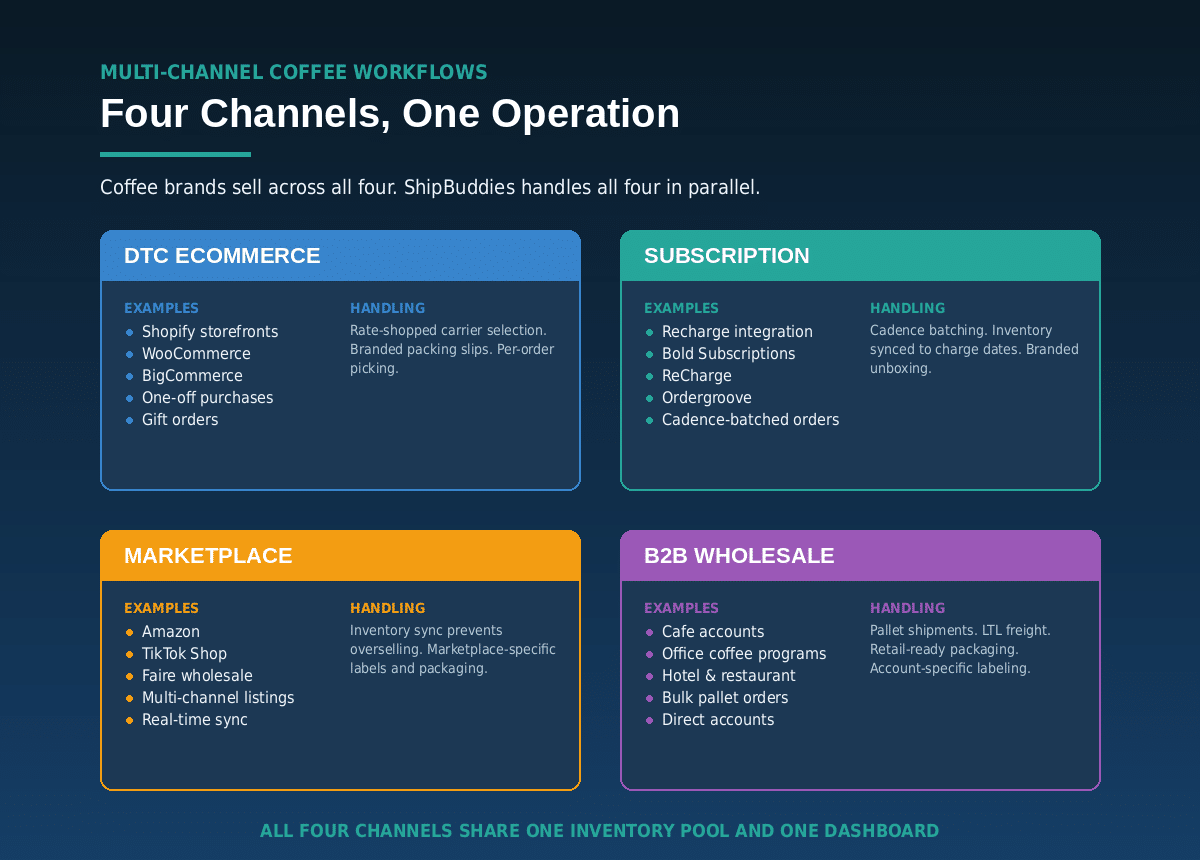
Most coffee brands run a Shopify or WooCommerce DTC store with subscriptions, list on Amazon for marketplace volume, and serve wholesale accounts (cafes, offices, hotels, restaurants) through Faire or direct relationships. Each channel has different packaging, picking, and shipping requirements. A 3PL that handles only DTC misses half the operation. Verify any prospective partner offers full ecommerce integrations across every channel you sell on.
Coffee subscriptions live and die on retention. The unboxing experience (custom inserts, branded packing slips, tasting notes, brand-specific outer mailers) is part of what subscribers are paying for. A 3PL that strips presentation down to a generic shipping box hurts retention even when the coffee inside is excellent.
Each challenge above maps to a specific reason to outsource. A specialized 3PL solves the problems an in-house operation or generalist fulfillment service cannot.
A specialized 3PL integrates directly with Shopify subscription apps including Recharge, Bold Subscriptions, ReCharge, and Ordergroove. Subscription orders batch on cadence, inventory syncs against upcoming charge dates, and your customers receive their coffee on the schedule they signed up for. Read more about shipping optimization for subscription cadences.
A 3PL with system-enforced FEFO captures roast-date at intake and ships oldest-dated stock first regardless of arrival order. Lot numbers stay tied to each SKU for recall traceability. The result is freshness rotation that protects your reviews, retention, and reputation in a category where stale shipments are unforgivable.
Coffee brands that serve wholesale accounts need a partner who handles cafe, office, and hotel orders alongside DTC. The right 3PL processes pallet shipments, LTL freight, and retail-ready packaging without slowing down the high-volume DTC and subscription workflow that runs in parallel.
A 3PL that integrates only with Shopify and Amazon misses Faire, TikTok Shop, and direct B2B channels. Look for a partner that connects to all of them with real-time inventory sync that prevents overselling when a wholesale order draws from the same SKU pool as DTC. Returns also matter: see how we handle returns and reverse logistics for coffee brands.
The right 3PL handles custom inserts, branded packing slips, tasting notes, and SKU-specific presentation rules without slowing down picking. Subscription boxes get curated assembly. Even one-off DTC orders get the same care as a hand-roasted operation in the back of a cafe.
Here is what coffee fulfillment looks like at ShipBuddies, broken down by capability.
ShipBuddies connects directly to Shopify, Amazon, WooCommerce, BigCommerce, TikTok Shop, and Faire, alongside Shopify subscription apps including Recharge, Bold Subscriptions, and ReCharge. Orders sync in real time with SKU-level inventory updates that account for roast, grind, size, and bag-format variants. Wholesale and B2B orders flow through the same dashboard as DTC and subscription orders.
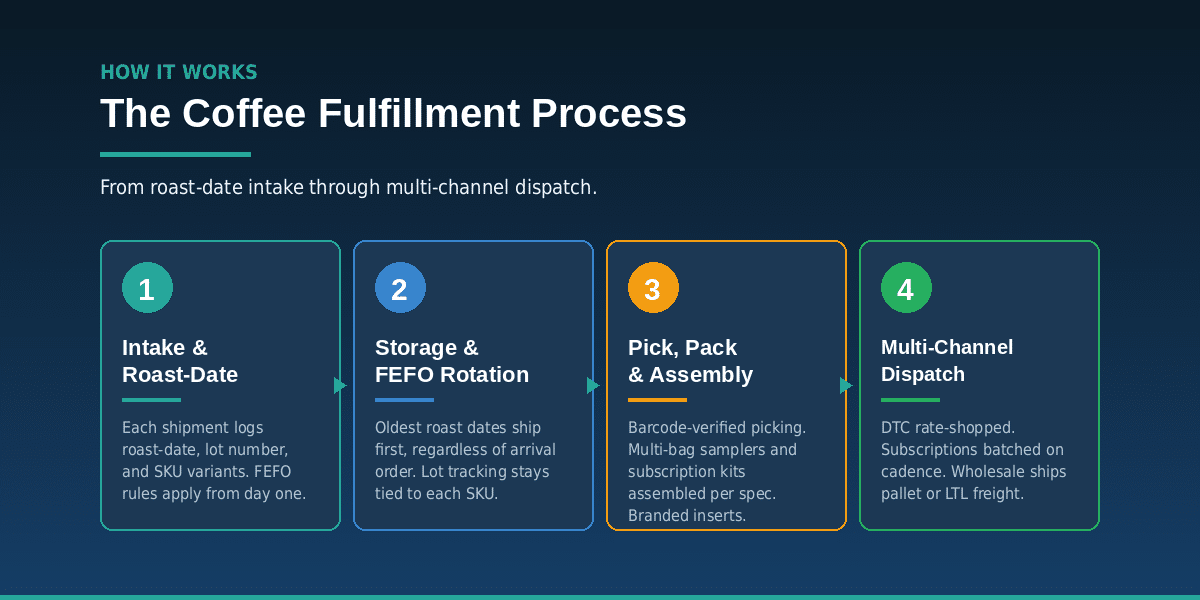
Every coffee SKU is logged at intake with roast date, lot number, bag format, and variant data (whole bean vs ground, size, origin, roast level). FEFO rules ship the oldest-dated stock first, system-enforced. Lot numbers stay tied to each SKU for recall scenarios, and freshness rotation protects your reviews and subscription retention.
Orders go through barcode-verified picking with roast and grind variant awareness, which prevents the most common coffee fulfillment errors. Multi-bag samplers, subscription kits, and gift sets get assembled per your specifications. Branded inserts, tasting notes, and custom packing slips get applied as part of the picking flow rather than as a separate step.
Wholesale accounts run alongside DTC in the same operation. Pallet shipments, LTL freight, and retail-ready packaging get processed for the cafe, office, and hotel accounts that anchor most coffee brand revenue. Account-specific packaging and labeling rules stay tied to each wholesale customer so retail-ready orders ship correctly every time.
Yes. ShipBuddies integrates with Recharge, Bold Subscriptions, ReCharge, and Ordergroove. Subscription orders batch on cadence, inventory syncs against upcoming charge dates, and your customers receive their coffee on the schedule they signed up for.
Every coffee shipment logs roast date and lot number at intake. FEFO rules ship oldest-dated stock first, system-enforced, so older roasts move before newer ones regardless of arrival order. Lot tracking stays tied to each SKU so a recall can isolate affected orders within hours.
Yes. Wholesale orders for cafe, office, hotel, and restaurant accounts run alongside DTC and subscription orders in the same operation. Pallet shipments, LTL freight, and retail-ready packaging are processed without disrupting the DTC and subscription workflow. If something does come back from a wholesale account, our returns and reverse logistics workflow handles it on the same cadence as your outbound orders.
Yes. Multi-bag samplers, subscription kits, and gift sets get assembled per your specifications. Branded inserts, tasting notes, and custom packing slips are applied as part of the picking flow.
Yes. Each combination of roast, grind, size, and origin logs as a distinct SKU with barcode-verified picking rules. This prevents the mis-picks (wrong roast, wrong grind) that are the most common errors in coffee fulfillment. Read more about shipping optimization for coffee SKUs.
Coffee brands need a fulfillment partner who treats subscription cadence as the core workflow, captures roast-date at intake, enforces FEFO so freshness stays first, and handles wholesale accounts alongside DTC in the same operation. ShipBuddies builds operations around the way coffee brands actually sell, including the cafe and office accounts that anchor revenue alongside the subscription business that drives growth. Request a quote today and find out what specialized coffee fulfillment looks like.